
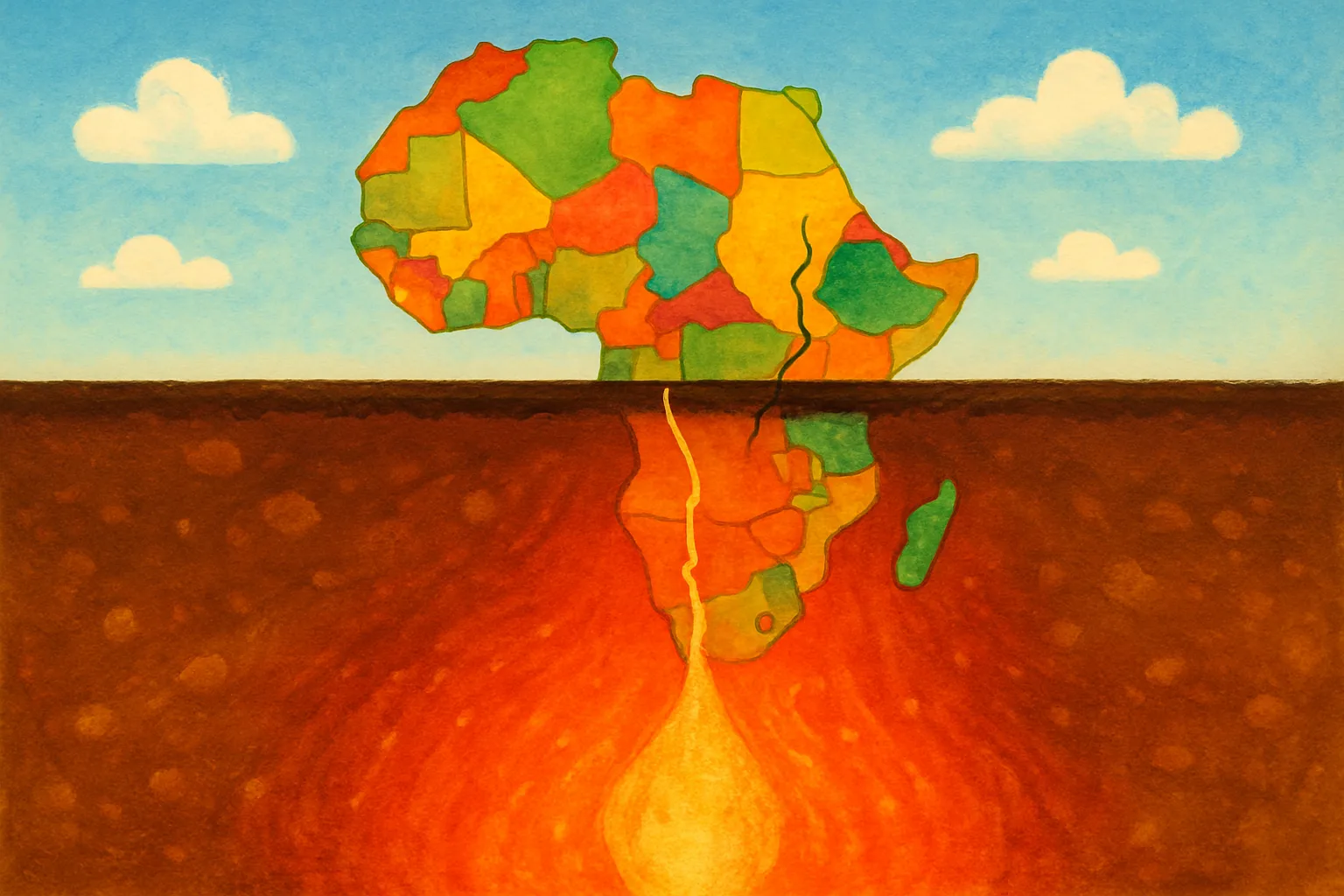
Earth Is Cracking Up! Scientists Find the Giant Engine Slowly Splitting Africa in Two
Quick Summary
Deep underground, a gigantic blob of scorching-hot rock is slowly pushing up against Africa from below. Scientists have been gathering new evidence that this underground force — called the African Superplume — is the main reason the continent is gradually being torn in two. It will take millions of years, but the process is happening right now!
What Happened?
Scientists have known for years that the eastern side of Africa is very slowly pulling away from the rest of the continent. There is a giant crack in the ground called the East African Rift System. It stretches for about 3,000 miles from the Red Sea in the north all the way down to Mozambique in the south — imagine drawing a line from the top of the United States all the way to the bottom of South America. That is how long this crack is.
But what is causing this gigantic tear? A new study looked at this question using computer models that simulate how rock moves deep inside Earth. The results point to what scientists call the African Superplume.
A superplume is an enormous blob of super-hot rock rising up from deep inside Earth — about 1,800 miles underground, near where Earth’s rocky outer layer meets the hot liquid iron core. It is not liquid like water. Instead, it is solid rock so incredibly hot that it very, very slowly flows upward, like honey creeping across a table. It just moves over millions of years instead of seconds.
As this giant hot blob pushes upward, it presses against the underside of the African continent like a thumb pressing up on a piece of cardboard. The pressure stretches and thins the crust above it. In some places, the crust is already only about 8 miles thick — less than the depth of some oceans! That is thin enough that scientists say a breakup is now very likely, though it will still take millions of years.
The new models also helped explain a mystery: scientists had noticed that parts of Africa were moving in unusual sideways directions that older models could not explain. The superplume’s northward push turned out to be the answer.
Why Does It Matter?
This is planet-building happening in slow motion, right before our eyes — or at least right under our feet! The same kind of process split the dinosaurs’ supercontinent apart long ago. It separated South America from Africa to create the Atlantic Ocean. Now something similar is happening again in East Africa.
In millions of years, water from the Indian Ocean will eventually flood the widening crack. A brand-new ocean will form. Parts of Kenya, Ethiopia, Somalia, and Tanzania will become a separate continent, a bit like a giant Madagascar.
For now, though, the crack creates volcanoes, hot springs, and some of the world’s most dramatic landscapes. It also preserved fossils of our ancient human relatives, because the shifting ground helped bury and protect bones for millions of years.
Big Words
- Tectonic plates — enormous slabs of rock that make up Earth’s outer shell; they slowly move around, carrying continents and ocean floors with them
- Rift — a long crack or gap in Earth’s crust where two tectonic plates are being pulled apart
- Superplume — a gigantic mass of very hot rock rising slowly from deep inside Earth, much bigger and more powerful than a regular mantle plume
- Mantle — the thick layer of hot rock that sits between Earth’s thin outer crust and its iron core; it makes up most of Earth’s volume
- Continental rifting — the process by which a continent is slowly stretched and torn apart by forces from below
Fun Fact
The Afar region of Ethiopia, which sits right at the center of the rift, is one of the lowest and hottest places on Earth. Temperatures can reach 122°F (50°C). Yet some communities have called it home for thousands of years!
Think About It
The African continent is moving apart about as fast as your fingernails grow each year. Scientists can measure this tiny movement using GPS satellites. How do you think it feels to be a scientist watching a continent move — knowing you’ll never live long enough to see the finished ocean?
Sources
- ScienceDaily — A massive plume deep beneath Africa is pulling the continent apart (September 1, 2026)
- Live Science — ‘Primordial’ superplume of deep mantle splitting Africa in two, study suggests
- News Directory 3 — Massive Underground Plume Pulling Africa Apart (highlights September 1, 2026 ScienceDaily report)
- Geophysical Research Letters — Constraining the Kinematics of the Victoria Microplate and the Northern Western Branch of the East African Rift System