
Brain Blueprint! Scientists Find a Hidden Clue Inside Alzheimer’s Disease
Quick Summary
Scientists have found a new clue about Alzheimer’s disease — a condition that slowly affects memory and thinking in millions of people. Using artificial intelligence, they discovered that the 3D shape of DNA inside brain cells is different in people who have the disease. The finding was published in one of the world’s top science journals.
What Happened?
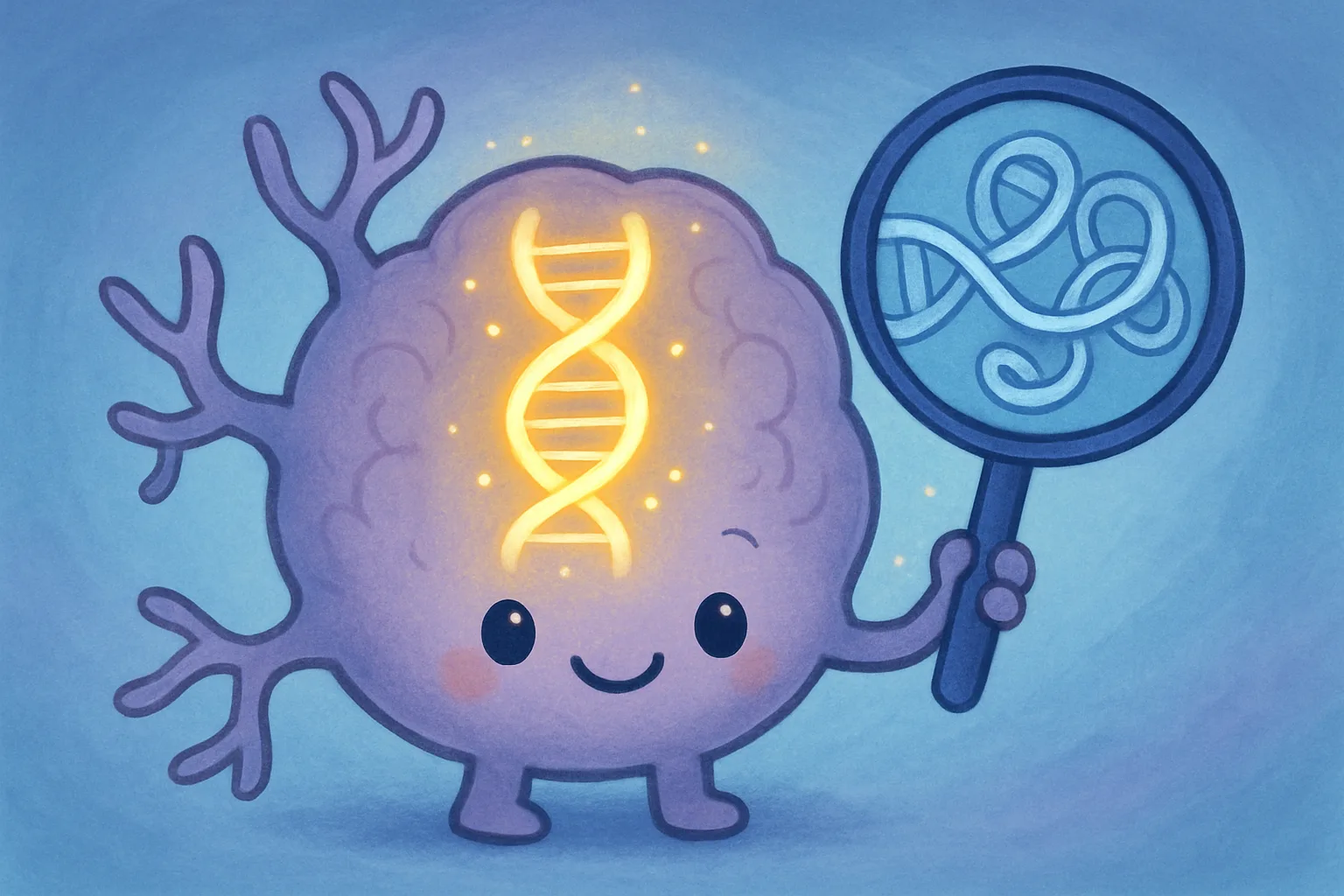
You probably know that DNA is the instruction manual inside every cell in your body. It tells your cells how to grow, what job to do, and how to fix themselves. But DNA does not just float around freely inside a cell. It is folded, bent, and looped into a specific three-dimensional shape — a bit like a piece of string that is coiled up in a very precise way inside a tiny box.
Scientists at Carnegie Mellon University and the University of Pittsburgh wanted to know if that shape changes in Alzheimer’s disease. They used a special technique to map the 3D folding of DNA inside individual brain cells from people who had the condition. Then they used an AI model called Hicformer to analyze the results.
What they found was surprising. In the brain cells of people with Alzheimer’s, the DNA was organized differently. Parts that are normally kept far apart were mixing together. Parts that should be active were quieter than they should be. These changes in DNA shape were linked to changes in how genes were turned on and off — and how brain cells were behaving.
Think of it like a very important book where someone shuffled the chapters into the wrong order. The words are all still there, but the story comes out scrambled. The cells do not get the instructions they need.
The team used donated brain tissue from people who chose to give their brains to science after they passed away, so their experiences could help find a cure.
Why Does It Matter?
Alzheimer’s disease affects more than 55 million people worldwide. It is the most common cause of memory loss and confusion in older adults. Scientists have known for a while that sticky clumps of protein called amyloid plaques and tangled protein fibers called tau tangles build up in Alzheimer’s brains. But those clues alone have not been enough to find a cure.
This new discovery reveals an entirely different layer of the disease — one that was hiding inside the shape of DNA itself. By understanding it, scientists may be able to find brand-new targets for future medicines. It does not mean a cure is here yet, but it is a meaningful step in the right direction.
The research was published in the journal Science, one of the most respected science publications in the world.
Big Words
- DNA — the molecule inside cells that carries the instructions for how living things grow and work, shaped like a twisted ladder
- genome — the complete set of all DNA instructions in a living thing
- 3D genome organization — the way DNA is folded and arranged in three-dimensional space inside a cell’s nucleus
- Alzheimer’s disease — a brain condition that slowly affects memory, thinking, and behavior, mostly in older adults
- AI (artificial intelligence) — computer systems that can learn from data and help scientists spot patterns too complex for humans alone
Fun Fact
If you stretched out all the DNA from just one single human cell, it would be about 6 feet (2 meters) long! The cell squeezes all of that into a nucleus about 10 times smaller than the width of a human hair.
Think About It
Many people who donate their brains to science help researchers find clues about diseases like Alzheimer’s. Why do you think it is important for scientists and regular people to work together to fight diseases?
Sources
- ScienceDaily — Scientists find a new layer of Alzheimer’s hidden in the genome (Sept 12, 2026)
- Carnegie Mellon University News — CMU Researchers Use AI To Explore How Alzheimer’s Changes Brain Cells
- Technology Networks — AI Reveals 3D Genome Changes in Alzheimer’s (published in Science journal)