
Earth’s Greatest Forest Needs Our Help — Scientists Sound the Alarm on the Amazon
Quick Summary
The Amazon rainforest is the largest tropical forest on Earth, and it is home to more species of plants and animals than almost anywhere else. New warnings from scientists this week say it may be in more danger than ever before. But researchers, local communities, and world leaders are working hard to protect it.
What Happened?
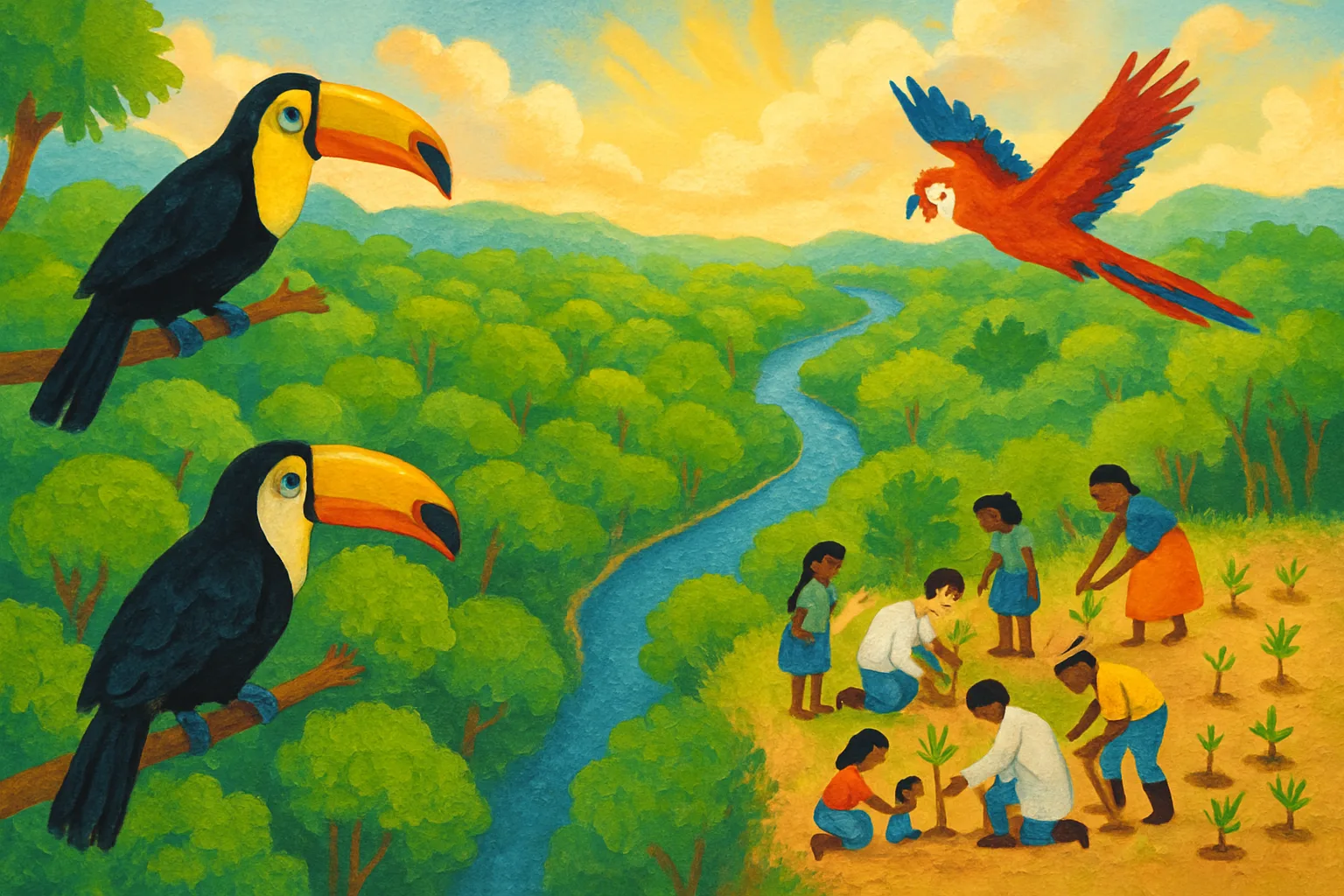
The Amazon covers a huge part of South America — imagine a forest bigger than the entire United States. It is sometimes called “the lungs of the planet” because its millions of trees absorb enormous amounts of carbon dioxide and release oxygen.
This week, scientists published urgent findings in the journal Nature. They are worried about two problems happening at the same time.
First, large areas of the Amazon forest have already been cut down for farming and logging. Researchers estimate that roughly 17 to 18 percent of the forest has been lost. If that number grows much further — to between 22 and 28 percent — scientists warn it could trigger a dramatic and hard-to-reverse change.
Second, a powerful weather pattern called El Niño has returned. El Niño happens when a large patch of unusually warm water grows in the Pacific Ocean. When that happens, it changes rainfall patterns all around the world. In the Amazon, El Niño usually means less rain, more drought, and more wildfires. The current El Niño looks like it could be especially strong — possibly the strongest ever recorded.
That combination worries scientists a great deal. The Amazon makes much of its own rain by recycling moisture from the Atlantic Ocean through its trees. If enough trees disappear, that water cycle breaks down. Parts of the Amazon could slowly dry out and turn into a different kind of landscape, more like a dry grassland called a savanna. That kind of change could begin to happen as soon as the 2040s if things do not improve.
Scientists are careful to say: this tipping point has NOT been reached yet. The Amazon still has the ability to recover. But time matters, and the warning is serious.
Why Does It Matter?
The Amazon is home to about 10 percent of all species on Earth. Jaguars, pink river dolphins, poison dart frogs, and thousands of species not yet discovered by science all live there. Millions of Indigenous people call it home too.
The Amazon also plays a huge role in slowing climate change. When trees are healthy, they lock away enormous amounts of carbon dioxide. When they burn or die, that carbon is released back into the air.
The good news is that people are paying attention. The COP30 global climate summit is being held in Brazil — right next to the Amazon — this year. World leaders, scientists, and conservation groups are there specifically to discuss how to protect tropical forests.
Many countries have also been reducing deforestation rates in recent years, showing that positive change is possible when people work together.
Big Words
- Rainforest — a thick, tropical forest that receives very heavy rainfall throughout the year and is home to an enormous variety of plants and animals.
- El Niño — a weather event that happens every few years when the Pacific Ocean’s surface temperatures rise, disrupting weather patterns around the world.
- Tipping point — a moment when a system changes so much that it flips into a completely different state and cannot easily go back.
- Deforestation — the cutting down or clearing of large areas of forest, often for farming, logging, or building.
- Savanna — a flat, open landscape covered in grasses and scattered trees, much drier than a rainforest.
Fun Fact
The Amazon River carries so much fresh water that when it flows into the Atlantic Ocean, scientists can detect fresh water nearly 200 miles (320 kilometers) out to sea — that is almost the distance from New York City to Washington, D.C.!
Think About It
The Amazon is called “the lungs of the planet.” If you were in charge of protecting it, what is one big change you would make — and one thing every kid could do to help?
Sources
- Nature — ‘A super El Niño could transform the Amazon. Is the world’s biggest rainforest doomed?’ (Aug 11, 2026)
- Gizmodo — ‘A Super El Niño Could Push the Amazon Toward a Tipping Point, Scientists Warn’ (Aug 12, 2026)
- Mongabay — ‘Deforestation and warming could push Amazon to tipping point by 2040s: Study’ (May 2026)