
Ancient Wolves Lived on an Island — and Only Humans Could Have Brought Them There!
Quick Summary
Scientists discovered wolf bones up to 5,000 years old on a tiny Swedish island in the Baltic Sea — an island that has absolutely no land animals of its own. The wolves could only have arrived by boat. This amazing find is changing what scientists thought they knew about the friendship between early humans and wolves.
What Happened?
Long, long ago — back when the ancient Egyptians were building their first pyramids — a group of wolves were living on a small island in what is now Sweden. The island is called Stora Karlsö. It is only about 2.5 square kilometers in size. That is roughly the area of 350 soccer fields.
Here is the puzzle: this island has no native land mammals at all. No deer. No rabbits. No foxes. Not a single wild land animal lives there naturally.
So how did wolves end up there?
Scientists from the Francis Crick Institute, Stockholm University, and the University of Aberdeen studied wolf bones found in a cave on the island. Using DNA tests and chemical analysis of the bones, they discovered something remarkable.
The wolves had been eating mostly fish and seals — not the rabbits and deer that wolves usually chase. That is exactly the diet of the seal hunters and fishers who lived on the island thousands of years ago.
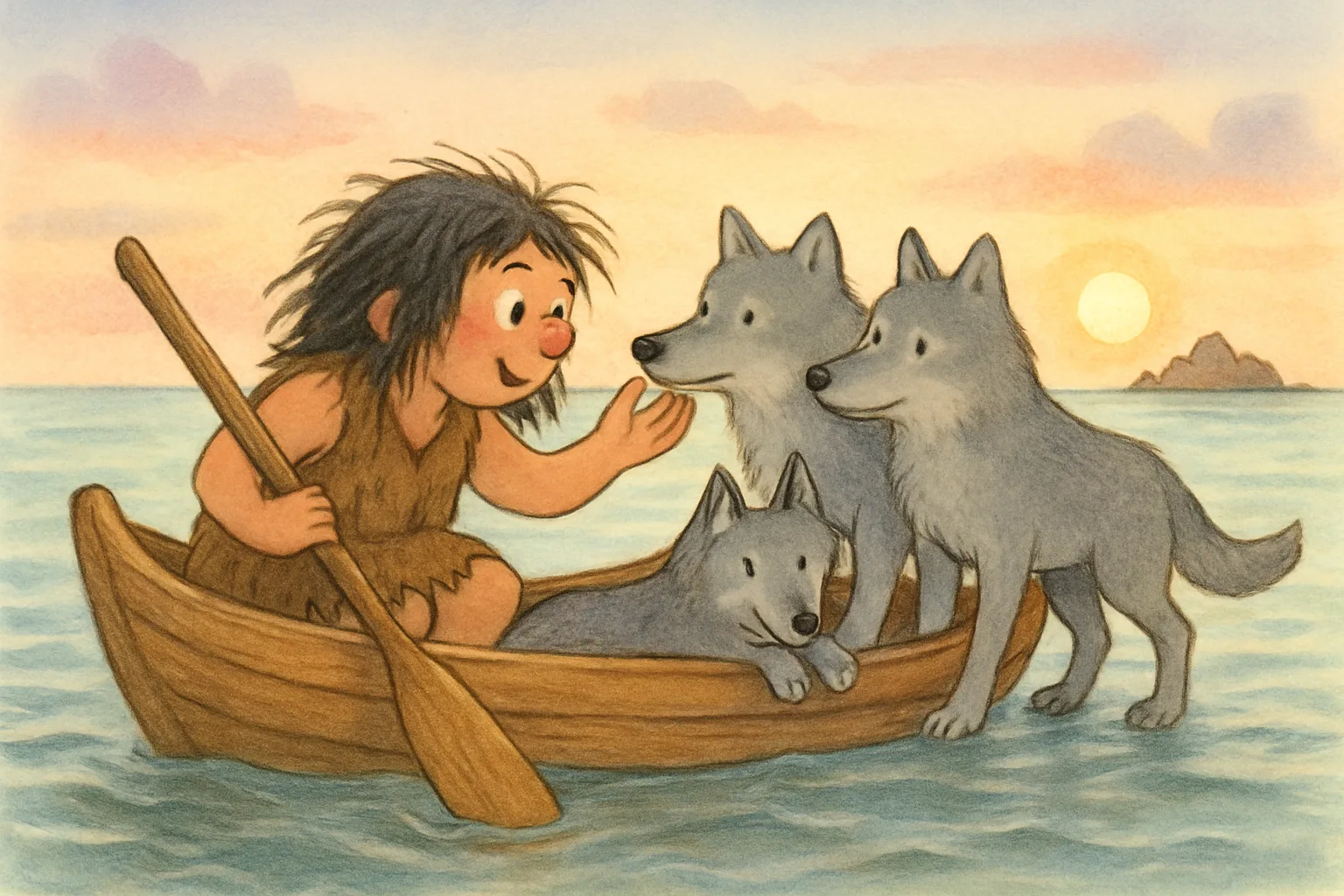
The wolves could not have swum to the island on their own. It was too far, and the water was too rough. The only explanation is that ancient humans brought them there by boat.
Even more surprising: one of the wolves had a badly injured leg. An animal with a broken leg cannot hunt. Yet this wolf survived. That means the humans were probably feeding it and taking care of it.
Why Does It Matter?
For a long time, scientists thought the story of how dogs came to be was pretty simple. Wolves started hanging around human camps. They ate scraps. Slowly, over many generations, tame ones were selected and they became dogs.
But this discovery adds a twist. These wolves were not dogs. Their DNA shows they were fully wild gray wolves — the same kind as the wolves howling in forests today. Yet ancient people were taking them on boat trips and caring for injured ones.
It suggests that thousands of years ago, some human communities were experimenting with wolves in ways scientists never imagined. They were forming a special bond with these animals — even before the first true dogs existed.
The scientists published their study in one of the world’s top science journals. They say this is proof that the human-wolf friendship was much more varied and creative than anyone had guessed.
Big Words
- Domestication — the long process by which humans take wild animals or plants and gradually change them, over many generations, to make them tamer, more useful, or more comfortable living alongside people. Dogs are domesticated wolves.
- DNA — the tiny instructions inside every living cell that tell it how to grow and what to look like. Scientists can read DNA from bones to learn what species an animal was and how it was related to others.
- Isotope analysis — a scientific test that looks at certain tiny particles in bones or teeth to figure out what an animal ate while it was alive.
- Quasi-satellite — (not in this article, skip)
- Population bottleneck — when a group of animals becomes very small, so the offspring all look genetically similar, like cousins with not many different family traits left.
Fun Fact
Sciencists found that the wolves on the island had unusually low genetic diversity — meaning they were very closely related to one another, like a small, tight family. Scientists say this is a clue that people were managing and controlling which wolves lived together, even 5,000 years ago!
Think About It
The ancient people who brought wolves to that island had to share their limited food with the animals. Why do you think they did that? What might they have gotten in return?
Sources
- ScienceDaily — ‘5,000-year-old wolves found on remote island rewrite what we know about domestication’ (July 5, 2026)
- SciTechDaily — ‘5,000-Year-Old Wolves Found on Remote Island Challenge Conventional Views of Domestication’
- Sci.News — ‘Ancient Humans Introduced Wolves to Remote Baltic Sea Island 5,000 Years Ago’
- IFLScience — ‘5,000 Years Ago, Ancient Wolves Reached A Remote Baltic Island – But How Did They Get There?’
- Phys.org — ‘Ancient wolves on remote Baltic Sea island reveal link to prehistoric humans’ (citing PNAS study)