
Nature Had Plastic First! Scientists Discover Animals Have Been Eating It for Millions of Years
Quick Summary
Long before humans ever made plastic, tiny microbes were already creating their own natural version. Now, scientists have discovered something surprising: animals — including worms, starfish, and earthworms — have the ability to eat and break down this natural plastic. They may have been doing it for hundreds of millions of years.
What Happened?
When we talk about plastic, most people think of water bottles and grocery bags. Those human-made plastics are a big problem because they stick around for hundreds of years without breaking down.
But there is another kind of plastic that nature invented all on its own. Tiny living things called bacteria and archaea — which are far too small to see without a microscope — make a natural plastic inside their own cells. It is called polyhydroxyalkanoate, or PHA for short. Think of it as a tiny energy storage tank, like a mini lunchbox packed inside a microbe. When bacteria have extra carbon and energy, they pack it into these PHA beads and save it for later.
For a long time, scientists thought only other microbes could break down and eat these PHA beads. Animals, they figured, simply did not have the right tools for the job.
Researchers at the Max Planck Institute for Marine Microbiology in Bremen, Germany, just proved that idea wrong. They found that a wide variety of animals have special enzymes — tiny biological tools — that can break down PHA. An enzyme works a bit like a key that unlocks a lock. The PHA is the lock, and the enzyme is the key that opens it up so the animal can absorb the nutrients inside.
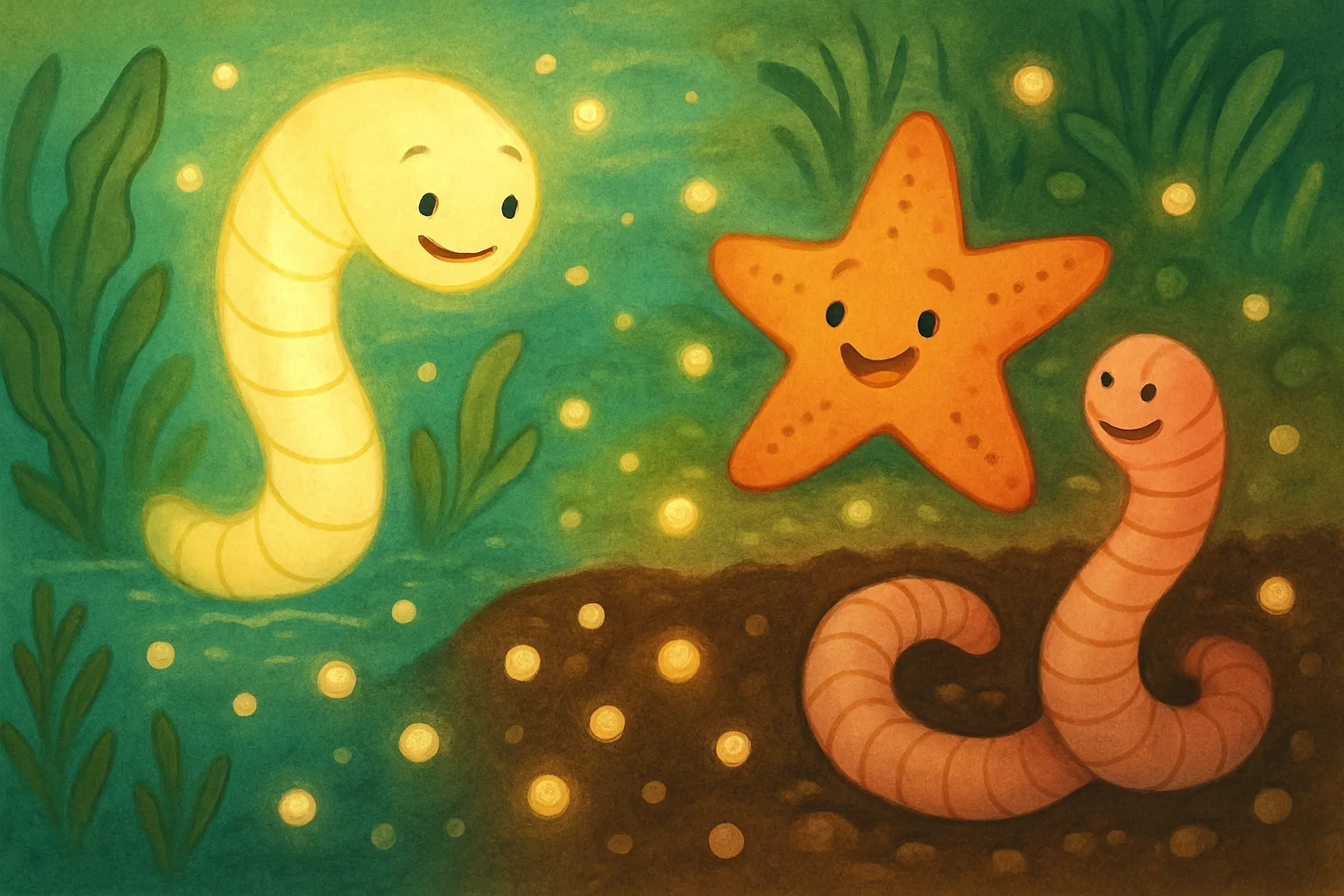
The animals that have this ability include marine worms, starfish, earthworms, and other species from many different animal groups. The discovery was published in the journal Nature Ecology & Evolution.
The story began with one especially unusual little worm. It is called Olavius algarvensis, and it is only about two centimeters long — roughly the size of a thumbnail. This worm has no mouth, no stomach, and no intestines. Yet it survives just fine. How? It has bacteria living on its skin that are packed with PHA. The bacteria act like a living lunchbox, and the worm eats right from it using its PHA-breaking enzymes.
Scientists then looked across the animal kingdom and found the same ability showing up in dozens of other species. Since PHA naturally exists in soils, ocean sediments, and water around the world, animals may have been quietly snacking on it for hundreds of millions of years.
Why Does It Matter?
This discovery matters for two big reasons. First, it changes our understanding of how animals get energy in nature. PHA turns out to be a hidden food source that was hiding in plain sight.
Second, humans are now trying to make more products from bioplastics — plastics that can break down naturally instead of polluting the environment. Understanding how animals and microbes work together to break down PHA in nature helps scientists figure out how to use these materials more wisely and create a cleaner planet.
Big Words
- Microbe — a living thing so tiny that you need a microscope to see it, like bacteria
- PHA (polyhydroxyalkanoate) — a natural plastic-like substance made by certain microbes to store energy, like a lunchbox packed inside a tiny cell
- Enzyme — a tiny biological tool in a living thing that speeds up a chemical reaction, like scissors that snip apart a long molecule
- Bioplastic — a type of plastic made from natural, living sources instead of petroleum, which can break down more easily in the environment
- Sediment — tiny particles of sand, mud, and bits of material that settle at the bottom of oceans, rivers, and lakes
Fun Fact
Microbes are so incredibly small that about one million of them could fit across the period at the end of this sentence. Yet those tiny creatures have been quietly engineering natural plastics for billions of years!
Think About It
If nature already invented biodegradable plastic long before humans did, what other problems do you think nature might have already solved that scientists are just starting to discover?
Sources
- ScienceDaily / Max Planck Institute for Marine Microbiology — Animals have been eating nature’s original bioplastic for hundreds of millions of years (Aug 17 2026)
- Nature Ecology & Evolution — Animal degradation of microbial storage polyhydroxyalkanoates (published Aug 13 2026)
- phys.org — Nature’s original bioplastic may have fed animals for hundreds of millions of years
- Mirage News / Max Planck Institute — Nature’s Bioplastic: Edible for Animals
- bioengineer.org — Nature’s Original Bioplastic Doubles as Food for Animals