
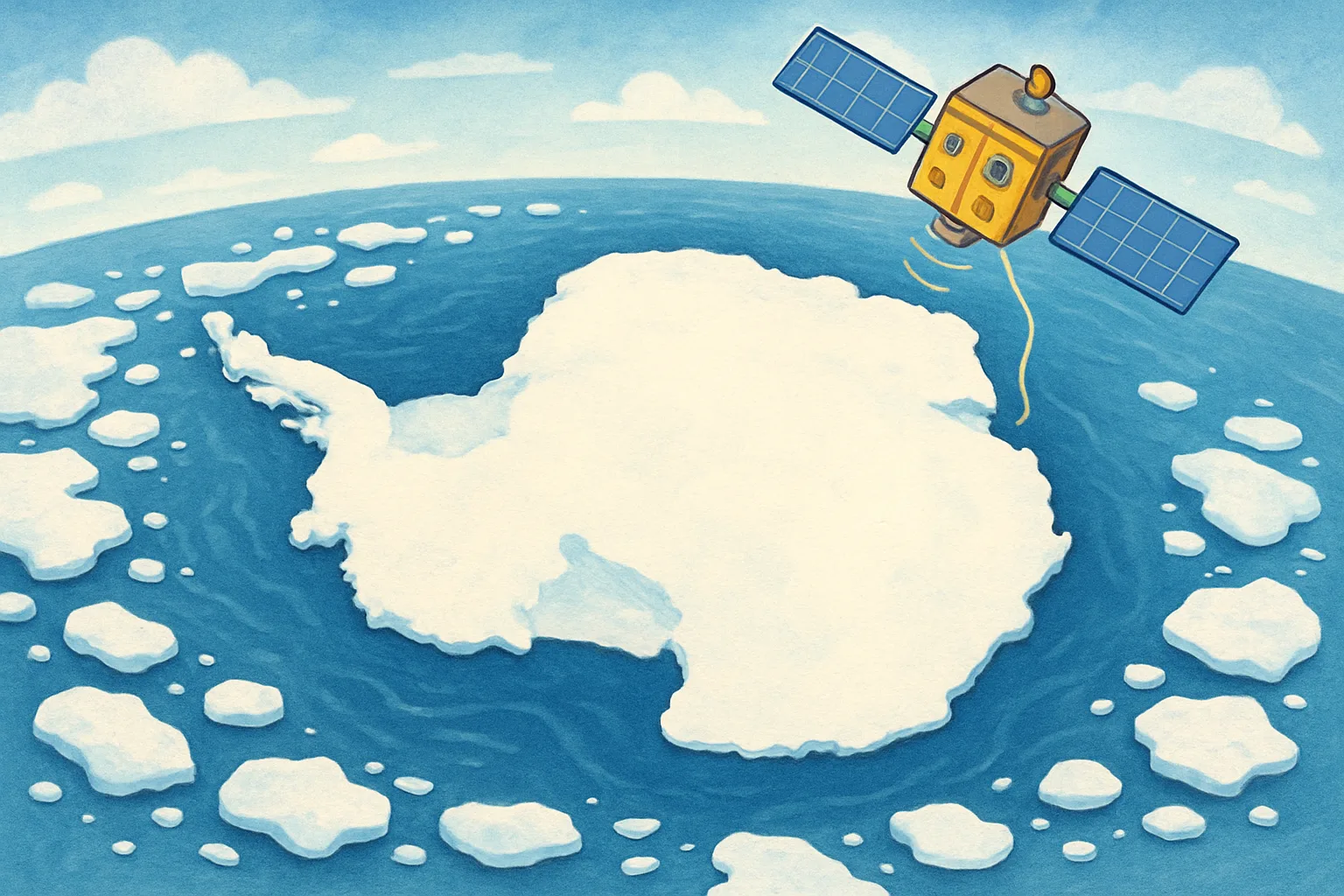
Shrinking Shield! Antarctica’s Sea Ice Hits One of Its Lowest Levels Ever Recorded
Quick Summary
Scientists at NASA and the National Snow and Ice Data Center have announced some big news about Antarctica. This past winter, the sea ice surrounding the frozen continent reached its third-lowest peak ever recorded by satellites. That record-keeping goes back nearly 50 years, making this a very notable measurement.
What Happened?
Every year, Antarctica — the giant frozen continent at the bottom of the world — gets surrounded by a huge ring of sea ice during its winter months. Just like how a pond freezes over in winter, the ocean around Antarctica freezes up each year. This frozen ocean water is called sea ice.
Sea ice usually grows biggest around September, when it is the middle of winter in the Southern Hemisphere. On September 14, 2026, Antarctica’s sea ice hit its biggest point for the year. Scientists measured it at about 17.59 million square kilometers. That sounds enormous — and it is. It is about twice the size of the United States!
But here is the surprising part: that measurement is actually much smaller than it used to be. NASA and the National Snow and Ice Data Center (NSIDC) confirmed it was the third-lowest winter maximum since satellites began watching Antarctica back in 1979. That is nearly 50 years of data.
For a long time — from the late 1970s all the way to 2014 — Antarctica’s sea ice was actually growing a little bit every decade. Then, starting in 2016, it began shrinking dramatically. The very lowest point happened in 2023. This year adds to that worrying pattern.
Scientists are carefully studying each year’s measurements to understand whether this is a long-term change or a natural swing. They say they will keep watching closely.
Why Does It Matter?
Sea ice around Antarctica plays an important role in keeping our planet cool and healthy. It acts like a giant mirror in the ocean, bouncing the Sun’s heat back into space. Less ice means more dark ocean water soaks up that heat instead.
Sea ice also provides habitat for animals like penguins, seals, and krill — tiny shrimp-like creatures that millions of ocean animals depend on for food. When the ice shrinks, these animals have less space and less food.
Scientists say watching sea ice is one of the most important ways we can take our planet’s temperature and understand how it is changing over time.
Big Words
- Sea ice — frozen ocean water that forms and melts with the seasons, unlike glaciers which are made of frozen snow on land
- Winter maximum — the biggest size that sea ice reaches each year, measured at the end of the cold season
- Satellite record — data collected by cameras and sensors on orbiting satellites, which scientists use to track changes on Earth over decades
- NSIDC — short for National Snow and Ice Data Center, the official U.S. organization that tracks ice and snow all over the planet
- Southern Hemisphere — the bottom half of Earth, below the equator, where seasons are opposite to ours — their winter is our summer
Fun Fact
Antarctica is the coldest, windiest, and driest continent on Earth. Even though it is covered in ice, it technically counts as a desert — because less snow falls there each year than in many other places on Earth!
Think About It
If you were a penguin living on sea ice near Antarctica and noticed the ice getting smaller each year, what would you do to adapt?
Sources
- NASA Earth Observatory / ScienceDaily — Antarctica’s sea ice has undergone a stunning reversal, Oct 15 2026
- NASA / NSIDC — Antarctic Sea Ice Reaches Third Lowest Winter Maximum, reported Oct 14-16 2026
- SSBCrack News — Antarctic Sea Ice Reaches Third Lowest Winter Maximum on Record, Oct 16 2026
- Eastern Herald / NSIDC — Antarctic Sea Ice Slides Toward Record Lows, Oct 14 2026