
Earth Got Pelted by Space Rocks 800 Million Years Ago — and Scientists Just Found the Culprit!
Quick Summary
A team of scientists has solved a very old mystery. About 800 million years ago, a wave of space rocks slammed into Earth, the Moon, and Mars. Now researchers think they know exactly what caused it — one massive asteroid that broke apart.
What Happened?
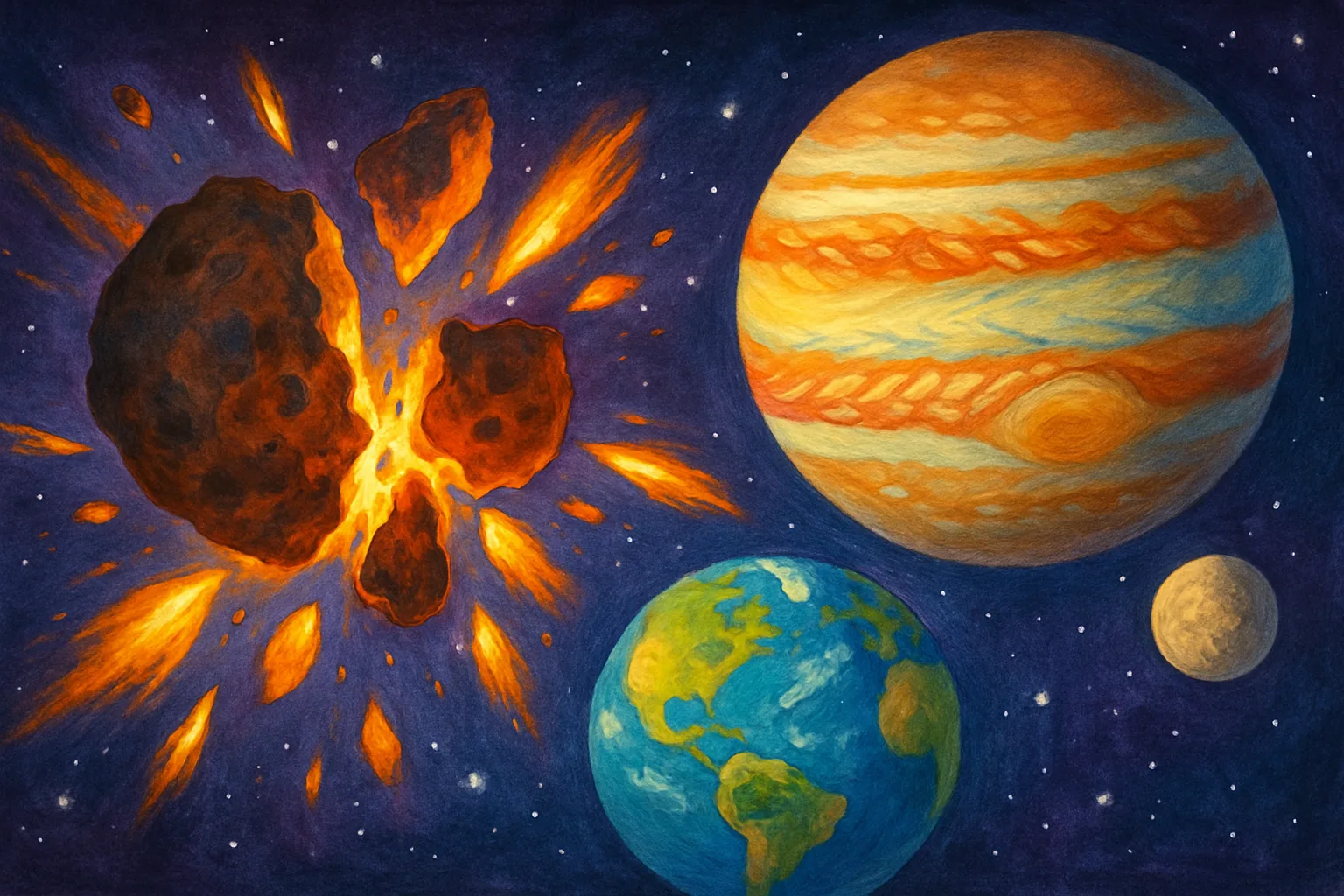
Scientists at the Southwest Research Institute published new research this week. They believe a single giant asteroid — called the Eulalia parent body — cracked apart in the main asteroid belt long ago. That breakup sent a huge cloud of rocky chunks flying through the inner solar system.
Think of it like dropping a giant bag of marbles on a hard floor. The bag splits open, and marbles scatter everywhere.
Jupiter’s powerful gravity acted like a gateway. It pulled chunks of the broken asteroid toward its orbit. From there, the pieces were flung toward Earth, the Moon, and Mars. Scientists call this kind of massive hit-fest an impact shower.
How do we know this happened? Researchers studied craters on the Moon. The Moon has no weather, so its craters never wash away. They act like a history book, recording every major collision. By carefully dating lunar craters, scientists matched them to this ancient bombardment episode.
The impact shower happened roughly 800 million years ago. To put that in perspective, that is about four times older than the age of the dinosaurs. Back then, the most complex life on Earth was mostly tiny sea creatures.
The study suggests the bombardment may have changed Earth’s climate and even shaped how life evolved here.
Why Does It Matter?
Scientists are still learning how asteroid impacts changed our planet’s history. This research connects a specific asteroid to a chain of events that shook the entire inner solar system.
Understanding past bombardments helps scientists protect Earth in the future. The better we understand where dangerous space rocks come from, the better we can track them today.
The study also shows that Jupiter — the solar system’s largest planet — acts like a giant “traffic controller” for space rocks. Its enormous gravity can send asteroids on new paths toward Earth.
Big Words
- Asteroid belt — a ring of rocky objects orbiting the Sun between Mars and Jupiter, like a giant donut of space rocks.
- Impact shower — a period when many space rocks hit a planet or moon in a short amount of time.
- Crater — a bowl-shaped hole left behind when a space rock smashes into a planet or moon.
- Eulalia parent body — the name scientists give to the ancient, large asteroid that broke apart and may have caused this bombardment.
- Gravity — the invisible pulling force that every object with mass has; Jupiter’s gravity is so strong it can change the paths of asteroids.
Fun Fact
The Moon’s surface has no wind, rain, or plants — so craters there can last for billions of years without changing. Scientists use Moon craters the way doctors use X-rays: to see hidden history that you cannot spot on the surface!
Think About It
Jupiter’s huge gravity can send space rocks flying toward Earth. Does that make Jupiter Earth’s protector, or a danger? Can it be both at once?
Sources
- ScienceDaily — A shattered asteroid may have bombarded Earth 800 million years ago (July 18, 2026)
- EurekAlert / Southwest Research Institute — SwRI-led research connects asteroid collision to impact showers 800 million years ago
- Phys.org — Asteroid breakup may explain inner solar system bombardment 800 million years ago