
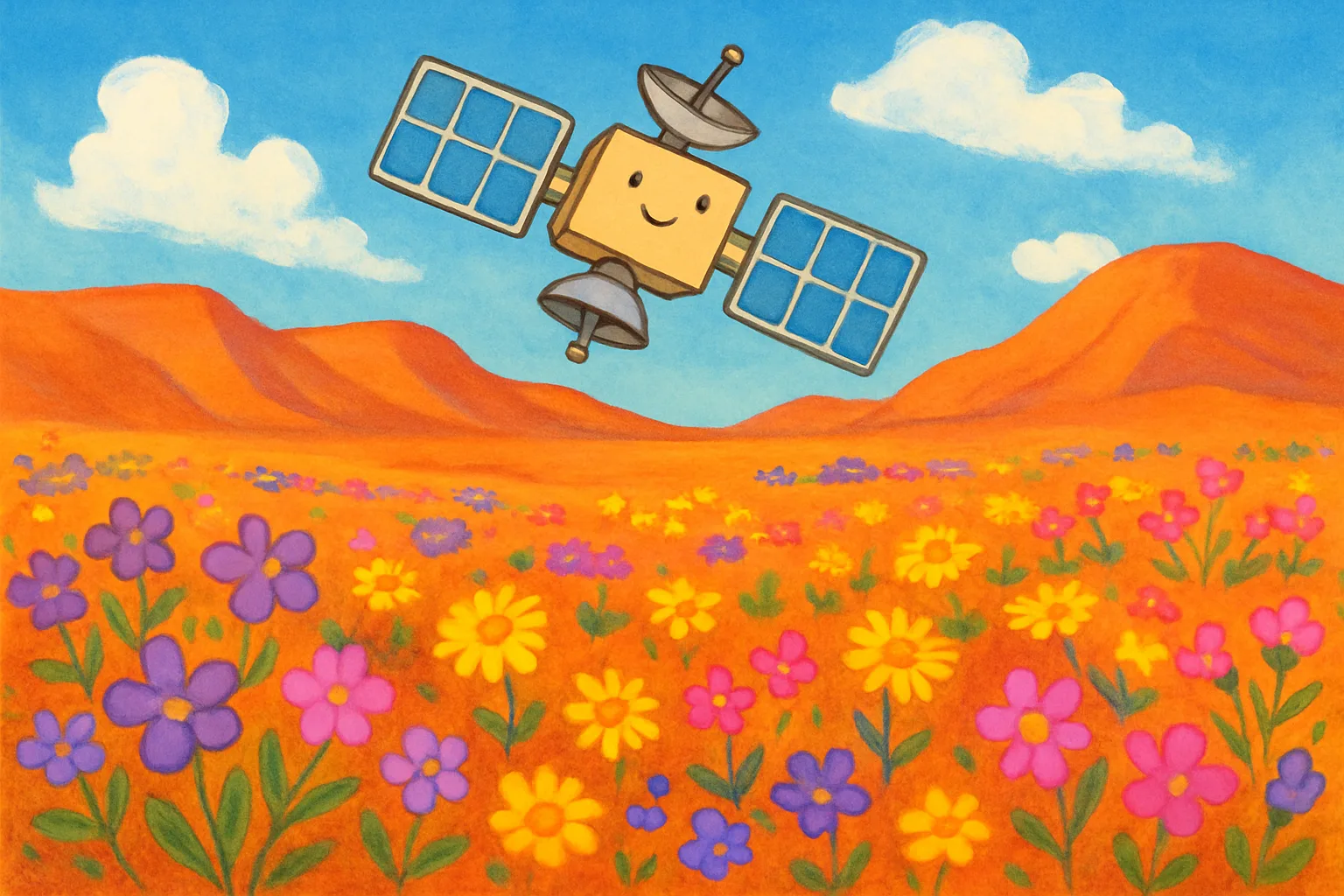
Desert in Bloom! NASA Satellites Spot a Rare Flower Explosion in Australia
Quick Summary
A huge patch of Australian desert has turned into a sea of colorful wildflowers! NASA satellites spotted the breathtaking change from space. Local experts say this could be the best flower show the area has seen in almost 20 years.
What Happened?
Western Australia’s Murchison region is normally a dry, rust-colored stretch of scrubland. About 600 kilometers north of the city of Perth, this remote area usually looks a lot like the surface of Mars — sandy, rocky, and bare.
But something remarkable happened this year. June and August brought much more rain than usual to the region. Several cold weather fronts swept through, dropping heavy rainfall across the outback. All that water woke up millions of dormant seeds hiding in the soil. Seeds that had been waiting — sometimes for many years — suddenly sprang to life.
The result? Carpets of bright wildflowers spread across the landscape. Purple mulla mulla flowers, yellow everlastings, and many other species burst into bloom across huge stretches of land. Some of those flowers belong to species that are threatened, meaning they are at risk of disappearing.
NASA’s Landsat 8 satellite — a spacecraft the size of a small bus that circles Earth taking photographs — captured the transformation on August 30. Scientists compared the image to a photo of the same area from August 2025. The difference is dramatic. What looked like bare red dirt last year is now covered in green and color.
The flowers also appeared right inside a famous science site: the CSIRO Murchison Radio-astronomy Observatory. This is a place where giant radio telescope antennas normally gaze into deep space. For a little while, the telescope operators had a stunning flower garden all around them!
Why Does It Matter?
Desert blooms like this remind scientists how quickly nature can bounce back when conditions are right. The event is also helping researchers study how desert plants survive and respond to extra rainfall. And because threatened plant species have appeared among the blooms, scientists are carefully documenting them.
Big Words
- Dormant — in a deep resting state; dormant seeds are alive but waiting for the right conditions — like rain — to grow
- Outback — the vast, remote, and mostly dry inland areas of Australia
- Landsat 8 — a satellite operated jointly by NASA and the U.S. Geological Survey that photographs Earth’s surface from space
- Threatened species — a plant or animal that scientists have identified as being at risk of disappearing from Earth
- Bloom — when flowers open up; a big bloom means millions of flowers opening at the same time
Fun Fact
The Murchison Radio-astronomy Observatory, where some of the wildflowers appeared, is inside a special “radio quiet zone.” That means no cell phones or Wi-Fi are allowed there, because even tiny electronic signals could interfere with the super-sensitive telescopes listening to the universe!
Think About It
Imagine seeds sitting quietly underground for years, just waiting for rain. What do you think it would feel like to be a seed, patiently waiting for your chance to grow?
Sources
- NASA Earth Observatory — Boom Year for Desert Blooms
- Space.com — Satellites spy rare explosion of color in Australian desert, Sept. 24, 2026
- Qazinform — Western Australia’s desert bursts into bloom after winter rains
- Newsbeep — Boom Year for Desert Blooms