
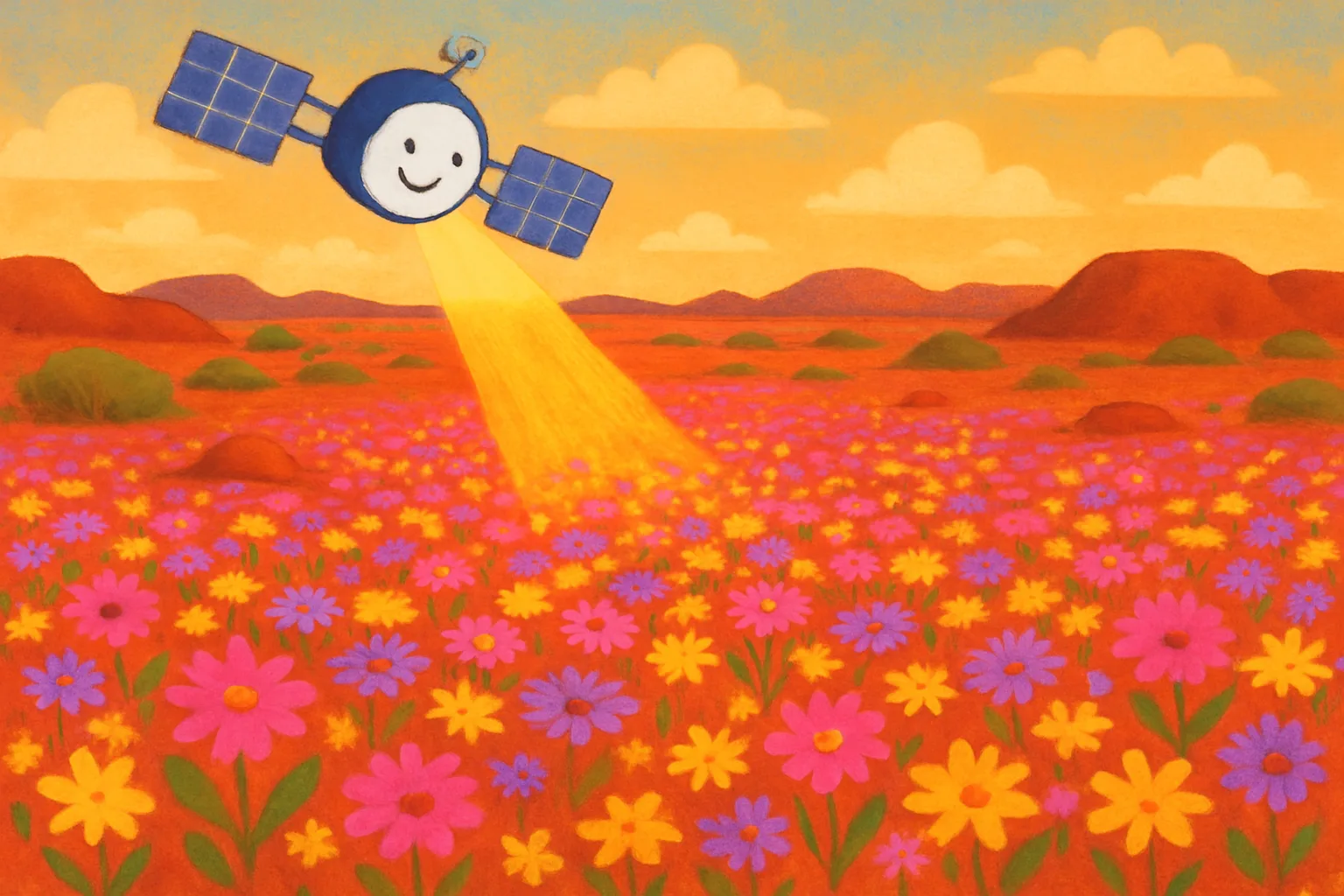
Desert in Bloom! NASA Satellites Spot Australia’s Greatest Wildflower Show in 20 Years
Quick Summary
Australia’s Murchison desert — one of the driest places on the continent — has exploded into a sea of colorful wildflowers. NASA satellites photographed the amazing change from space. Scientists say this could be the biggest bloom the area has seen in nearly 20 years!
What Happened?
Picture a stretch of land as large as many countries, covered in rust-red dirt and barely any plants. That is normally what the Murchison region of Western Australia looks like. It sits about 600 kilometers north of the city of Perth and bakes in the sun for most of the year.
But something special happened in 2026. The winter brought much more rain than usual. June was wetter than average. August was very much wetter than normal. Several cold weather systems swept through the region, dropping even more moisture.
All that rain woke up something hidden — seeds. Desert seeds can sleep in dry soil for years and years, waiting patiently for just the right amount of rain. Once it arrived, they burst into life all at once. The result? A spectacular carpet of flowers spreading across the red landscape as far as the eye can see.
NASA’s Landsat 8 satellite — which circles Earth taking pictures — captured images on August 30, 2026, that show the transformation clearly. A photo from August 2025 shows the same area as dry, muted, and almost bare. The 2026 photo looks like a completely different planet — vivid green and splashed with color.
Among the flowers are some very special ones. A few of the blooming plants are threatened species — rare plants that scientists worry about. Some had not been seen in that area for nearly 20 years. They even bloomed on the grounds of a big radio telescope observatory, painting the usually quiet science station with pink and purple flowers.
Why Does It Matter?
This bloom shows the incredible power of nature to bounce back after long dry spells. It also reminds us that seeds are patient little survival experts. Scientists and botanists are excited to visit the area and document the rare and threatened species before they go dormant again. NASA’s satellites help researchers track changes in nature across the whole planet, even in places too remote and vast for people to easily reach.
Big Words
- Dormant — in a sleep-like resting state, waiting for the right conditions to wake up and grow
- Arid — very dry, with little rainfall; deserts are arid
- Threatened species — a type of plant or animal that is at risk of disappearing from an area or the world
- Satellite imagery — photos of Earth taken from spacecraft orbiting high above
- Germinate — when a seed begins to sprout and grow into a plant
Fun Fact
The wildflower show was so big and so colorful that it was easily visible from hundreds of miles up in space — just from the way the land reflected light differently!
Think About It
Seeds can wait underground for years without any rain. What other surprising ways do you think plants or animals survive in very harsh places?
Sources
- NASA Earth Observatory / ScienceDaily — NASA captures a stunning transformation in Australia’s red outback (Oct 12, 2026)
- Space.com — Satellites spy rare explosion of color in Australian desert
- Impactful Ninja — Threatened Plants Unseen for 20 Years Bloom Across Australian Desert
- Qazinform / NASA — Western Australia’s desert bursts into bloom after winter rains