
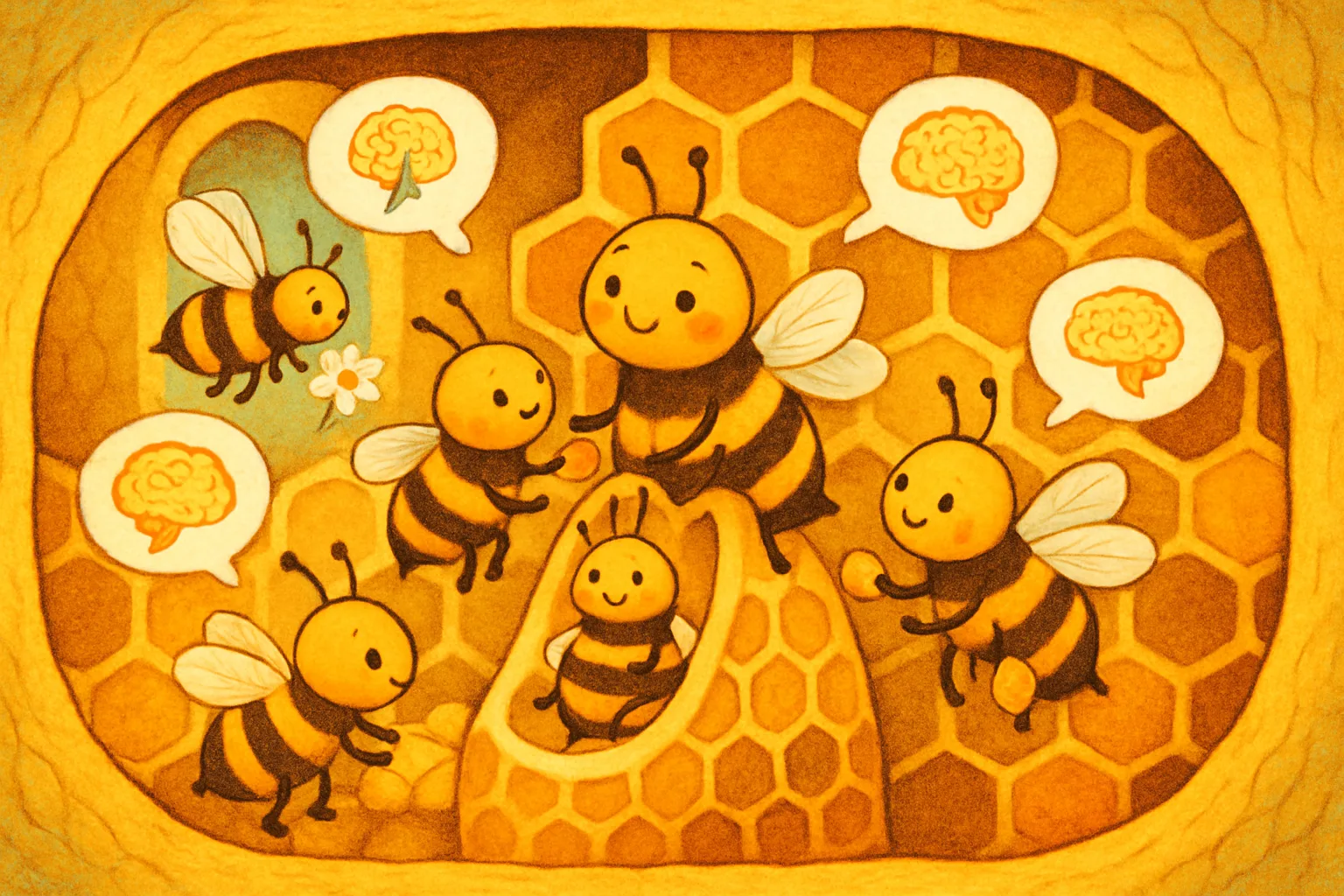
Every Bee Has a Secret Job Switch Inside Its Brain!
Quick Summary
A honeybee hive is like a tiny, perfectly organized city. Every bee has a job. Young bees stay inside and care for the baby larvae. Older bees fly out to collect pollen and nectar. Scientists just figured out how bees know which job is theirs — and it all comes down to a hidden switch inside their brains.
What Happened?
Researchers from Heinrich Heine University in Düsseldorf, Germany — along with scientists from universities in Cologne and Frankfurt — have been studying honeybee brains very carefully. They wanted to answer a question that has puzzled scientists for a long time: how does a bee know when to change jobs as it gets older?
They found that specific groups of brain cells act like a switch. When a bee is young, these circuits are set one way. The bee stays in the hive and looks after the queen and baby bees. As the bee ages, the switch flips. Suddenly, the bee starts flying out to gather food for the colony.
To prove this is really what happens, the scientists tried something clever. They used a special technique to turn off those brain circuits in older bees. The result was surprising. Older worker bees started acting young again. They went back to caring for the queen, just like they did when they were babies.
Think of it like a volume knob on a radio. Turn it one way and you hear one station. Turn it the other way and you hear a completely different one. The bee’s brain has a similar kind of knob, and age is what turns it.
The study was published in the Proceedings of the National Academy of Sciences, one of the most respected science journals in the world.
Why Does It Matter?
Bee colonies are one of nature’s great teamwork stories. A single hive can have tens of thousands of bees, yet every bee knows its role perfectly — with no manager telling them what to do. Understanding how the brain controls this could help scientists learn more about how all animal brains — including human ones — assign and switch between different tasks over a lifetime.
Bees also help grow about one-third of the food humans eat by pollinating plants. The more we understand about bee biology, the better we can protect them.
Big Words
- neural circuit — a connected group of brain cells that works together to control a behavior, like the wiring inside a computer
- larvae — the worm-like babies that hatch from bee eggs inside the hive; they are fed and cared for by young worker bees
- colony — a group of bees that live and work together in a shared hive
- forager — a bee whose job is to fly out of the hive and collect pollen and nectar from flowers
- inhibit — to slow down or block something; in the study, scientists inhibited, or turned down, certain brain circuits in older bees
Fun Fact
A single worker honeybee will visit around 50 to 100 flowers on each trip — and it takes the nectar from about two million flowers to make just one pound of honey!
Think About It
If scientists can flip a switch to change what a bee does, do you think other animals — like ants or wasps — might have similar brain switches? What would you want to test first?
Sources
- ScienceDaily — Scientists discover the hidden brain switch that assigns bees their jobs (July 22, 2026)
- Phys.org — Bee brains reveal how colonies divide work without central planning (July 20, 2026)
- Proceedings of the National Academy of Sciences — Seiler et al., Inhibitory modulation of age-dependent behavior through dsx-expressing cells in honeybees, PNAS 2026