
Cosmic Burp! Scientists Crack the Secret of When Black Holes Explode
Quick Summary
Astronomers have discovered that black holes of all different sizes follow the exact same rule when they shoot powerful jets into space. Whether a black hole is the size of a small city or a billion times the mass of our sun, the rule is the same. Scientists published this discovery in the journal Nature Astronomy.
What Happened?
Black holes are regions in space where gravity is so strong that nothing — not even light — can escape. They come in very different sizes. Some black holes weigh about 10 times as much as our sun. Others are supermassive, weighing millions or billions of times more than the sun. The difference in size is enormous — like comparing a marble to a mountain range.
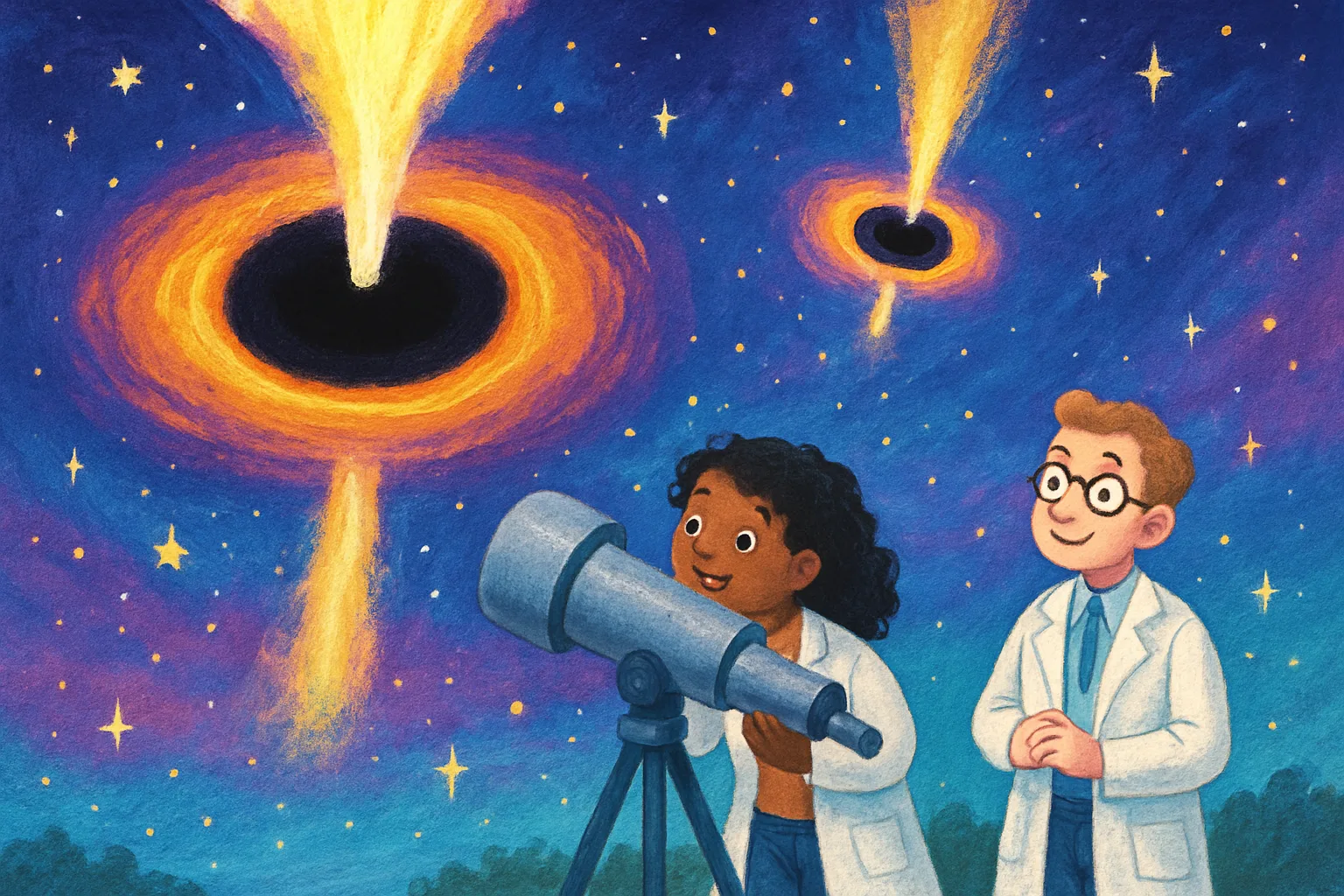
Sometimes black holes act like messy eaters. When a star gets too close, the black hole tears it apart and swallows the material. During this feeding frenzy, the black hole can shoot enormous jets of particles and energy out into space at nearly the speed of light. Scientists call these jets.
For a long time, scientists were puzzled about when these jets fired. Some black holes launched jets right away after eating. Others went quiet for months or even years, then suddenly shot off jets without warning. It seemed completely random.
Now a team led by Dr. Adelle Goodwin at Curtin University in Australia has cracked the mystery. By studying 20 events where black holes shredded and ate nearby stars, and using telescopes across Australia, the United States, India, South Africa, and space, they found a clear pattern.
Black holes launch their delayed jets at the exact moment their feeding rate drops to about 2 percent of the maximum speed at which they can swallow material. Think of it like a bathtub draining — when the water slows down to just a trickle, something suddenly clicks and a burst of energy fires out. That “trickle point” is 2 percent, and it is the same for every black hole, no matter how big or small.
The finding was published in the scientific journal Nature Astronomy.
Why Does It Matter?
This discovery means that the basic rules of physics work the same way across the whole universe, whether you are dealing with a small black hole or a monster supermassive one. That is a big deal — it tells scientists that black holes are not as mysterious or unpredictable as they once seemed.
Better still, knowing the 2-percent rule helps scientists predict when a black hole is about to fire off a jet. That means astronomers can now point their telescopes in the right direction at the right time, instead of watching and waiting for years. It is like knowing exactly when a fireworks display will start.
The discovery also opens new questions. Scientists now want to know exactly what physical process flips that “switch” inside a black hole at 2 percent. Finding that answer could help us understand gravity itself — one of the greatest mysteries in all of science.
Big Words
- Black hole — a region of space where gravity is so strong that nothing, not even light, can escape
- Jet — a powerful beam of particles and energy that a black hole shoots out into space at nearly the speed of light
- Supermassive black hole — an incredibly large black hole, millions or billions of times heavier than the sun, found at the centers of galaxies
- Accretion — the process of a black hole slowly pulling in and swallowing material from nearby space
- Tidal disruption event — when a black hole’s gravity tears apart a star that gets too close
Fun Fact
The jets fired by supermassive black holes can stretch for hundreds of thousands of light-years — so long that they would reach from our Milky Way galaxy all the way to a neighboring galaxy and back!
Think About It
If you were an astronomer and you discovered a new rule about how the universe works, what would you want to discover next — and why?
Sources
- ScienceDaily / Curtin University — Astronomers discover a strange universal rule behind black hole eruptions (Oct 16, 2026)
- Nature Astronomy — Published study on universal jet threshold (Sept 2026)
- Archyde / Curtin University ICRAR — Scientists Discover Universal Rule for Black Hole Burps (Sept 19, 2026)
- Time.news — Black Holes Launch Jets When Feed Rate Drops to 2% of Eddington Limit (Sept 19, 2026)