
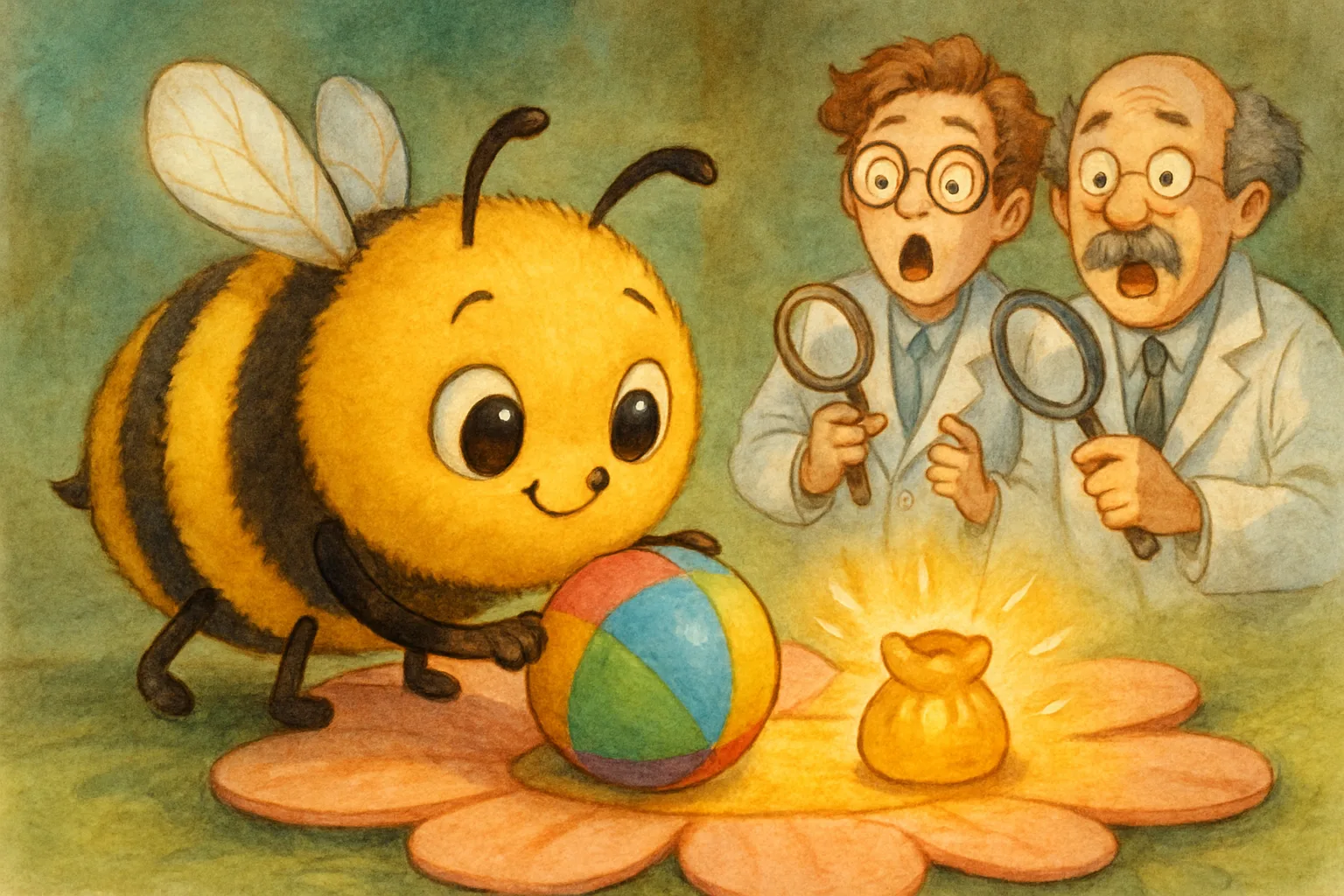
Tiny Bees, Big Brains: Bumblebees Solve a Puzzle Scientists Thought Only Chimps Could Crack!
Quick Summary
Scientists in Finland set up a tricky puzzle and watched in amazement as bumblebees figured it out — completely on their own, with zero training! The bees had to move a ball into position and use it to reach a hidden sugary treat. A bee’s brain is smaller than a sesame seed, but this study, published in the journal Science, shows they can think in surprisingly clever ways.
What Happened?
More than 100 years ago, a famous psychologist named Wolfgang Köhler discovered that chimpanzees could solve brand-new problems by using objects in creative ways. In one classic test, chimps stacked boxes to reach a banana hanging out of reach. Scientists called this kind of sudden, flexible thinking “insight” — and for a long time, they believed it was only possible in animals with big, complex brains like apes, elephants, and humans.
Now, researchers from the University of Oulu and other universities in Finland have shown that bumblebees can do something strikingly similar.
Here’s how the experiment worked: Scientists showed bees a ball and a special artificial flower with a hidden reward inside. The bees were never taught how to solve the puzzle. But many of them figured out, all on their own, that they could push the ball underneath the flower and climb on top of it to reach the sweet reward. Nearly 75 percent of bees that had been shown the ball and the flower solved the puzzle!
The researchers were very careful to make sure it wasn’t just luck. They used bees that had never seen anything like this before — the researchers called them “truly naive” bees. The bees combined two things they already knew (the ball, and the location of the reward) into a brand-new action that no one had shown them. That’s what makes the discovery so exciting.
The study was published in the prestigious journal Science in June 2026 and has scientists around the world buzzing with excitement.
Why Does It Matter?
This discovery challenges a long-standing idea that clever, flexible thinking is only possible in animals with large brains. Bumblebees have tiny brains — yet they showed a kind of problem-solving that scientists once thought only vertebrates (animals with backbones, like us) were capable of.
This research helps scientists understand how intelligence can come in many different shapes and sizes in the animal kingdom. It also makes us appreciate the incredible creatures we share our planet with — especially the small ones we might overlook!
Big Words
- Insight — A sudden moment when a brain figures out how to solve a new problem by connecting things it already knows — like a light bulb turning on!
- Cognitive flexibility — The ability to think in new ways and adapt to new challenges, instead of just doing the same thing over and over.
- Vertebrate — An animal that has a backbone (spine), like humans, dogs, fish, and birds.
- Spontaneous — Doing something on your own, without being taught or told how to do it.
- Naive — In science, this word describes a test subject that has no prior experience with the experiment, so researchers know their behavior is truly new.
Fun Fact
Bumblebees don’t just work — they also play! The same research group in Finland previously discovered that bumblebees will roll small wooden balls around even when there’s no reward involved. Scientists think this might be a form of play, just like how puppies or children play for fun.
Think About It
If bumblebees can solve puzzles that scientists thought only chimps could do, what other animals do you think might be smarter than we give them credit for?
Sources
- Science (journal) — Spontaneous problem-solving in bumble bees (Bhambore et al., June 4, 2026)
- ScienceDaily — Scientists Stunned as Bumble Bees Solve a Classic Intelligence Test
- SciTechDaily — Bumble Bees Solve an Insect Version of a Famous Primate Intelligence Test
- CBC Radio — Bumblebees can solve complex puzzles like chimpanzees and elephants, study finds
- Smithsonian Magazine — Bumblebees Can Solve Problems on the Fly