
Camping Trip Surprise! A Man Planning a Vacation Accidentally Found a 390-Million-Year-Old Crater
Quick Summary
A Canadian man named Joël Lapointe was scrolling through Google Maps to plan a camping trip when he spotted something unusual: a perfectly round ring in the wilderness of Quebec, Canada. Scientists have now confirmed it is a 390-million-year-old meteor crater. It is one of the biggest crater discoveries on Earth in years!
What Happened?
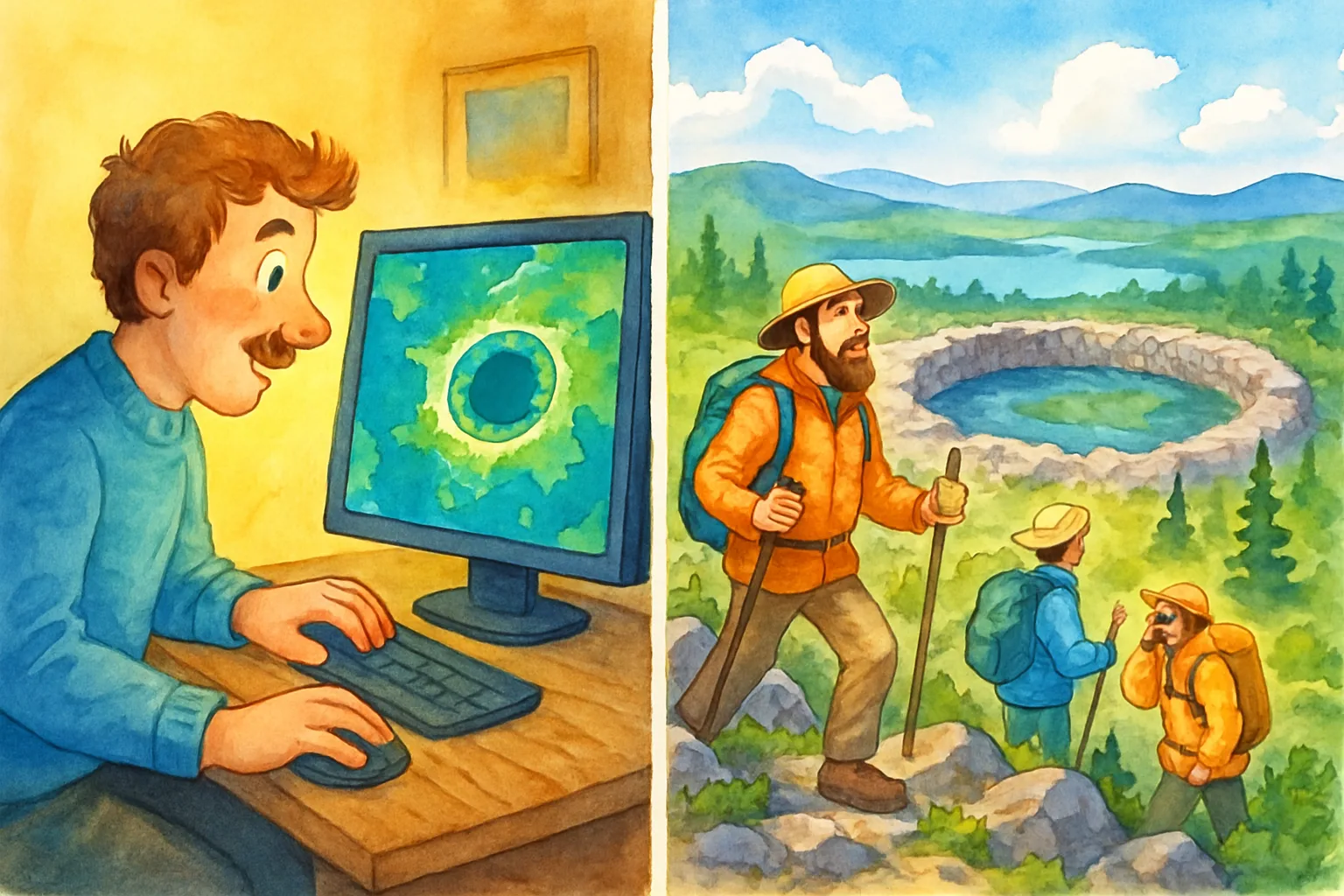
Back in 2024, Joël Lapointe was at his computer, planning a camping trip to a remote region of Quebec called Côte-Nord. He was browsing satellite maps online when something caught his eye — a large, almost perfectly circular indentation near a lake called Lake Marsal. The circle was about 15.5 miles wide. That is wide enough to fit the entire city of Paris, France, inside it.
Lapointe, who has a keen interest in astronomy, suspected this unusual ring shape might be a meteor crater. He searched through several scientific databases of known craters around the world. It wasn’t listed in any of them. So he did something brave: he contacted scientists in France and North America and told them what he found.
At first, some scientists were skeptical. But in October 2025, a team of geologists — including Gordon Osinski, a professor of Earth Sciences at Western University in Canada — hiked into the rugged, wild terrain to investigate. Getting there was tough. Osinski described it as one of the most challenging expeditions he had ever done.
The team collected rock samples and found something very exciting: shatter cones. Shatter cones are a special kind of rock fracture pattern that only forms when a space rock slams into Earth with enormous force. Finding them was proof. This was indeed a meteor crater, now officially named Uhackatik.
Scientists say the meteor hit Earth about 390 million years ago — long before dinosaurs even existed. The crater was then buried and hidden by forests and lakes for all that time.
NASA confirmed the discovery and the structure has been added to the official list of known impact sites on Earth. The crater’s name, Uhackatik, was chosen in consultation with the Innu Council of Ekuanitshit, the Indigenous people whose ancestral land includes the site.
Why Does It Matter?
Earth has around 200 known confirmed impact craters, but scientists believe hundreds more are still hidden out there. Uhackatik is now among the confirmed ones — and it is actually the largest crater discovered anywhere on Earth since 2018.
This story is also inspiring because Lapointe was not a professional scientist. He was just a curious person who paid attention and took his hunch seriously. Scientists say discoveries like this remind us that anyone can contribute to science — even on a camping trip!
Big Words
- Meteor crater — A bowl-shaped hole in the ground made when a space rock (a meteor) smashes into Earth at very high speed.
- Shatter cones — A special type of grooved rock fracture that only forms during a massive meteorite impact; scientists use them as proof that a crater was made by a space rock.
- Geology — The science of studying Earth’s rocks, layers, and history.
- Genome — (Not used here — see next term!)
- Indigenous — Describing the original people who have lived in a place for thousands of years before others arrived.
Fun Fact
The meteor that created the Uhackatik crater hit Earth about 390 million years ago — a time when the first forests were just beginning to appear on land and fish were the most advanced animals on the planet!
Think About It
Joël Lapointe found an ancient crater just by being curious and looking closely at a map. What is something in your neighborhood or community that you have always wondered about but never looked into more carefully?
Sources
- NASA Earth Observatory — An Accidental Impact Crater Discovery (Sept 2026)
- ScienceDaily — A strange circle on satellite maps turned out to be a 390-million-year-old impact crater (Sept 21, 2026)
- ABC News — Amateur astronomer discovers 390-million-year-old meteorite impact crater in Quebec (July 24, 2026)
- CBC News — He saw a pit on Google Maps. It turned out to be a 390-million-year-old meteor crater (July 14, 2026)
- Smithsonian Magazine — An Amateur Astronomer Using Google Maps Spotted a Strange Indentation. It Turned Out to Be a Meteorite Crater From 390 Million Years Ago (July 21, 2026)