
Moon Mail! Scientists Find a Never-Before-Seen Mineral in Far-Side Moon Dirt
Quick Summary
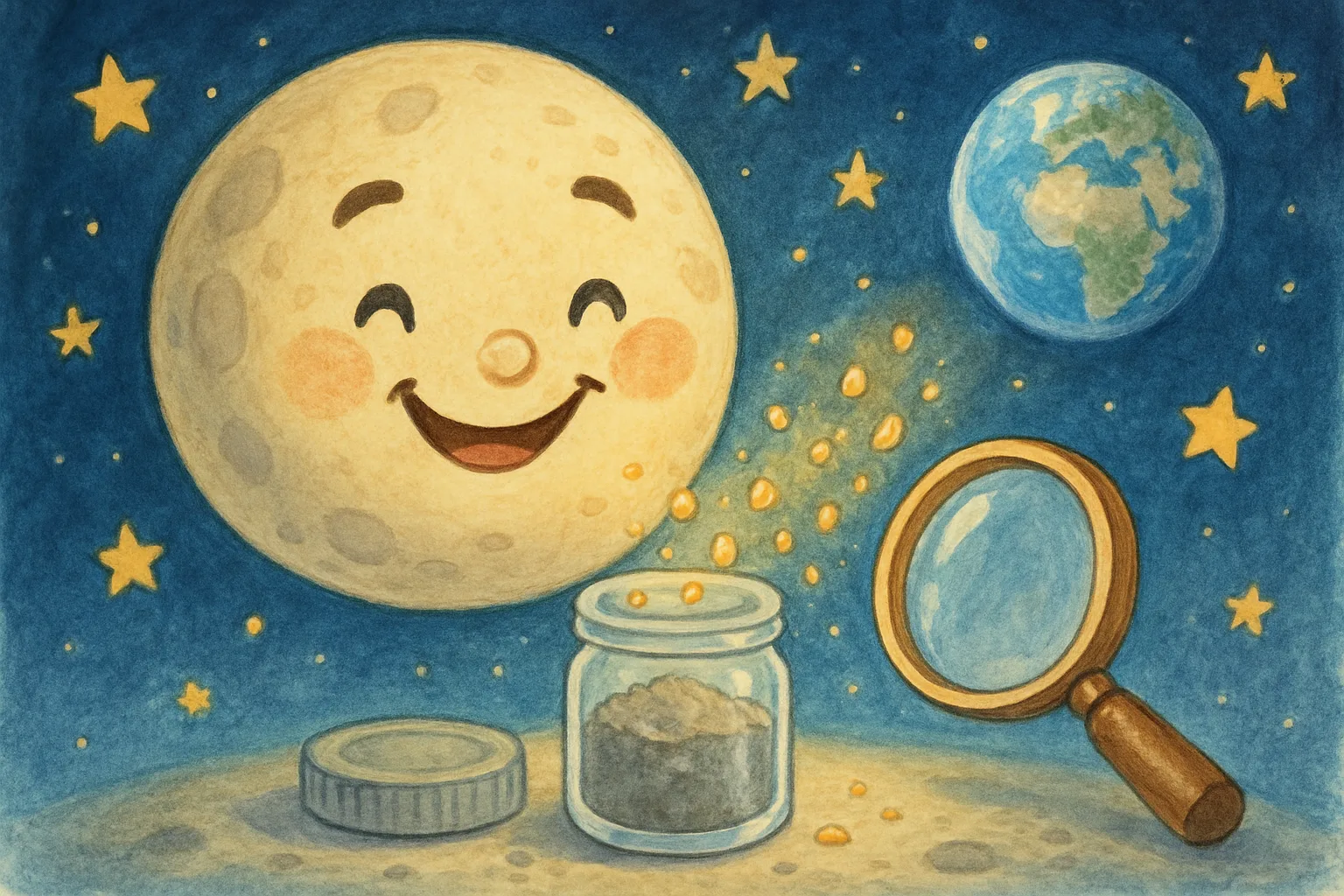
Scientists studying moon soil from China’s Chang’e-6 mission have found something brand new: a magnetic mineral that has never been seen before in natural Moon samples. The tiny mineral may act like a frozen record of the Moon’s ancient magnetic past. It is like finding an old diary hidden inside a grain of sand.
What Happened?
In 2024, China’s Chang’e-6 spacecraft did something extraordinary. It landed on the far side of the Moon — the side that always faces away from Earth — and scooped up a bag of soil. Then it flew that soil all the way back to Earth. No mission had ever returned samples from the Moon’s far side before.
Scientists around the world have been studying that precious dirt ever since. This week, a team from the Chinese Academy of Sciences announced a remarkable find inside the soil. Tucked inside tiny pieces of impact glass — that is glass formed when a space rock smashes into the Moon’s surface at high speed, melting the rock and turning it into glass — they discovered a form of iron called gamma iron, or γ-Fe.
This type of iron is a bit unusual. Normally, it only exists at very high temperatures — about as hot as the inside of a volcano. When things cool down, it usually changes into a different form. But inside the Moon’s impact glass, it somehow stayed in its high-temperature shape even after cooling. Scientists think the glass, along with tiny amounts of carbon and other materials, acted like a protective bubble that kept the iron locked in place.
Here is the exciting part: this special iron is magnetic. The Moon no longer has a global magnetic field today, but it used to — billions of years ago. Scientists think this tiny mineral may have frozen a record of that ancient magnetism inside itself, the way a photograph captures a moment in time. Each particle is only about 140 nanometers across — roughly 700 times smaller than a single human hair.
The discovery was published in the scientific journal Proceedings of the National Academy of Sciences.
Why Does It Matter?
The Moon’s ancient magnetic field disappeared long ago, and scientists still do not fully understand why. Finding minerals that preserve old magnetic signals — even incredibly tiny ones — is like discovering clues from a crime scene that happened billions of years ago. The more clues scientists collect, the better they can reconstruct what the early Moon was like. That also helps us understand how rocky planets, including Earth, change over billions of years.
Big Words
- Mineral — a naturally formed solid with a specific structure, like salt crystals or the iron in your blood; rocks are made of minerals
- Impact glass — glass created when a space rock crashes into the Moon at enormous speed, creating heat that melts the rock and rapidly cools into glass
- Magnetic field — an invisible force produced by magnets and some planets that pushes or pulls on certain metals; Earth’s magnetic field protects us from solar radiation
- Nanometer — an incredibly tiny unit of measurement; one nanometer is about 100,000 times thinner than a single sheet of paper
- Far side of the Moon — the half of the Moon that always faces away from Earth; we can only see it from spacecraft
Fun Fact
The Chang’e-6 mission brought back about 1.9 kilograms (around 4 pounds) of Moon soil from the far side — roughly the weight of a full water bottle. Scientists are finding new discoveries in that tiny sample all the time!
Think About It
If you could bring back a sample from anywhere in the solar system to study on Earth, where would you choose — and what do you hope you might find inside it?
Sources
- ScienceDaily / Chinese Academy of Sciences — ‘Chang’e-6 lunar soil contains a surprising magnetic time capsule’
- The Brighter Side of News — ‘Chang’e-6 samples reveal a form of magnetic iron never before found on the Moon’
- Shafaqna English — ‘Chang’e-6 lunar soil reveals rare magnetic mineral’
- EurekaAlert / Chinese Academy of Sciences — ‘Moon’s farside holds magnetic secrets’