
🔎 This story is still developing. We will update it as we learn more!
Storm Stops the Moon Hunt! China’s Chang’e-7 Rocket Stays on the Ground
Quick Summary
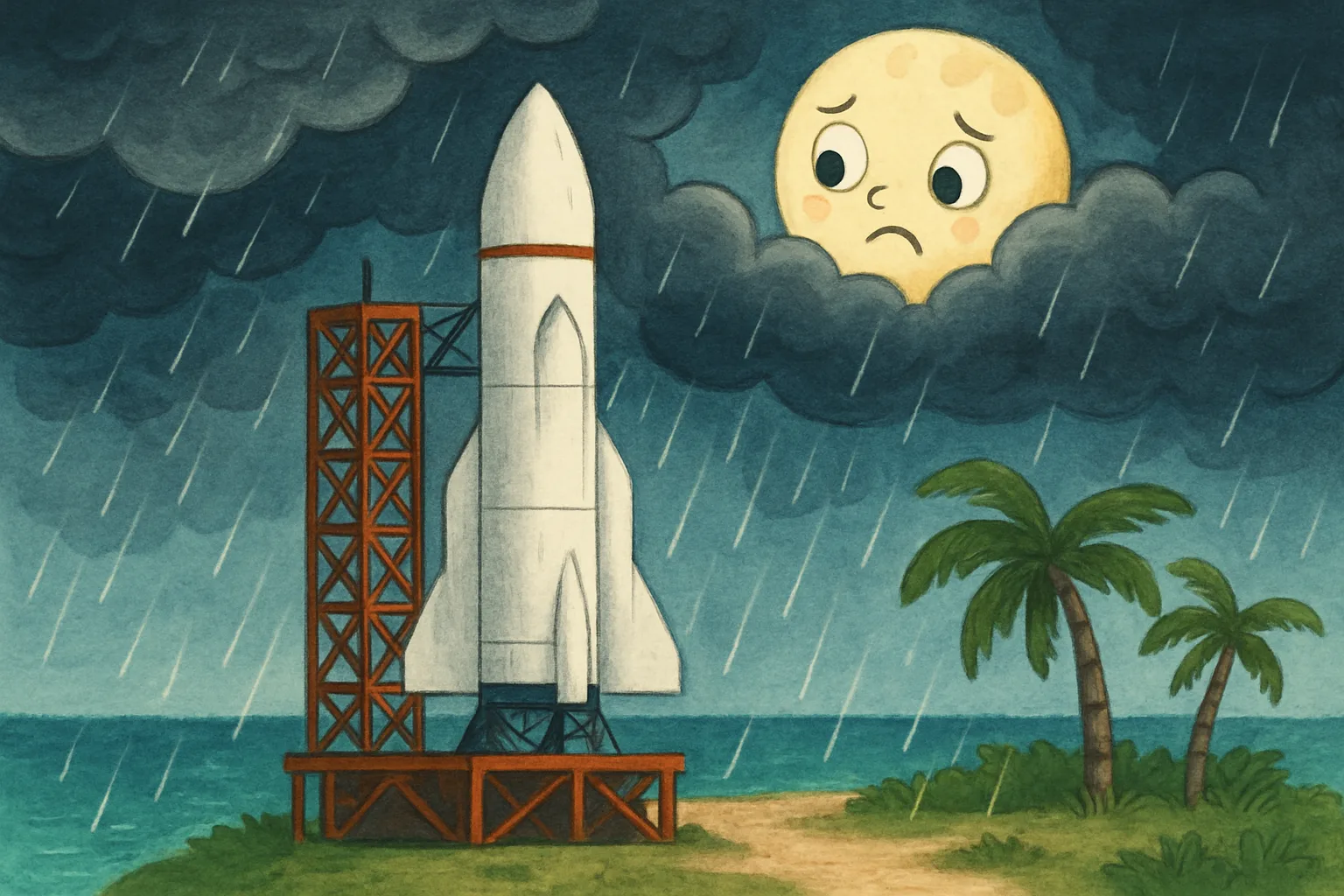
China’s Chang’e-7 spacecraft was ready to fly to the Moon today — but a tropical storm had other plans. The mission is now delayed by at least a month, and scientists are waiting for a new launch date.
What Happened?
For months, space fans around the world had circled today — August 24, 2026 — on their calendars. That was the day China’s Chang’e-7 spacecraft was supposed to blast off on a big mission to the Moon.
But a tropical storm named Narra moved in and ruined the plan. Narra churned through the Gulf of Tonkin, the stretch of water right next to Hainan Island. That is the island where China’s Wenchang Space Launch Site is located. With strong winds and rough weather swirling nearby, launching a rocket became too risky.
China’s space agency announced that Chang’e-7 “does not meet the conditions for launch.” The rocket and spacecraft are safe. They are still sitting on the launch pad, waiting for better days.
Thailand also had a special reason to be disappointed. Its scientists built a scientific instrument called CE-7 MATCH and bolted it right onto the Chang’e-7 spacecraft. That instrument is fine — it is tucked safely inside and will be ready to go when the mission eventually launches.
The delay is tricky for another reason. Getting to the Moon’s south pole is not like driving to the grocery store — you cannot just leave whenever you feel like it. The Sun, Earth, and Moon all have to line up in just the right way. Scientists think the next good launch window is about a month away. Some reports suggest the mission might even wait until 2027.
Why Does It Matter?
Chang’e-7 is one of the most exciting Moon missions ever planned. It carries an orbiter, a lander, a rover, and a tiny hopping probe — four spacecraft in one! Think of it like a Swiss Army knife for exploring the Moon.
The mission’s biggest goal is hunting for water ice. Scientists believe frozen water is hiding inside permanently shadowed craters near the Moon’s south pole. Those craters never see sunlight — they are as cold as -250°C, colder than anywhere on Earth. If water ice is confirmed there, future astronauts could use it for drinking, growing food, and even making rocket fuel. It could be like finding a gas station on the Moon.
Countries around the world are watching closely. The United States, India, and others are also planning to send missions to the lunar south pole. The race to understand — and eventually use — the Moon’s resources is heating up.
Big Words
- Launch window — a specific period of time when the position of Earth, Moon, and Sun makes it possible to travel between them efficiently
- Lunar south pole — the bottom tip of the Moon, where sunlight never reaches the inside of deep craters
- Water ice — frozen water trapped in super-cold, permanently shadowed areas on the Moon
- Rover — a robot vehicle that can drive across the surface of a moon or planet and send back data
- Hopping probe — a small robot that can jump short distances, allowing it to leap into shadowed craters that a rover cannot safely roll into
Fun Fact
The craters near the Moon’s south pole that may hold water ice have been cold and dark for more than two billion years — that is longer than complex animal life has existed on Earth!
Think About It
If you were designing a mission to find water on the Moon, what other tools or instruments would you want to bring along?
Sources
- Space.com — Bad weather delays launch of China’s historic Chang’e 7 mission to moon’s south pole
- SpaceNews — China delays Chang’e-7 lunar south pole landing mission launch
- The Nation Thailand — Storm Narra delays Chang’e-7 and Thailand’s CE-7 MATCH
- OAN — China postpones launch of Chang’e-7 in quest to find water on the moon