
A Mystery in the Forest! Chimps Have Been Throwing Rocks at the Same Trees for Over Ten Years
Quick Summary
Scientists studying chimpanzees in West Africa have discovered something very surprising. The chimps keep returning to the same trees and throwing rocks at them, again and again, for more than a decade. No one is completely sure why — but researchers think it might be a kind of culture, something chimpanzees pass down and share with each other.
What Happened?
Imagine walking through a forest in Guinea-Bissau, a small country on the west coast of Africa. You spot a tree — but something is strange. The bark is covered in dents and scars. And at the bottom of the tree, there is a pile of rocks.
Who put them there?
Chimpanzees did. And they have been doing it for years.
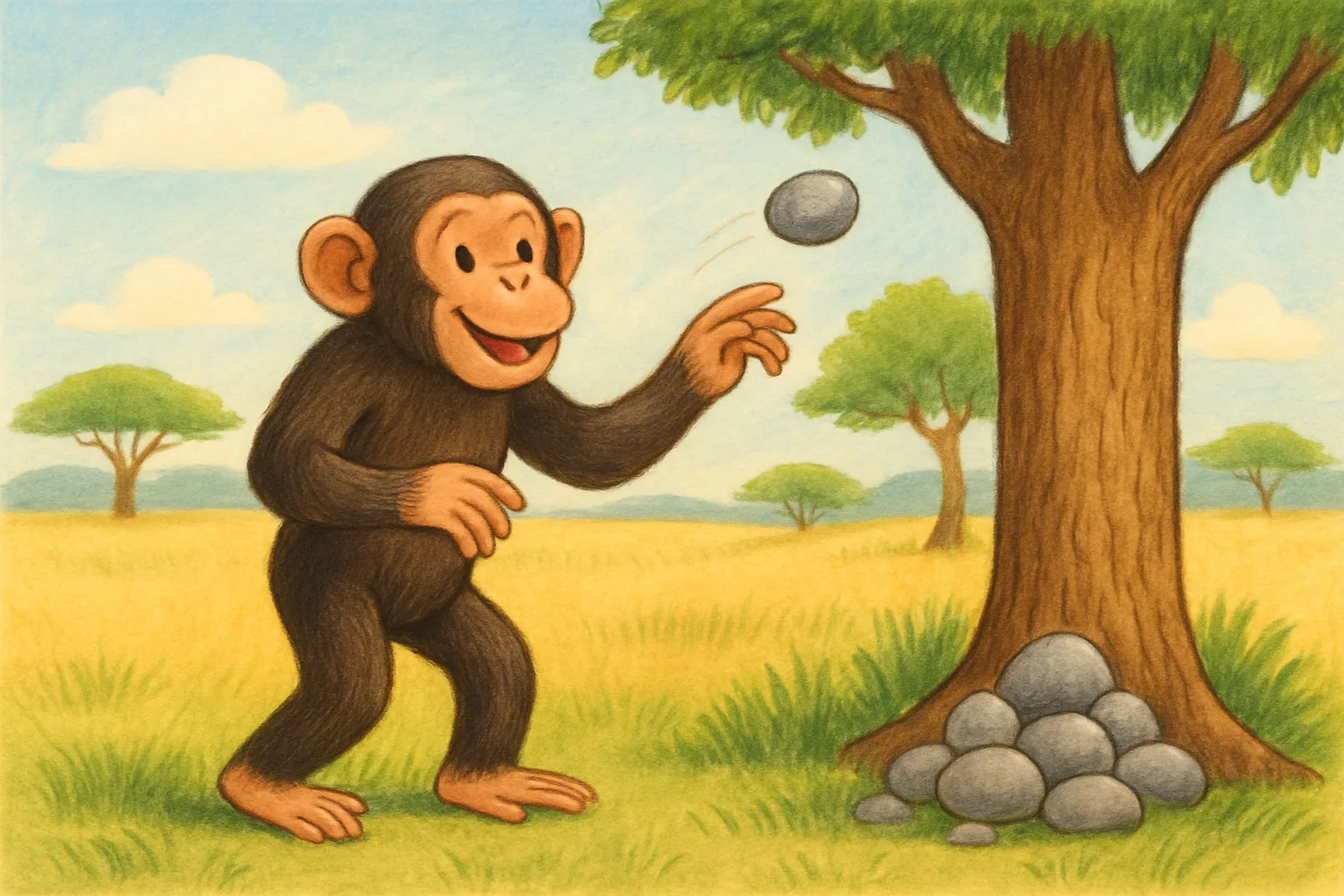
Scientists set up special cameras in the forest called camera traps. These cameras film animals without any humans nearby. The footage showed something remarkable. Adult male chimpanzees would walk up to a specific tree, pick up a rock, and hurl it at the trunk — sometimes with one hand, sometimes with both. Then they would walk away. Later, another chimp would return and do the same thing.
Over many years, the rocks piled up at the base of the trees. Some of these stone piles have been growing for more than ten years.
While throwing, the chimps often make a loud, whooping call. Scientists call this a “pant hoot” — a booming sound chimps use for long-distance communication, the way you might shout to a friend across a big field.
The behavior has now been observed in several different groups of wild chimpanzees in West Africa. But no one has ever seen chimps doing this anywhere else in the world — not in East Africa, not in zoos, nowhere.
Why Does It Matter?
Chimpanzees are our closest animal relatives. Scientists already know they use tools — they poke sticks into termite mounds to fish out a snack, and they use rocks to crack open nuts. But those behaviors are all about finding food.
This rock throwing has nothing to do with food. The chimps are not hungry. They are not chasing away a predator. They are not playing a game. They are doing something that has no obvious purpose anyone can figure out.
That is exactly what makes it so exciting.
Researchers think it could be a form of culture — a behavior that chimps learn from watching each other and pass down through groups, just like how humans pass down traditions and customs. It could be a way of marking territory, like putting up a signpost. Or it might be something even more complex and hard for us to understand.
Scientists are now using cameras and sound recorders to find out more about who throws the rocks, and how nearby chimps react when they hear the sound.
Big Words
- Primatologist — a scientist who studies primates, the group of animals that includes monkeys, apes, and humans
- Camera trap — a camera set up in the wild that automatically takes photos or videos when an animal walks by
- Pant hoot — the loud, rising call that chimpanzees make to communicate over long distances, almost like a shout
- Culture — behaviors, traditions, or knowledge that are learned and shared within a group, rather than being instinctive
- Accumulative — building up over time; in this case, rocks that keep piling up as more chimps visit the same spot
Fun Fact
These mysterious stone piles look a lot like cairns — stacks of rocks that humans have been building for thousands of years as landmarks, memorials, or sacred markers. The chimp piles are not stacked neatly, but the similarity has made some scientists wonder if the two behaviors could share a deep history.
Think About It
If chimpanzees really do have their own cultural traditions, what does that tell us about the difference between humans and other animals? Can you think of a tradition your family or community has that might seem mysterious to an outside observer?
Sources
- ScienceDaily — Chimpanzees have been hurling rocks at the same trees for more than a decade (Aug 28 2026)
- University of Zurich / The Conversation — Accumulative stone throwing in chimpanzees (Aug 28 2026)
- Smithsonian Magazine — Chimps May Be Performing Rituals at ‘Shrine Trees’