
No Eyes, No Problem! Scientists Find China’s First-Ever Cave Snail
Quick Summary
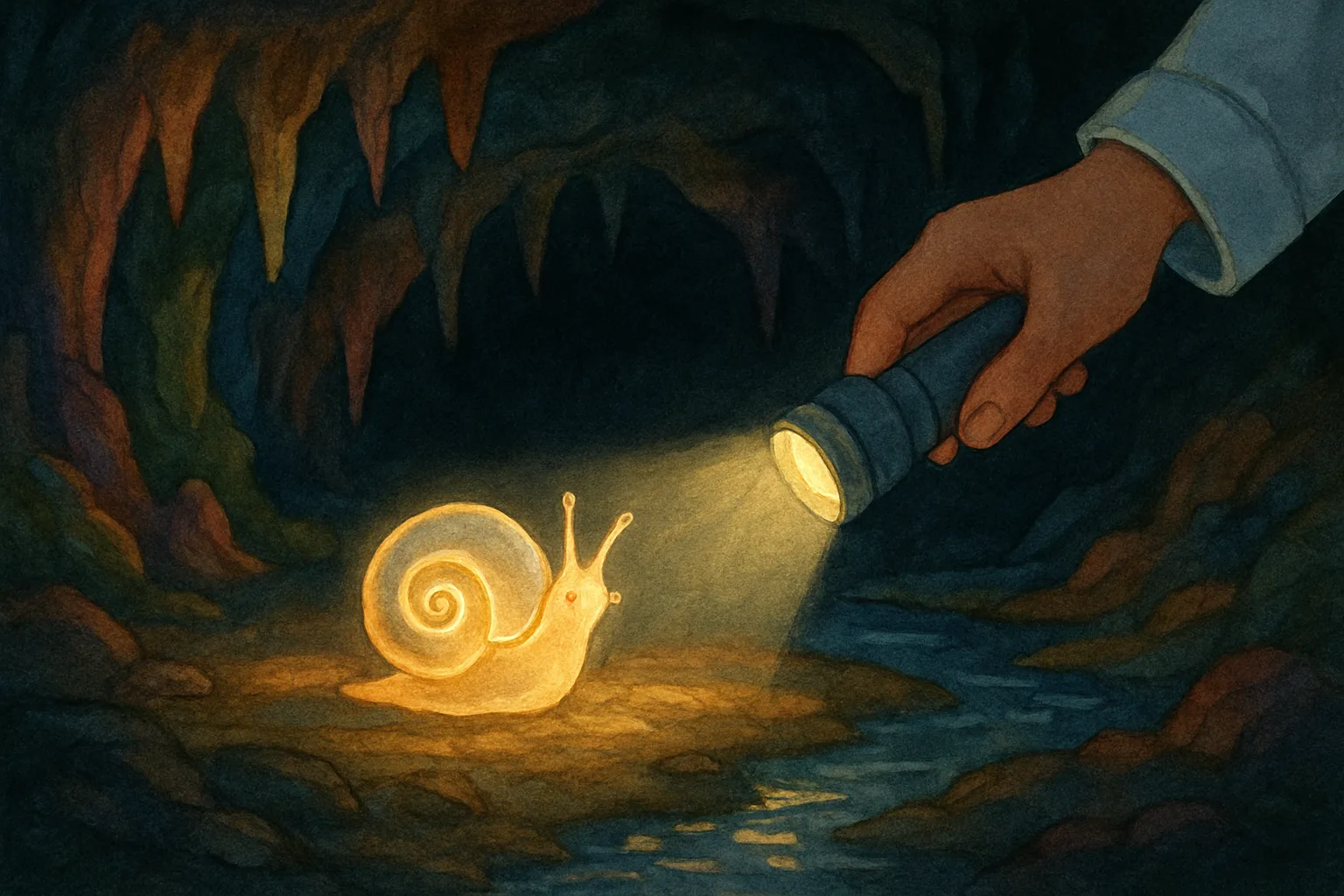
Deep inside a mountain cave in southwestern China, scientists found a tiny snail that has never been recorded before. It has no eyes, nearly no color, and a shell so thin you can almost see through it. It is the first freshwater cave snail ever found in all of China!
What Happened?
A team of researchers from several Chinese universities found the snail in a cave in Yunnan Province — a mountainous region in southwest China famous for its rich wildlife and ancient landscapes.
The cave sits more than 2,000 meters above sea level. That is higher than any mountain in the entire eastern United States. For a snail that loves cold, dark underground streams, this is a record-setting home.
The snail is tiny — its shell measures about 1 millimeter across. That is smaller than a sesame seed. You could fit a whole crowd of these snails on your fingernail.
Scientists named it Erhaia dijiang. The second part of the name — “dijiang” — comes from Di Jiang, a mysterious creature from ancient Chinese mythology. In the famous old book Classic of Mountains and Seas, Di Jiang is described as a faceless mountain god. That is a perfect fit for a tiny snail that has no eyes and lives in complete darkness!
The snail has evolved over a very long time to survive without sunlight. It has no eyes at all. Its body has no pigment, meaning it has almost no color — it looks pale and ghostly. Its shell is so thin that light passes right through it.
In the lab, scientists watched the snails carefully hide under rocks whenever a light was turned on. They are perfectly adapted for a life of total darkness.
So far, researchers have only found three living adults and one empty shell. That makes this one of the rarest animals scientists have ever officially described.
The cave where they live is fed by underground water that stays at a steady temperature near 20 degrees Celsius (68°F) all year long. The snails graze on tiny algae called diatoms that grow on the cave rocks — like a miniature underwater lawn.
The discovery was published in the journal Subterranean Biology.
Why Does It Matter?
China has thousands of caves across its limestone mountain regions. But until now, scientists had never found a freshwater cave snail there. This discovery opens up a whole new chapter in understanding what kinds of creatures live in underground waters in East Asia.
Cave animals are special. Because they are cut off from the outside world — like tiny islands underground — they can evolve in surprising directions, losing features they do not need (like eyes) and developing sharper senses they do.
Scientists are now calling for urgent cave surveys across China to search for more hidden species. The tiny snail also needs protection. With only three individuals known, even a small disturbance to its cave could wipe it out forever.
Big Words
- Troglobiont — an animal that lives its whole life underground and is specially adapted to survive there
- Karst — a landscape made of dissolved limestone rock, full of caves, sinkholes, and underground rivers
- Pigment — the natural coloring in skin, feathers, or shells that gives animals their color
- Diatom — a type of tiny algae that grows as a film on rocks and is eaten by many small water creatures
- Endemic — found only in one specific place in the world and nowhere else
Fun Fact
Cave animals that lose their eyes over many generations often develop other super-senses to replace their sight. Some cave fish can detect tiny water vibrations. Some cave spiders have an amazingly powerful sense of touch through their legs!
Think About It
If you had to live in complete darkness for your whole life, what extra senses do you think would be most useful to have? How might your body change over thousands of generations?
Sources
- SciTechDaily — Only Three Are Known To Exist: China’s Mysterious Eyeless Cave Snail (Aug. 9, 2026)
- Phys.org — Mythical mountain god inspires name for China’s first freshwater cave snail (Aug. 4, 2026)
- bioengineer.org — China’s First Cave-Dwelling Freshwater Snail Named for Mythical Mountain God
- blog.pensoft.net — China’s First Cave-Dwelling Freshwater Snail Named After A Mythical Mountain God
- Mirage News — China Names First Cave Snail After Mythical Mountain God