
Stick the Landing! China’s Private Rocket Pulls Off a History-Making Touchdown
Quick Summary
On the night of August 18, a Chinese rocket company called LandSpace launched its Zhuque-3 rocket into space — and then brought part of it safely back to Earth. It was the first time a private Chinese company ever landed an orbital rocket booster. This is a big deal for the future of spaceflight!
What Happened?
LandSpace is a private space company based in Beijing, China. On August 18, they launched their Zhuque-3 rocket from the Jiuquan Satellite Launch Center, a spaceport in the Gobi Desert in northwest China.
The rocket had two parts, called stages. The top part carried a satellite all the way into orbit — that’s the main job. But here’s the cool part: the bottom part, called the first stage or booster, flew back down to Earth on its own.
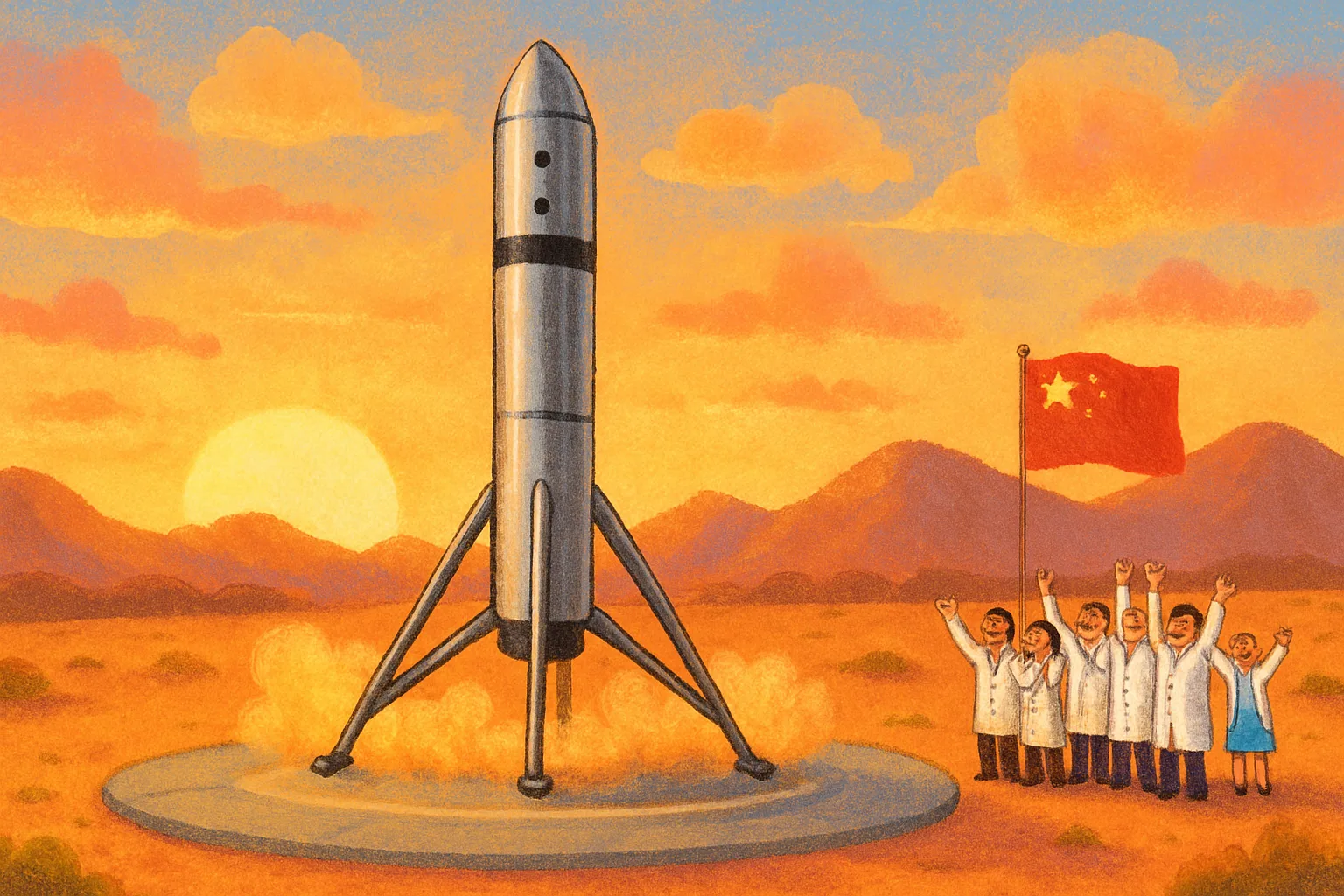
The booster fired its engines to slow down, popped out four landing legs, and touched down gently on a landing pad about 390 kilometers away from the launch site. That’s roughly the same distance as driving from New York City to Boston!
The landing was smooth and the rocket stayed perfectly upright. Engineers watching from mission control cheered.
This was only the second time Zhuque-3 had ever flown. On its very first flight back in December 2025, LandSpace tried the same landing — but it didn’t work. The team went back, studied what went wrong, and fixed it. This time, everything went right.
Why Does It Matter?
When rockets are used once and then thrown away, spaceflight is extremely expensive. Imagine buying a brand-new airplane, flying it once, and then tossing it in the ocean! That’s how rockets used to work.
But when a rocket can land and be reused — like an airplane — it becomes much cheaper and faster to reach space. SpaceX’s Falcon 9 rocket pioneered this idea, and now LandSpace has joined that small club.
LandSpace is now only the second private company in the world to successfully land an orbital rocket booster. China also becomes the only country with BOTH a government rocket AND a private company rocket that can land and be reused. That’s a first for any nation on Earth.
More reusable rockets mean more countries can afford to send satellites, science experiments, and one day people into space.
Big Words
- Booster — the powerful bottom section of a rocket that launches everything into the sky
- Orbital — going all the way around the Earth, which takes much more energy than just flying up and coming back down
- Reusable — able to be used again, like a reusable water bottle instead of a throw-away one
- Landing legs — folding metal legs that pop out from the rocket’s sides so it can stand upright when it lands
- Stage — one section of a rocket; big rockets have multiple stages that separate during flight
Fun Fact
The Zhuque-3 rocket runs on liquid methane and liquid oxygen as fuel — the same combination used by SpaceX’s Starship! Methane burns very cleanly, which makes engines easier to reuse without a lot of gunk building up.
Think About It
If rockets can be reused again and again, how might that change who gets to go to space someday — and what kinds of things people might launch?
Sources
- Space.com — Touchdown! Private Chinese rocket aces landing on 2nd-ever flight
- SpaceNews — China’s Landspace recovers booster with second orbital launch of Zhuque-3 rocket
- NASASpaceFlight.com — Zhuque-3 Completes Second Flight with Successful First-Stage Landing
- China-in-Space.com — LandSpace Recovers China’s Second Rocket Booster, Deploys Demo Satellite