
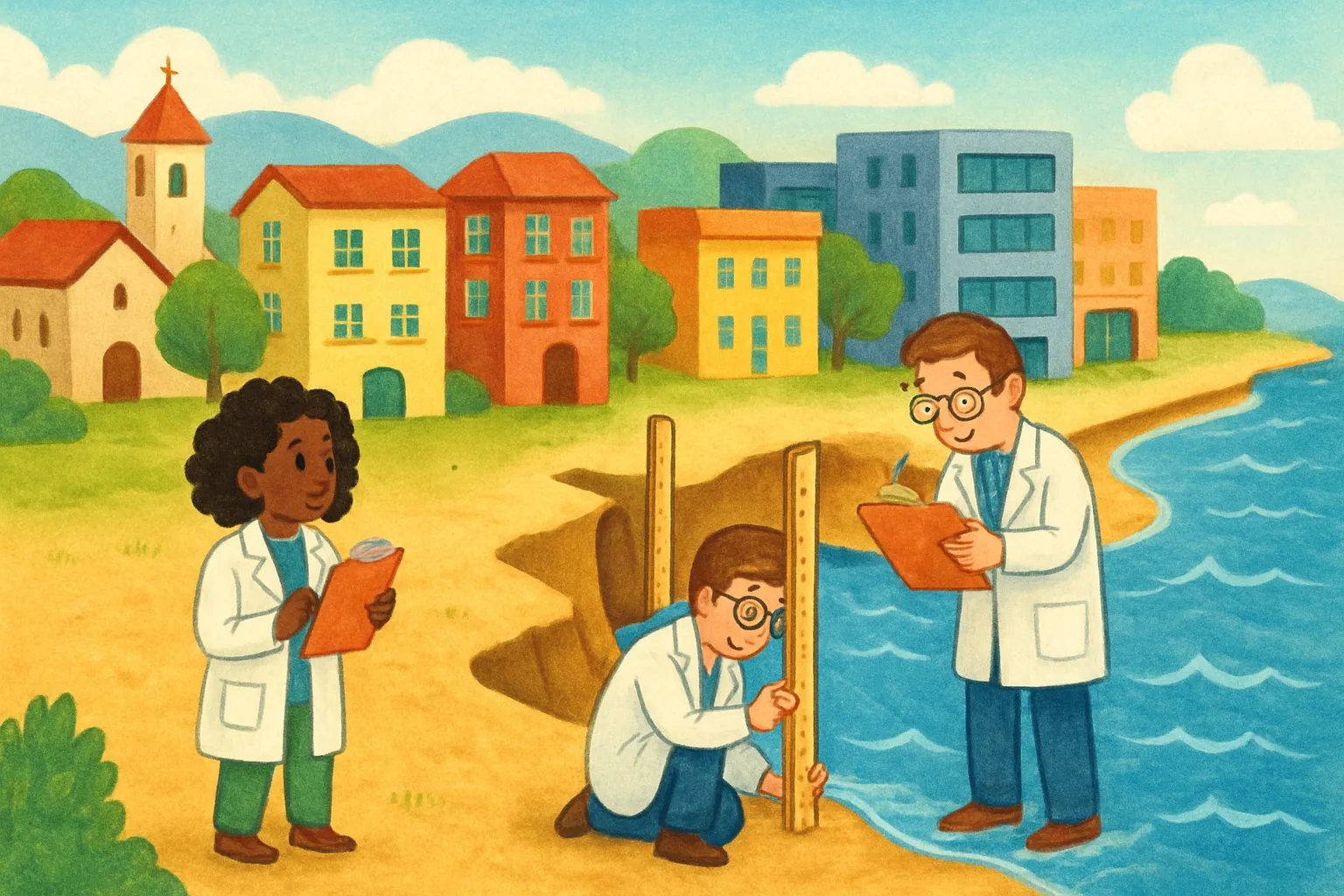
Double Trouble! Some Cities Are Sinking AND the Seas Are Rising
Quick Summary
Scientists have discovered that millions of people living in coastal cities are facing a double problem. The ocean is rising because of climate change. But at the same time, the land underneath many cities is quietly sinking. A brand-new study published this week explains just how serious this double threat really is.
What Happened?
Researchers from the Technical University of Munich in Germany and Tulane University in the United States published a major new study in a top science journal called Nature Communications.
They looked at coastal cities all around the world — big, crowded places near the ocean where millions of people live and work. They found something surprising and important.
Globally, the ocean is rising by about 3 millimeters per year because of climate change. That is roughly the thickness of two stacked pennies each year. It sounds tiny, but over decades it adds up.
But in many busy coastal cities, the ground itself is also sinking — sometimes much faster than the sea is rising. When you add these two movements together, the flood risk gets much worse.
In the most crowded coastal areas, residents are experiencing a combined water-level rise of about 6 millimeters per year. That is nearly three times the global average for coastlines.
Why is the ground sinking? Cities pump enormous amounts of groundwater — underground water — out of the earth for drinking and industry. Think of it like squeezing a wet sponge: when water leaves the ground, the soil shrinks and compacts. Heavy buildings, roads, and construction also press down on the earth over time.
Countries like Bangladesh, Indonesia, Nigeria, Egypt, China, and Thailand are among those most affected. Cities like Jakarta, Indonesia, and Bangkok, Thailand, are sinking especially fast.
Why Does It Matter?
Coastal cities are home to hundreds of millions of people. Flooding is already a risk in many of these places during storms or high tides. If the land keeps sinking and the seas keep rising, that risk grows bigger every decade.
The good news is that scientists now have much better maps of exactly where the problem is worst. That means city planners, engineers, and governments can focus their attention and resources on the places that need the most help.
Some cities are already taking action. They are building better flood barriers, planting wetlands that absorb floodwater, and rethinking how much groundwater they pump out of the earth.
Knowing about a problem is the first step to solving it — and this research gives communities around the world a powerful tool to plan for a safer future.
Big Words
- Subsidence — the slow sinking or caving in of a patch of ground, often caused by water being pumped out from below
- Groundwater — water stored underground in cracks and pores in rock and soil, which people pump out for drinking, farming, and industry
- Relative sea-level rise — the actual rise in water level that a specific place experiences, which combines both ocean rise AND land sinking
- Compaction — when soil or sediment is squeezed together and takes up less space, often because water has left it
- Coastal — anything relating to the area where land meets the sea or ocean
Fun Fact
Jakarta, Indonesia — one of the world’s largest cities — has sunk more than 13 feet (4 meters) in some neighborhoods over the past 30 years! The Indonesian government is even building a brand-new capital city further inland partly because of this problem.
Think About It
If you were designing a city from scratch near the ocean, what are two things you would do differently to make sure it stayed safe from flooding?
Sources
- ScienceDaily / Technical University of Munich — ‘Some coastal cities are sinking faster than the ocean is rising’
- HUN-REN TKI — ‘Some coastal cities are sinking faster than the ocean is rising’
- Nature Communications (DOI: 10.1038/s41467-026-72293-z) — published study