
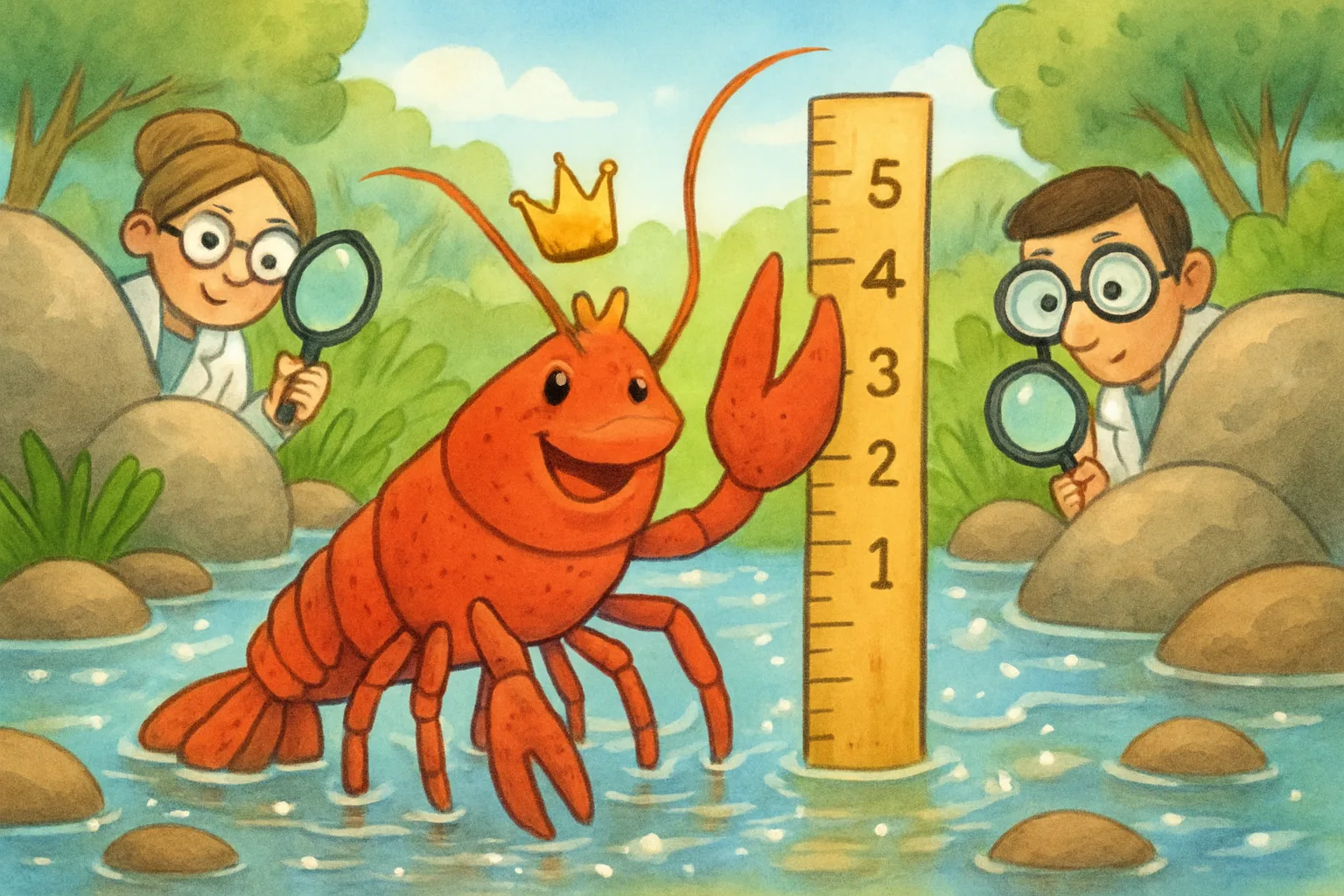
Crawzilla! Scientists Hunt Down North America’s Biggest Freshwater Crayfish
Quick Summary
A scientist in Kentucky pulled a massive crayfish out of the mud — and thought she had found the world record. That sparked a friendly scientific contest. Researchers searched museums across the country, and the results were surprising.
What Happened?
In 2023, scientist Caitlin Bloomer was doing a wildlife survey in Kentucky. She reached into a muddy burrow and pulled out an enormous crayfish. Its species is actually nicknamed the “Crawzilla Crawdad.” Bloomer was sure she had caught the biggest crayfish anyone had ever seen.
She was wrong — but just barely.
She brought her catch back to the University of Illinois to brag to her colleague. He took one look and told her he had caught bigger ones. That friendly argument turned into a real scientific quest.
Bloomer and her team reached out to museums and scientists across North America. They asked everyone to measure their largest crayfish specimens. In the end, they compared 60 giant crayfish from nine major collections.
The winner? A Tennessee bottlebrush crayfish from a collection at West Liberty University in West Virginia. Its shell — measured from the tip of its head to where its tail begins — was 3.4 inches (86.6 millimeters) long. That’s about as long as a credit card! With its tail, claws, and antennae, the whole creature stretched nearly as wide as a sheet of notebook paper.
Bloomer’s Crawzilla? It came in at about 3.05 inches — still good enough to make the top 20 list.
Why Does It Matter?
This was not just a fun competition. The scientists published their results in the scientific journal Ecology. They discovered something puzzling: almost all of North America’s biggest crayfish seem to stop growing around the 3.1-inch (80 millimeter) mark.
That is strange, because crayfish never stop growing during their whole lives. So why does there seem to be a size limit? Scientists are not sure yet. They looked at temperature, oxygen levels, and habitat, but could not find a clear answer. The mystery continues!
For comparison, the world heavyweight champion is the Tasmanian giant freshwater crayfish, found in Australia. It can grow to 4.7 inches — about the length of a TV remote.
Big Words
- Carapace — the hard shell that covers the head and chest of a crayfish or lobster, like a suit of armor.
- Specimen — a single example of a plant or animal collected and kept for scientific study.
- Survey — a careful look around an area to count and identify which animals and plants live there.
- Ecology — the scientific study of how living things interact with each other and with their environment.
- Species — a group of living things that are alike and can have babies together.
Fun Fact
Crayfish are freshwater relatives of lobsters. In different parts of the United States, people call them crawfish, crawdads, or mudbugs — but they are all the same creature!
Think About It
If you were a scientist searching for the world’s biggest animal of any kind, which creature would you want to find a record-breaker for — and where would you look?
Sources
- Earth.com — North America’s biggest crayfish reveals a strange mystery about size
- Phys.org — Biologists battle over North America’s largest crayfish
- Nautilus — Behold, Crawzilla, the Not-Quite-Biggest Crayfish Ever Caught
- SciTechDaily — Crawzilla: Scientists Just Found North America’s Biggest Known Crayfish