
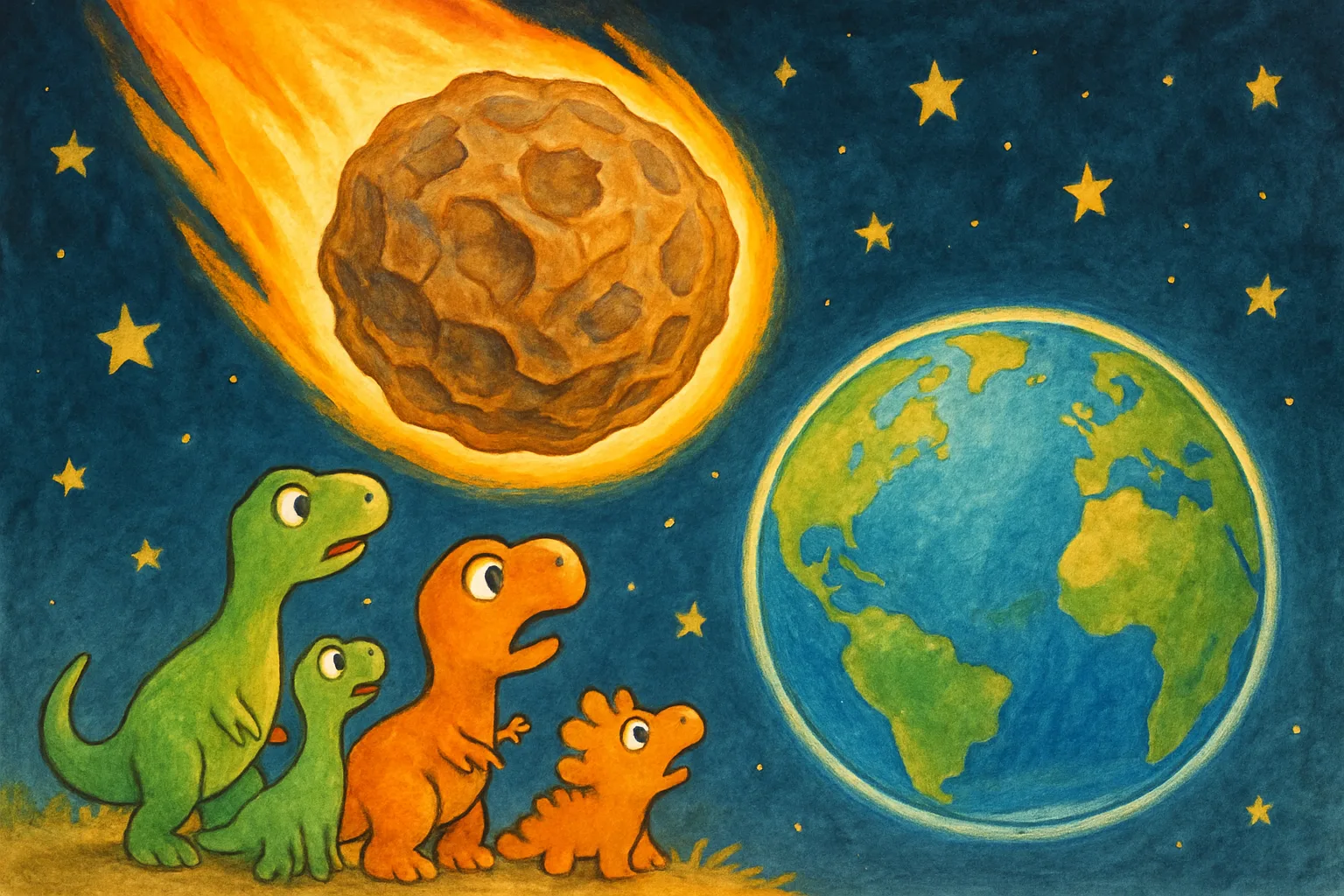
Case Closed? Scientists Finally Figure Out What Kind of Rock Killed the Dinosaurs
Quick Summary
Scientists have solved a long-standing mystery: they now know the exact type of space rock that crashed into Earth 66 million years ago and wiped out the dinosaurs. It was a super-rare kind of meteorite called a CO chondrite. This changes what we thought we knew about how the extinction happened.
What Happened?
About 66 million years ago, a giant rock from space crashed into what is now Mexico’s Yucatán Peninsula. The impact was catastrophic. Scientists estimate the rock was between 10 and 15 kilometers wide — roughly the length of Manhattan Island. It was traveling at about 64,000 kilometers per hour, which is 50 times faster than a speeding bullet.
The crash created a crater 200 kilometers wide and triggered the end of the age of dinosaurs. About 75 percent of all species on Earth went extinct shortly after. Birds survived because they are related to certain dinosaurs. But every large, non-bird dinosaur — from T. rex to Triceratops — was gone.
Scientists have known for years that an asteroid caused this extinction. But they did not know exactly what kind of asteroid it was. Now they do. An international team from the University of British Columbia, along with researchers in Paris, Brussels, and Vienna, solved the mystery using a clever trick: they studied the nickel locked inside ancient clay.
When the asteroid hit Earth, it completely vaporized. The entire rock turned to dust and gas in an instant. That dust fell all over the world, leaving behind a thin layer of clay that scientists can still find today — in Denmark, Spain, and Italy, among other places. By measuring a type of nickel locked inside that clay, the scientists could match it to a specific type of meteorite.
The match pointed to a CO chondrite. These are among the rarest and most ancient types of space rock. They make up a tiny fraction of the meteorites found on Earth. They are also very dry and low in sulfur — a clue that turned out to be important.
Why Does It Matter?
For years, scientists thought the sulfur inside the asteroid helped cause a deadly “nuclear winter” that blocked sunlight and killed plants after the impact. But CO chondrites are very low in sulfur. This means the sulfur from the rock itself was probably not the main killer.
Instead, scientists now believe the main culprit was enormous amounts of fine dust blasted into the atmosphere from the pulverized Earth’s crust. That dust blocked the Sun for months or years, causing temperatures to plunge worldwide and plants to die. The dinosaurs were very, very unlucky to be hit by such a rare and unusual space rock from a distant part of the solar system.
Big Words
- Meteorite — a piece of rock from space that has fallen to Earth’s surface
- CO chondrite — an exceptionally rare type of ancient meteorite full of tiny round pebbles called chondrules; the “CO” stands for Carbonaceous Ornans, named after a town in France where one was found
- Isotope — a slightly different version of an element; like cousins in a family, isotopes of nickel are all nickel but weigh slightly different amounts — and scientists can use those differences like a fingerprint
- Vaporize — to turn instantly into gas; the asteroid was moving so fast it completely vaporized on impact
- Extinction — when every single member of a species dies out and they disappear from Earth forever
Fun Fact
The thin layer of clay left behind by the Chicxulub impact can be found on almost every continent on Earth. Scientists call it the KT boundary layer, and it marks the exact moment in rock history when the dinosaurs disappeared.
Think About It
If the asteroid had been a more common type with lots of sulfur, would scientists have figured out what happened sooner — or would that have changed how the extinction happened?
Sources
- ScienceDaily / University of British Columbia — Scientists identify the rare meteorite that killed the dinosaurs
- phys.org — Researchers identify class of ‘oddball’ meteorite that killed the dinosaurs
- Discover Magazine — The Dinosaur-Killing Asteroid May Have Come From a Rare Class of Meteorites
- Sci.News — Dinosaurs May Have Been Wiped Out by ‘Oddball’ Space Rock
- The Brighter Side of News — The asteroid that killed the dinosaurs was more odd than expected