
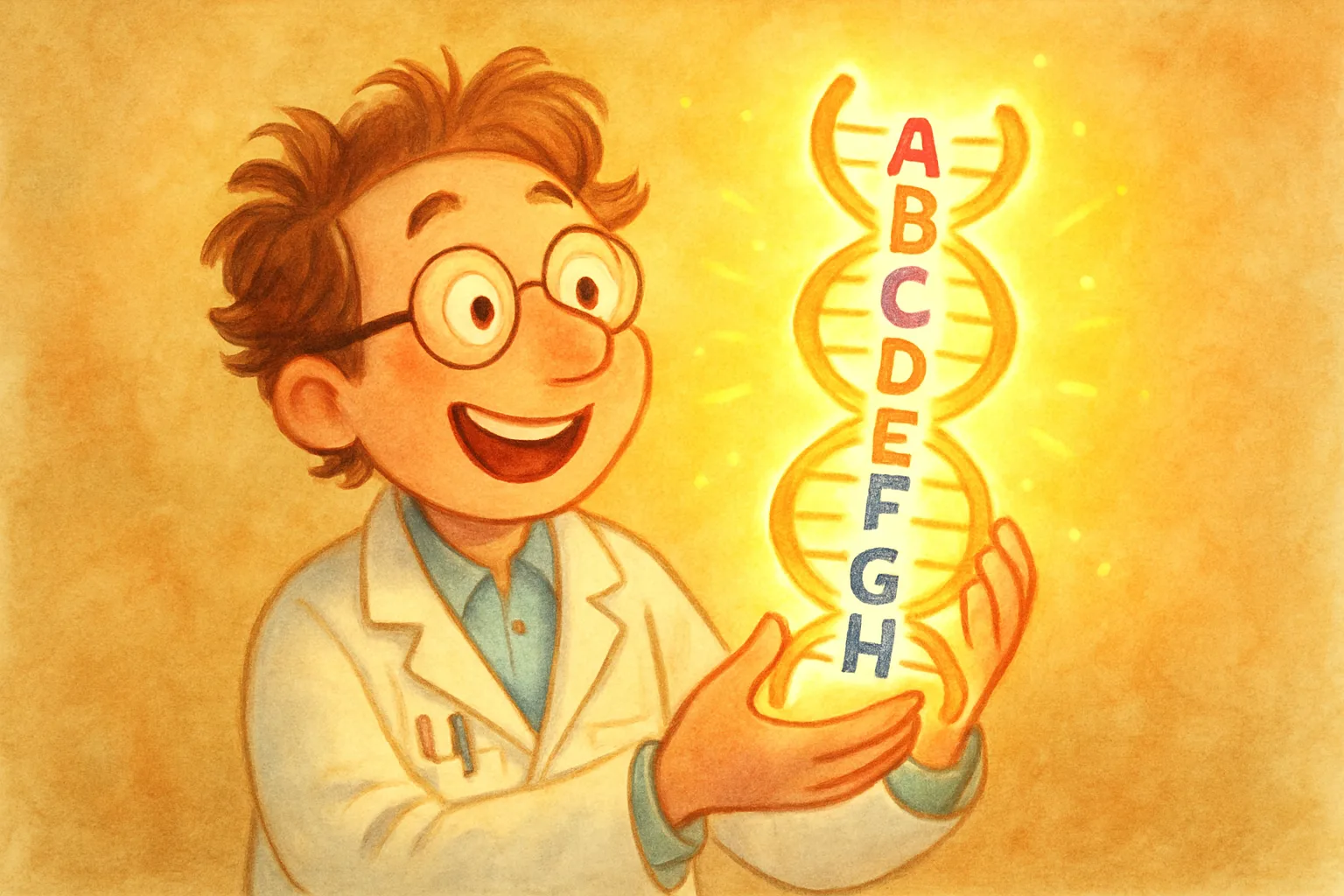
Life Has Always Used 4 Letters. Scientists Just Made 8 Work!
Quick Summary
Every living thing on Earth — from a blade of grass to a blue whale — uses the same four-letter code to store its instructions. Scientists at UC San Diego just showed that a key body enzyme can read a brand-new eight-letter version of that code. It’s one of the biggest steps forward in the science of life itself.
What Happened?
Inside every cell is a long instruction manual called DNA. Scientists describe DNA using just four letters: A, T, C, and G. Those four letters get read, copied, and used to build everything in your body — your hair, your heart, your eyeballs.
Now, a team at the University of California San Diego has created an expanded version with eight letters instead of four. Think of it like upgrading a keyboard. Normally you have four keys. The scientists added four brand-new keys — and then asked whether the cell could still type with them.
The answer? Yes! The team discovered that an important enzyme called RNA polymerase can accurately read all eight letters. An enzyme is a tiny protein that does a job inside your body, like a little worker robot. RNA polymerase’s job is to read DNA and copy it. It turns out this worker robot can handle the new letters just as well as the original four.
The researchers used a powerful camera called cryo-electron microscopy to zoom in and watch the enzyme work in real time. That camera can see details smaller than a single atom — like using a magnifying glass so powerful it could read the writing on a grain of sand.
The study was published in the scientific journal Nature Communications.
Why Does It Matter?
This discovery is a huge step for a field called synthetic biology — the science of building new living things and new medicines. If cells can use an expanded code, scientists may one day be able to give them new instructions they’ve never had before.
Imagine being able to program a cell to make a medicine that doesn’t exist in nature, or to build materials stronger than anything we’ve ever seen. That’s what scientists dream about with an eight-letter alphabet.
Right now, the team hasn’t built a whole living thing with eight letters. They’ve shown the door is open. That’s how big discoveries work — first you find the door, then you walk through it.
Big Words
- DNA — the instruction manual inside every cell that tells it how to grow and work
- Enzyme — a tiny protein in your body that does a specific job, like a microscopic worker robot
- RNA polymerase — the specific enzyme that reads DNA and copies its instructions
- Synthetic biology — the science of designing or re-engineering living things in a lab
- Cryo-electron microscopy — a super-powerful camera that can see details smaller than a single atom by freezing samples
Fun Fact
The four-letter DNA code has been the same in every living creature for roughly 3.5 billion years — since the very first life appeared on Earth! That’s longer than dinosaurs, longer than fish, longer than almost anything we can imagine.
Think About It
If scientists could add four new letters to the code of life, what new ability or feature would you want to program into a living thing — and why?
Sources
- UC San Diego Today — Breakthrough Helps Expand Genetic Alphabet
- Phys.org — Eight-letter DNA alphabet is accurately transcribed by a natural enzyme
- ScienceDaily — Life uses 4 DNA letters. Scientists just made 8 work
- Sense About Science — RNA polymerase shown to read eight-letter genetic alphabet in UC San Diego studies