
🔎 This story is still developing. We will update it as we learn more!
Wings in Space! America’s New Spaceplane Is Almost Ready to Fly
Quick Summary
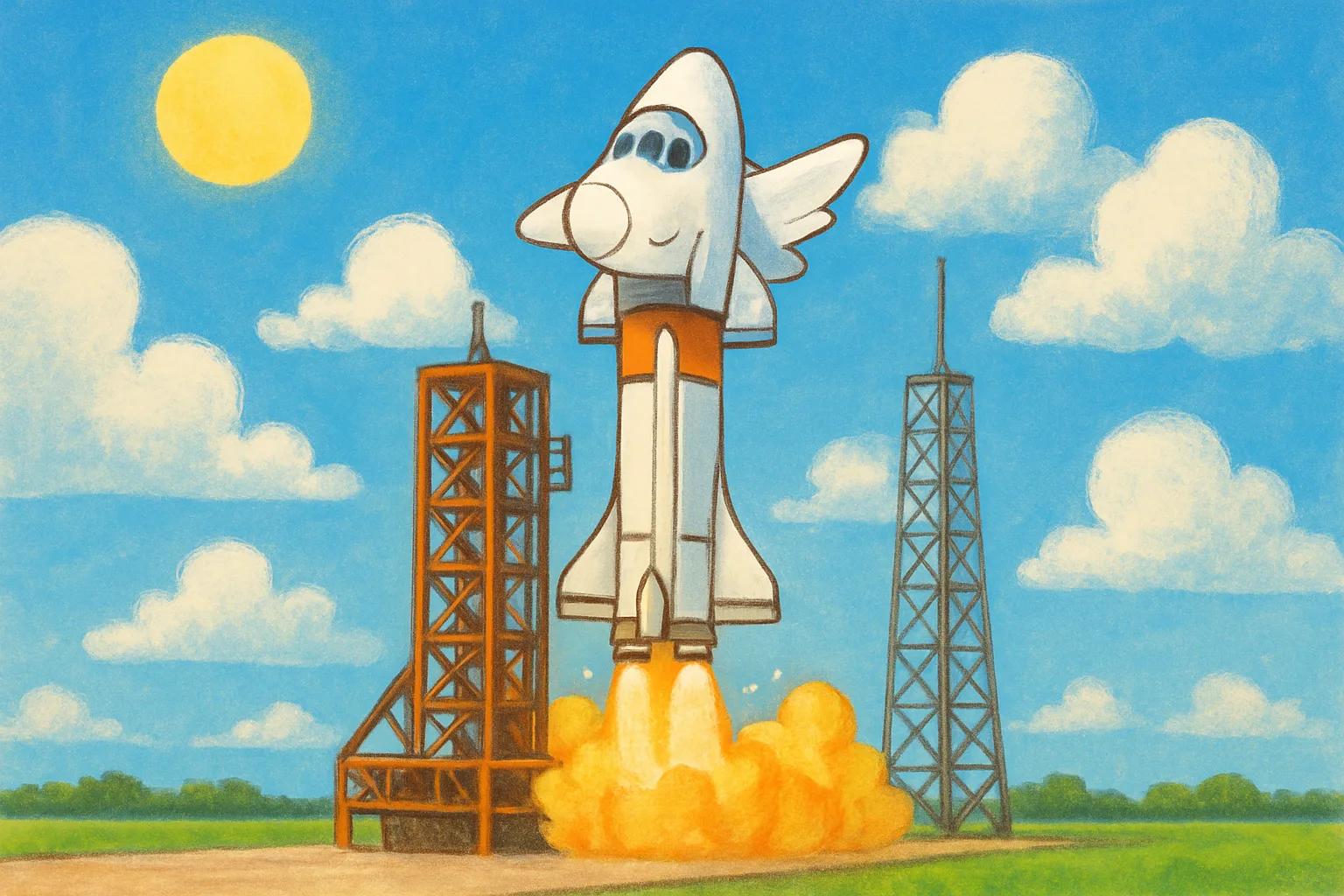
A brand-new kind of spacecraft called Dream Chaser is getting ready for its first trip to space. It looks like a tiny version of the old Space Shuttle. If everything goes to plan, it will launch before the end of 2026 — making history as America’s first winged spacecraft to fly in more than a decade.
What Happened?
For more than ten years, a company called Sierra Space has been building a special spacecraft. It is called Dream Chaser, and it is unlike any spacecraft flying today.
Most spacecraft that carry supplies to space look like capsules — round pods that parachute into the ocean when they come home. Dream Chaser is different. It has wings. It launches on top of a rocket, travels through space, and then glides back to Earth and lands on a runway — just like an airplane.
Imagine a school bus shrunk down to one-quarter the size of the old Space Shuttle. That is roughly how big Dream Chaser is. It is about nine meters long — shorter than a city bus — but it is designed to carry thousands of pounds of cargo.
Dream Chaser has finished a long list of difficult tests. Engineers checked how it handles loud rocket noises during launch. They tested whether its electronics survive being around other machines that produce radio waves. They even towed it around a runway to make sure it handles correctly on the ground.
The spacecraft is now targeted to launch no earlier than late 2026 from Cape Canaveral in Florida. It will ride into space on a United Launch Alliance rocket called Vulcan Centaur. This first trip will be a solo practice flight. Dream Chaser will spend about 45 days orbiting Earth on its own, then glide back and land on a runway. It is a test to show that the whole system works before future cargo missions.
Why Does It Matter?
Spaceplanes that land on runways can be reused more easily than capsules that splash into the ocean. That could make future space missions cheaper and quicker to turn around. Sierra Space also hopes Dream Chaser could one day carry experiments — or even people — to future space stations.
The Space Shuttle retired in 2011. Since then, no winged spacecraft from the United States has flown to orbit. If Dream Chaser launches successfully, it will end that 15-year gap and open a new chapter for reusable spacecraft.
The launch date has not been set exactly yet — engineers are still completing final checks — but the team says they are on track for a year-end liftoff.
Big Words
- Spaceplane — a spacecraft that has wings and can land on a runway, like a mix between a rocket and an airplane.
- Vulcan Centaur — a powerful new American rocket built by United Launch Alliance, designed to launch heavy payloads into space.
- Free-flyer — a spacecraft that travels through space on its own, without docking to a space station.
- Reusable — able to be used again after returning from a mission, instead of being thrown away.
- Orbit — the curved path a spacecraft travels around the Earth, kept in place by gravity and speed working together.
Fun Fact
Dream Chaser got its name from the idea of chasing humanity’s dreams into space. Its first spacecraft is called Tenacity — a word that means never giving up, which perfectly matches the ten-plus years it took to build it!
Think About It
What do you think would be the best thing to ship to space on a winged cargo spacecraft — scientific experiments, food, tools, or something else entirely?
Sources
- SpaceflightNow — Launch Schedule, NET Q4 2026 Vulcan Centaur • Dream Chaser 1
- Sierra Space press release — Dream Chaser Spaceplane Successfully Completes Critical Pre-flight Milestones
- Wikipedia — Dream Chaser Tenacity / SSC Demo-1
- Autoevolution — Dream Chaser Spaceplane Moves One Step Closer to First Launch
- Earth.com — NASA’s Dream Chaser ‘mini shuttle’ has a flight schedule change