
A Space Telescope Found the Universe’s Oldest ‘Cosmic Lighthouses’!
Quick Summary
Europe’s Euclid space telescope has spotted 31 of the oldest objects ever found in the universe. Two of them set a new record — they are the most ancient quasars ever seen. These incredible objects were shining when our universe was less than 700 million years old.
What Happened?
Scientists announced this week that the Euclid space telescope — launched in 2023 by the European Space Agency, with help from NASA — discovered 31 ancient objects called quasars.
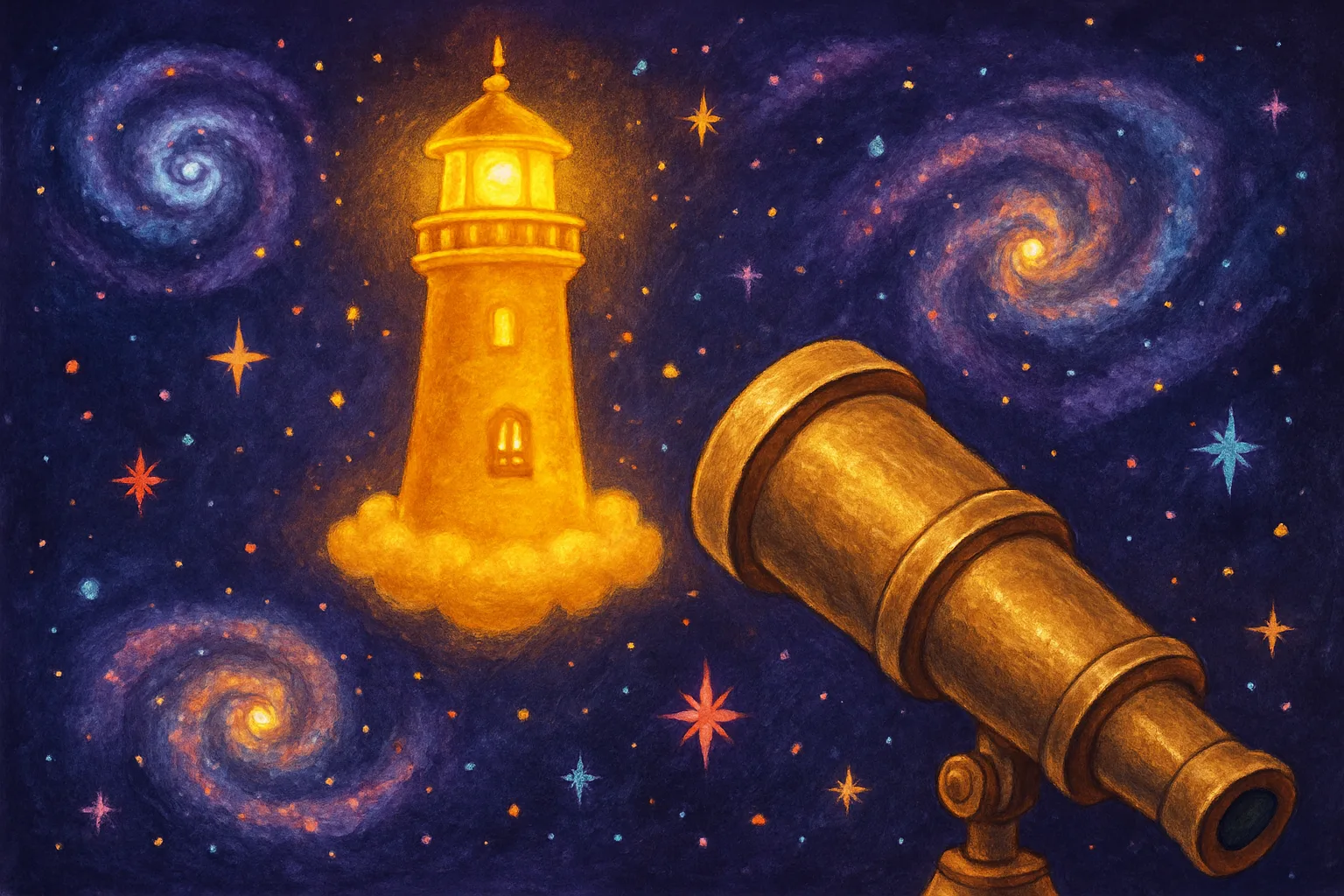
A quasar is a little like a cosmic lighthouse. It is the super-bright center of a young galaxy. At the center sits a giant black hole millions or even billions of times heavier than our Sun. When huge amounts of material swirl into that black hole, like water going down a drain, it releases a stunning flash of energy. That flash can shine hundreds to thousands of times brighter than an entire galaxy filled with billions of stars.
The two most distant quasars in this discovery are record-breakers. Their light has been traveling through space for more than 13 billion years to reach us. That means we are seeing them as they looked when the universe was only about 670 million years old — just 5% of its current age of about 13.8 billion years.
To imagine how long ago that was: if the entire history of the universe were squeezed into one calendar year, these quasars were shining back in January — and we are now in December.
Finding them was a huge challenge. These quasars are very rare and very far away. Their ancient light has been stretched into infrared — a type of light our eyes cannot see. They can look just like ordinary nearby stars, which makes them easy to miss. Euclid’s powerful cameras are especially good at spotting exactly this kind of faint, stretched-out light across enormous areas of sky.
Scientists at the Keck Observatory in Hawaii have already confirmed 21 of the 31 new quasars through follow-up observations.
Why Does It Matter?
Finding quasars this old is a little like finding the very first campfires lit by humans — they tell us what conditions were like at the very beginning. Scientists have wondered for a long time how supermassive black holes could grow so huge so quickly in the early universe. These newly discovered quasars are important clues.
Euclid is just getting started. It is mapping more than one-third of the entire sky. Astronomers expect it to find many more ancient objects hiding in the data — possibly breaking these records again.
Big Words
- Quasar — an extremely bright core of a young, distant galaxy, powered by a supermassive black hole swallowing enormous amounts of material.
- Black hole — a region of space where gravity is so strong that nothing, not even light, can escape from it.
- Infrared — a type of light that is invisible to human eyes but can be detected by special cameras; it has longer wavelengths than visible red light.
- Galaxy — a huge collection of stars, gas, and dust held together by gravity; our own galaxy is called the Milky Way.
- Redshift — the way light from very distant objects is stretched to longer (redder) wavelengths as the universe expands, which tells scientists how far away something is.
Fun Fact
The two record-breaking quasars shine with the light of a trillion Suns — that is a one followed by twelve zeroes!
Think About It
If you could build a telescope powerful enough to see the very first light that ever existed in the universe, what do you think you might find?
Sources
- ESA — Euclid discovers the most ancient quasars in the Universe
- NASA Science Blog — ESA’s Euclid Space Telescope Finds Universe’s Most Ancient Quasars
- EarthSky — Euclid finds the most ancient quasars in the universe so far
- Phys.org — Euclid discovers the most ancient quasars in the universe