
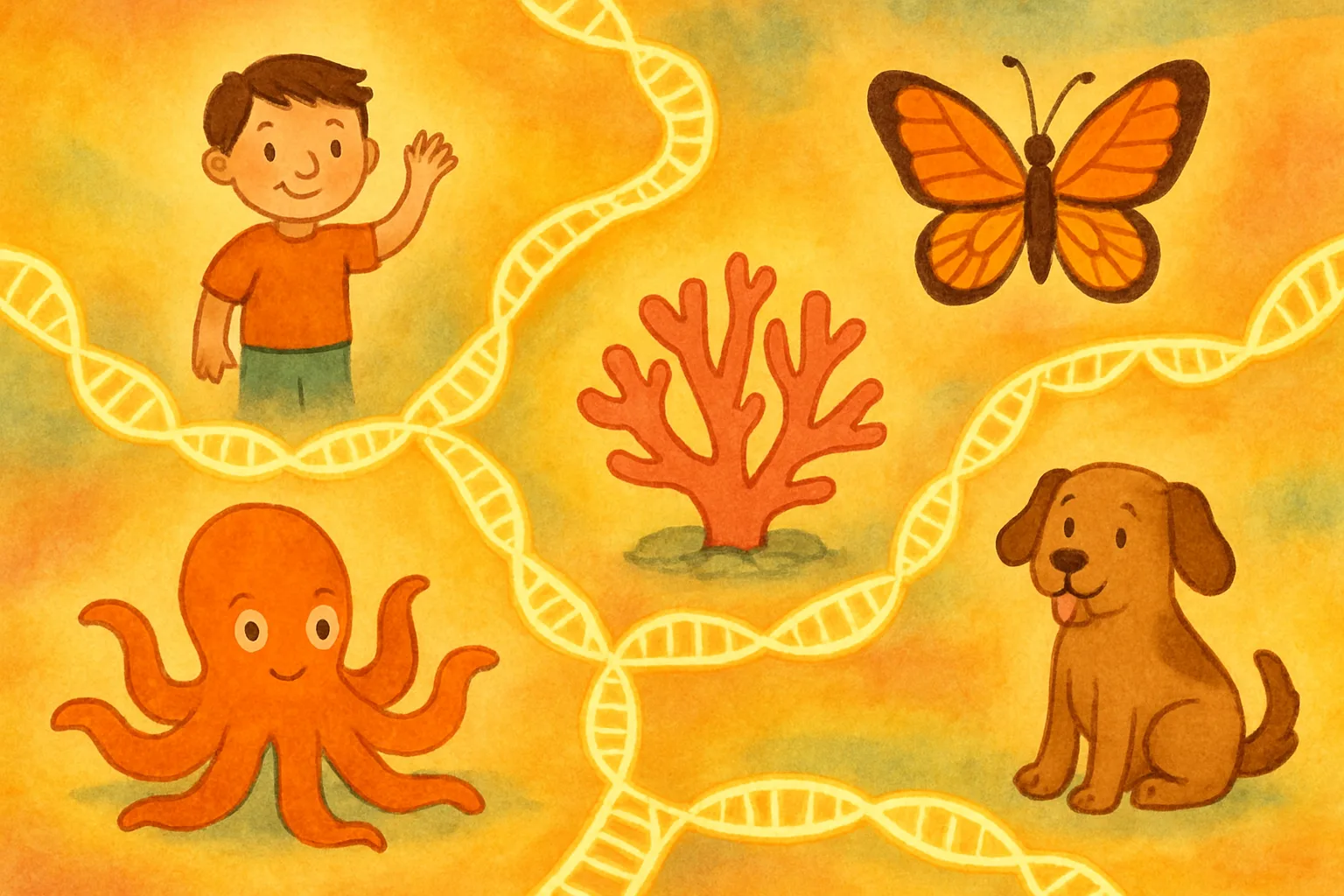
Secret DNA Road Map! Scientists Just Charted How All Animals Are Connected
Quick Summary
Scientists compared the DNA of more than 4,400 animal species and made a stunning find. All animals — from humans and octopuses to corals and butterflies — share ancient DNA patterns that have been changing for more than 600 million years. And those changes follow a small set of hidden “evolutionary highways.”
What Happened?
Inside every living cell are tiny thread-like structures called chromosomes. They carry the instructions — the DNA — that help build and run a living body. Scientists have long known that different animals have different sets of chromosomes. But until now, no one had ever compared the chromosomes of thousands of species all at once.
A team of scientists from the University of Vienna, in Austria, decided to try. They gathered genetic data on 5,821 chromosome-scale genomes. That means detailed maps of chromosomes for 4,454 different species, drawn from 19 major animal groups. The study was published in the journal Science Advances.
They built a new tool — like a giant diagram — to place all these different genomes on one big map. What they found was surprising. Chromosomes don’t change randomly. Instead, over millions of years, they seem to travel along a limited number of paths. The scientists called these paths “evolutionary highways.”
Here’s what that means. When two chromosomes fuse together, their genes get reshuffled — mixed up like a deck of cards. Scientists discovered that once this happens, it almost never gets undone. It is a one-way journey. And the same kinds of journeys have happened over and over again in different animals throughout history.
Imagine there are only a few roads connecting major cities. No matter how far apart two cities are, travelers must use those same roads. DNA evolution works in a similar way. Different animals may have taken different journeys, but they all traveled on the same small set of roads through history.
A human and an octopus look completely different. But deep inside their cells, both still carry echoes of the same ancient ancestor that lived more than 600 million years ago. The new map makes it possible to trace those echoes across almost the entire animal kingdom.
Why Does It Matter?
This is the largest-ever comparison of its kind across the animal world. Scientists say the new map could help protect endangered species. By understanding which animals have truly unique chromosome patterns, conservationists can spot which species are irreplaceable — ones that cannot be rebuilt by evolution if they go extinct.
The research could also help scientists predict how animal genomes might continue to change in the future. Think of it like a weather forecast, but for DNA.
Big Words
- Chromosome — a thread-like structure inside a cell that carries an animal’s DNA instructions; humans have 46 of them
- Genome — the complete set of DNA instructions for a living thing, like a full instruction manual written in a chemical code
- Evolution — the slow process by which living things change over many generations, driven by changes in their DNA
- Evolutionary highway — the scientists’ name for the limited set of paths that animal chromosomes seem to follow when they change over millions of years
- Phylum — a major grouping of animals that share a basic body plan; for example, all animals with backbones belong to one phylum
Fun Fact
A human and an octopus both inherited parts of their chromosomes from the same ancestor — a tiny, soft-bodied creature that lived in ancient seas more than 600 million years ago. That’s older than the dinosaurs by hundreds of millions of years!
Think About It
If all animals are connected through ancient DNA that goes back 600 million years, what does that tell us about how all life on Earth is related?
Sources
- Phys.org — Animal genomes follow irreversible ‘evolutionary highways’ across thousands of species, August 22, 2026
- Newswise / University of Vienna — Roadmap of animal biodiversity: largest-ever comparison of chromosome-scale genomes, August 19, 2026
- ScienceDaily — Scientists find hidden ‘highways’ guiding animal evolution, August 25, 2026
- AZO Life Sciences — Study Traces Animal DNA Along Irreversible Evolutionary Highways, August 21, 2026