
Cosmic Glow! Scientists Hear a Planet 64 Light-Years Away for the Very First Time
Quick Summary
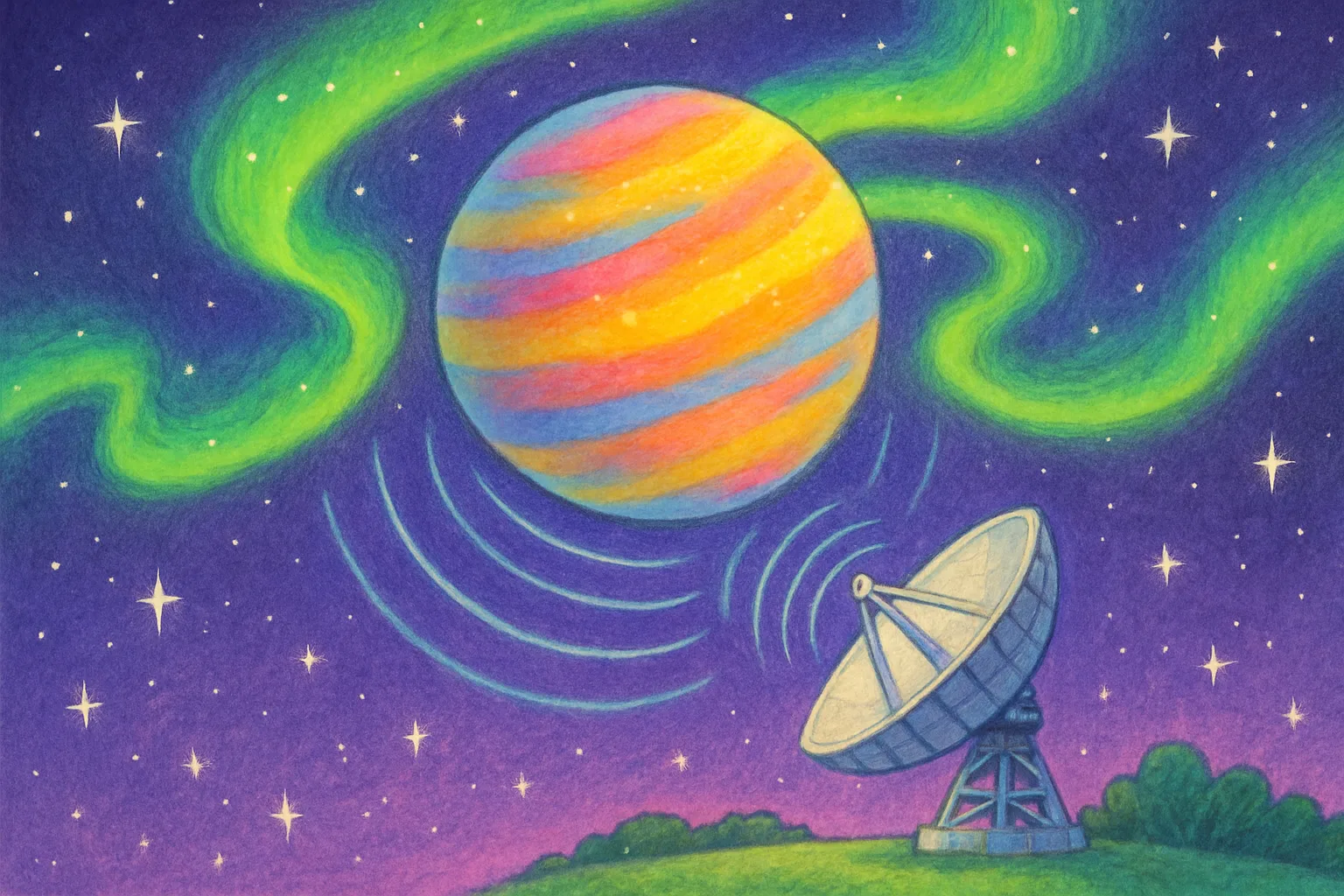
Scientists have picked up a radio signal coming directly from a planet outside our solar system for the very first time. The planet is called Beta Pictoris b, and it is 64 light-years away. The signal is not from aliens — it comes from the planet’s own glowing auroras!
What Happened?
You have probably heard of the Northern Lights — that beautiful colorful glow you can sometimes see in the night sky near the North Pole. Those lights are called auroras. They happen when tiny charged particles from the Sun crash into Earth’s magnetic field and release energy as light.
Now scientists have discovered that a planet far, far outside our solar system makes auroras too. And those auroras produce radio waves — the same kind of invisible waves that carry music to your radio at home.
A team of researchers from Harvard, the Smithsonian Institution, and the University of Oregon used the MeerKAT telescope in South Africa to listen to the skies. MeerKAT is made up of 64 separate radio dishes that all work together as one giant ear — like putting 64 megaphones together to hear a very faint sound.
The planet they were listening for is named Beta Pictoris b. It is a gas giant, kind of like Jupiter — but about 10 to 12 times bigger. They spotted short, repeating radio bursts from that planet across four separate listening sessions in 2025 and 2026.
This is the first time scientists have ever been sure that a radio signal came from a single planet outside our solar system — and not just from the nearby star.
Why Does It Matter?
This discovery tells scientists something brand new: they can now measure a planet’s magnetic field from far away using radio waves. A magnetic field is like an invisible force field around a planet. Earth’s magnetic field protects us from harmful radiation from the Sun — like a giant invisible umbrella.
Beta Pictoris b has an extremely powerful magnetic field — far stronger than Jupiter’s. This opens a whole new way to study faraway planets. One day, scientists might even use this method to look for planets with magnetic fields strong enough to protect life.
The research has been shared online but has not yet been reviewed by other scientists in a journal, so experts will keep studying the results.
Big Words
- Exoplanet — A planet that orbits a star other than our Sun
- Aurora — Colorful lights in a planet’s sky caused by charged particles hitting its magnetic field (on Earth, we call them the Northern or Southern Lights)
- Radio waves — A type of invisible energy that travels through space; the same kind used by your radio, TV, and Wi-Fi
- Magnetic field — An invisible force field around a planet, created by its core, that can protect it from harmful space radiation
- MeerKAT — A powerful radio telescope in South Africa made of 64 linked dish antennas
Fun Fact
Light travels at about 186,000 miles per second — the fastest speed in the universe. Even so, the radio waves from Beta Pictoris b took 64 years to reach us. That means the signal left that planet around the time your grandparents were young!
Think About It
Earth has a magnetic field that protects life on our planet. If scientists find another planet with a similar magnetic field, what else would they need to check before deciding whether life could exist there?
Sources
- Phys.org — Astronomers detect radio signals coming from an exoplanet for the first time
- ScienceAlert — Astronomers Detect Radio Signals Coming Directly From an Exoplanet For The First Time
- Newsweek — Scientists Detect Radio Signal from Exoplanet: Here’s What That Means
- IBTimes UK — Astronomers Detect the First Direct Radio Signal From an Exoplanet