
Brain Maps! Scientists Discover That Depression Looks Five Different Ways Inside the Brain
Quick Summary
Scientists in Finland studied the brains of hundreds of people with depression. They found something surprising: there are actually five different patterns of brain activity hiding under the same diagnosis. This discovery could one day help doctors find the right treatment much faster.
What Happened?
Depression is a medical condition that makes people feel very sad, tired, or empty for a long time. It affects about 332 million adults around the world — that is more than the entire population of the United States.
Doctors have always known that depression can feel very different from person to person. One person might feel mostly sad. Another might feel exhausted. A third might feel worried all the time. Even so, all three people might receive the same diagnosis: depression.
Now researchers at the University of Helsinki in Finland have discovered something important. They measured the brain activity of 263 people with depression and 75 healthy people. They used a special tool called a magnetoencephalography scanner — or MEG for short — that can detect tiny magnetic signals from the brain in less than a single millisecond. That is faster than the blink of an eye.
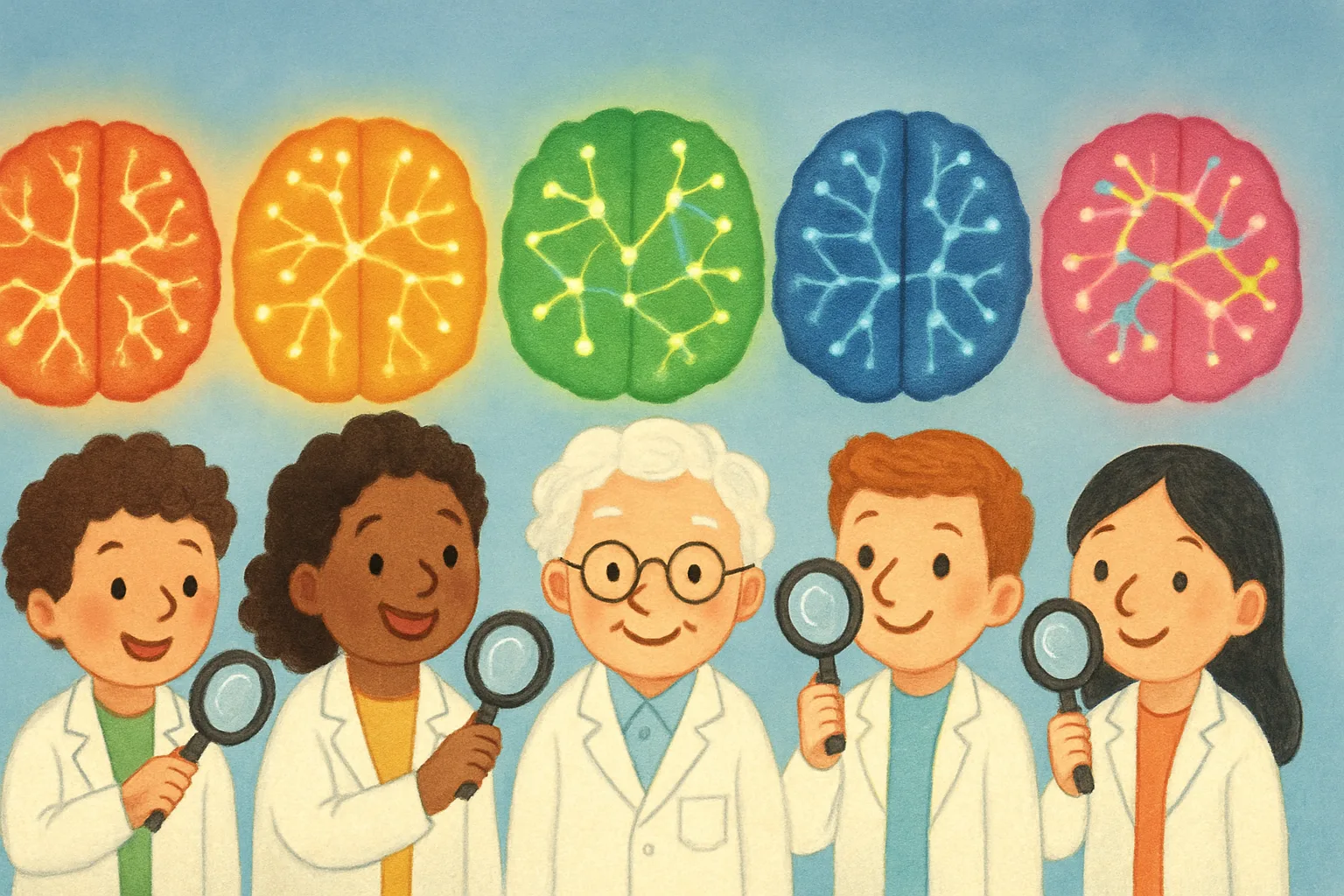
When they looked at all that brain data, the scientists found five distinct patterns — like five different maps of the same city, each with roads drawn in different places.
Some people with depression had brain regions that communicated too strongly with each other. Others had regions that barely talked at all. Each pattern was linked to different kinds of symptoms.
Think of it like this: imagine five kids all named “Alex” who all have the sniffles. One Alex has a cold. One has allergies. One has the flu. The illness label is the same, but what is happening inside each body is very different — and each one needs a different treatment.
The study was published in the scientific journal Nature Mental Health.
The scientists say they are not yet ready to use brain scans to choose treatments for patients. But they believe this research points toward a future where doctors can do exactly that — finding the right treatment much faster instead of having to try many things one by one.
Why Does It Matter?
Right now, finding the right treatment for depression can take a long time. A doctor might try one approach, wait several weeks, and then try another if it does not work. If scientists can one day match a person’s specific brain pattern to the best treatment, that waiting time could shrink from months to days.
Understanding that depression is not just one thing is also important in another way. It reminds us that people who feel sad or depressed are not all the same — and they all deserve patient, personalized care.
Big Words
- Depression — a medical condition where a person feels very sad, empty, or hopeless for weeks or months; it is not just feeling blue for a day
- MEG (magnetoencephalography) — a special brain scanner that measures tiny magnetic signals from electrical activity in the brain, with very high speed and precision
- Brain connectivity — how well different parts of the brain communicate or “talk” to each other
- Diagnosis — the name a doctor gives to a medical condition after examining a patient
- Phenotype — a word scientists use to describe a specific version or pattern of a condition that can be grouped and studied
Fun Fact
Your brain sends signals between its regions using electricity — the same force that powers a light bulb! The MEG scanner detects the tiny magnetic fields these electrical signals create, even through your skull.
Think About It
If every person’s depression is a little different, why do you think it might be important for doctors to listen carefully to each patient’s own description of how they feel?
Sources
- University of Helsinki — Researchers identify five brain profiles for depression
- Nature Mental Health (2026) — Magnetoencephalography oscillation-based functional connectivity identifies clinically relevant depression phenotypes
- Neuroscience News — Five Brain Profiles of Depression Identified
- ScienceDaily — Scientists Discover 5 Hidden Brain Patterns Behind Depression
- Medical Xpress — Same depression diagnosis, opposite brain patterns: Five profiles emerge