
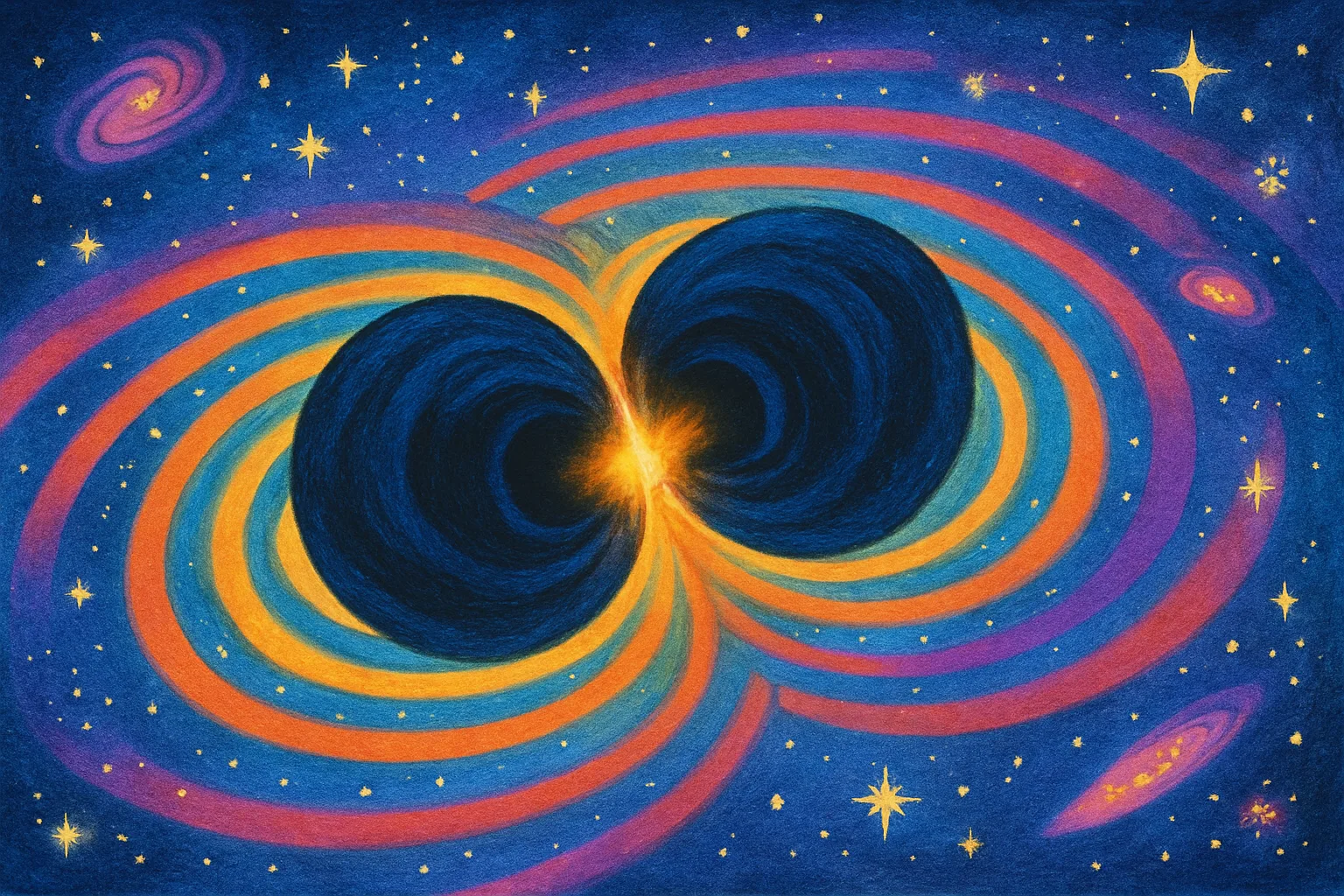
Scientists Catch Ripples in Space From 390 Colliding Black Holes!
Quick Summary
Scientists just published the largest-ever list of gravitational wave detections — a total of 390! Gravitational waves are invisible ripples in space caused when massive objects like black holes crash together. The new record is helping scientists map hidden populations of black holes and learn more about the universe than ever before.
What Happened?
Imagine dropping a huge rock into a still pond. The rock sends ripples spreading out in every direction. Now imagine that rock is actually two enormous black holes — objects so heavy that even light can’t escape them — smashing together. That collision sends ripples through the very fabric of space itself. Those ripples are called gravitational waves.
A total of 161 events, detected between April 2024 and the end of January 2025, have been added to a new collection by the LIGO–Virgo–KAGRA Collaboration, bringing the total number of gravitational wave signals detected to date to 390.
Among the most significant findings are: evidence for the existence of second-generation black holes, the most precise sky localization ever achieved for a gravitational wave source, and the clearest gravitational wave signal ever recorded.
Think about how remarkable that is! Just 11 years ago, there were no known gravitational wave events. Today, in 2026, there are 390 confirmed events.
The new catalogue includes observations collected by the LIGO detectors in the United States, Virgo in Italy, and KAGRA in Japan. These three giant detectors work as a team — the more detectors pick up the same ripple, the better scientists can figure out exactly where in space the collision happened.
The growing number of gravitational wave detections is helping scientists improve measurements of black holes, test fundamental laws of physics, and refine estimates of how quickly the universe is expanding.
With discoveries now arriving several times a week, gravitational wave astronomy is entering an exciting new era.
Why Does It Matter?
Gravitational waves give scientists an entirely new way to “listen” to the universe — almost like getting a brand-new sense. For most of history, astronomers could only study space using light. Now they can detect the invisible vibrations from the universe’s most powerful events. Beyond adding 161 new detections to the scientific record, the catalog provides an unprecedented dataset that researchers can use to investigate black hole evolution, test the laws of physics under extreme conditions, and refine measurements of the expanding universe. Every new detection teaches us something new about the cosmos.
Big Words
- Gravitational wave — A ripple in the fabric of space and time caused by massive objects accelerating; travels at the speed of light
- Black hole — A region of space where gravity is so strong that nothing — not even light — can escape
- LIGO — Short for Laser Interferometer Gravitational-Wave Observatory; a giant detector in the U.S. that senses tiny ripples in space
- Catalog — A detailed list or database of scientific observations organized for study
- Second-generation black hole — A black hole that formed from the merger of two other black holes (rather than from a dying star)
Fun Fact
The gravitational waves LIGO detects are unimaginably tiny — they stretch and squeeze the detectors by less than one-thousandth the diameter of a proton! That’s like measuring a change the size of an atom across a distance larger than a galaxy.
Think About It
Gravitational waves let us “hear” collisions between black holes billions of light-years away — events that happened long before Earth even existed. If you could listen to the universe with gravitational waves, what kind of cosmic event would you most want to discover?
Sources
- LIGO Lab Caltech — Official catalog announcement, GWTC-5.0
- ScienceDaily — “390 Gravitational Wave Detections Reveal Hidden Population of Black Holes” (July 1, 2026)
- Max Planck Institute for Gravitational Physics (Albert Einstein Institute) — catalog release statement
- Innovation News Network — “LVK collaboration reports 161 new gravitational wave detections” (June 1, 2026)