
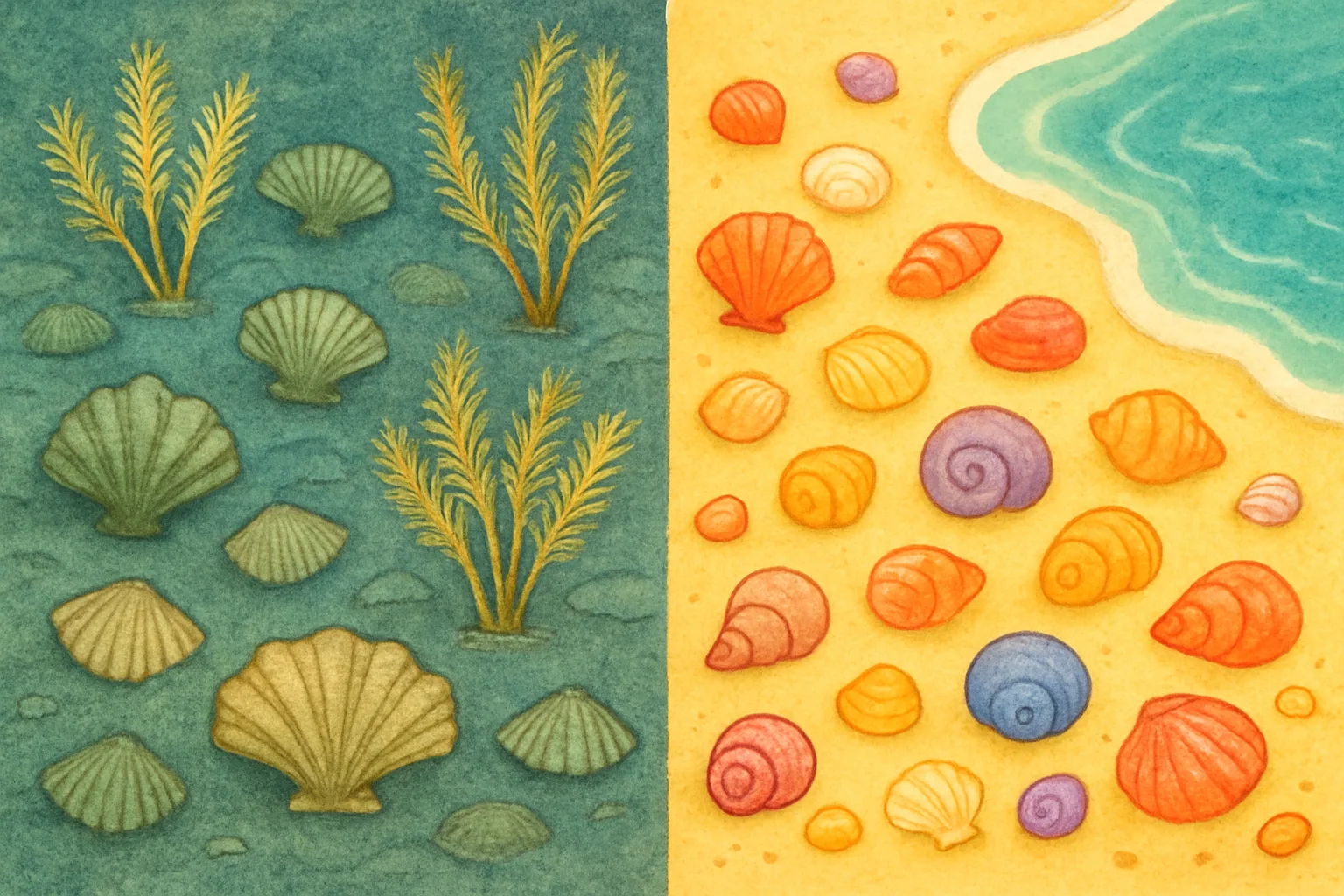
Why Are There No Brachiopods at the Beach? Scientists Finally Have the Answer!
Quick Summary
Have you ever collected shells at the beach? Almost all of them are from clams, snails, or oysters. But 252 million years ago, the oceans looked totally different — and a new study from Stanford University explains exactly why everything changed.
What Happened?
Long, long ago — way before the dinosaurs even existed — the bottom of the ocean was covered with strange creatures called brachiopods. They looked a little like clams, but they belonged to a completely different branch of the animal family tree. They outnumbered clams and snails by enormous amounts.
Then something terrible happened. Scientists call it the “Great Dying.” It is Earth’s single biggest mass extinction event. About 252 million years ago, roughly 96% of all ocean species and 70% of all land animals died out. It was far worse than the extinction that killed the non-bird dinosaurs.
After the Great Dying, brachiopods were nearly gone. Clams, snails, starfish, and sea urchins took over. And here is the mystery: why did some creatures survive while others were wiped out almost completely?
A team of scientists from Stanford University has now published the strongest answer yet. Their study appeared in the Proceedings of the National Academy of Sciences.
The researchers compared the biology of creatures that survived with those that did not. They even collected living brachiopods from places like Washington State’s San Juan Islands — one of the few places brachiopods still exist today — and measured how their bodies react to warm, low-oxygen water.
What they found was a clear pattern. Brachiopods have very slow, low-energy body processes. In cold water with plenty of oxygen, that worked fine. But the Great Dying was triggered by enormous volcanic eruptions that pumped huge amounts of warming gases into the air. The oceans got hotter and lost oxygen, like a warm pond going stale.
In those conditions, brachiopods could not keep up. Their slow bodies could not work hard enough to survive. But clams and snails have faster, more flexible body systems. They could adapt. They survived — and eventually took over the ocean floors of the entire planet.
Today, only about 400 species of brachiopods still exist. But there are between 10,000 and 15,000 species of clams, mussels, and oysters. That flip happened because of what the oceans went through all those millions of years ago.
Why Does It Matter?
This discovery is not just about the past. The Great Dying was caused by warming oceans and falling oxygen levels. Scientists point out that Earth’s oceans are warming again today, just much more quickly.
Understanding which creatures survived last time — and why — helps scientists think about how ocean life might be affected in the future. Nature has lessons hidden inside ancient shells.
Big Words
- Brachiopod — An ancient ocean animal that looks like a clam but is actually a completely different creature; most are now extinct.
- Mass extinction — A time when a huge percentage of Earth’s species die out in a geologically short period.
- Metabolism — All the chemical processes inside a living thing’s body that turn food into energy and keep it alive.
- Permian-Triassic extinction — The scientific name for the Great Dying, the largest mass extinction in Earth’s history, which happened 252 million years ago.
- Oxygen depletion — When water or air loses much of its oxygen; fish and other animals need dissolved oxygen in water to breathe.
Fun Fact
Before the Great Dying, brachiopods had dominated the seafloor for about 280 million years — that is longer than the dinosaurs existed! They were incredibly successful creatures before the catastrophe struck.
Think About It
If you were a sea creature living 252 million years ago as the oceans got warmer and lost oxygen, what kind of superpower would you want your body to have in order to survive?
Sources
- ScienceDaily — Scientists Finally Solved the Mystery of Earth’s Greatest Mass Extinction (July 12, 2026)
- Stanford Doerr School of Sustainability — Researchers confirm cause of Earth’s biggest mass extinction
- Phys.org — Researchers link the mass extinction of once-dominant marine groups to intolerable heat, diminished oxygen in oceans
- Earth.com — Why some sea creatures survived Earth’s greatest mass extinction