
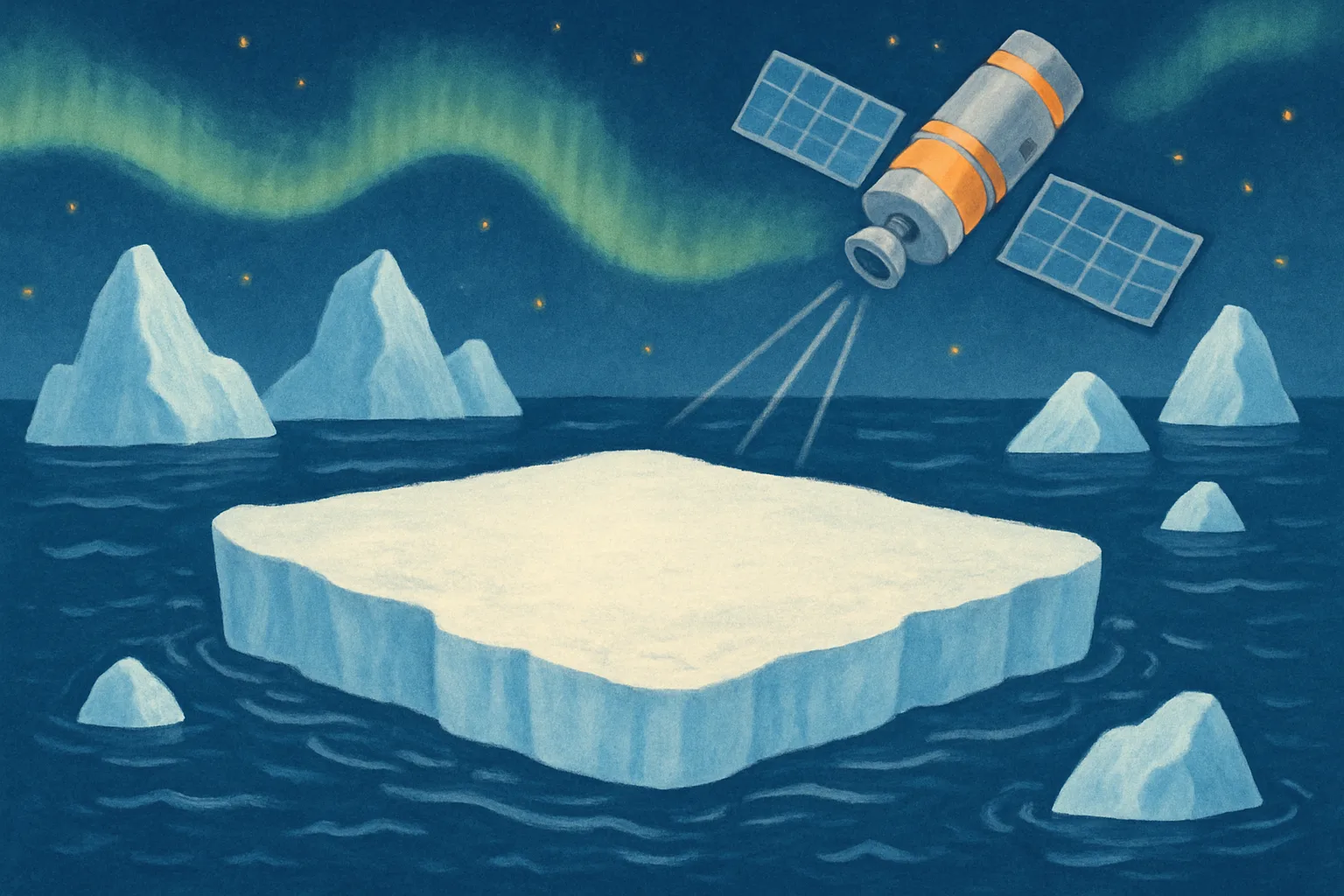
A Chunk of Ice the Size of Manhattan Just Broke Off Greenland!
Quick Summary
On August 4, 2026, a massive slab of ice snapped away from a glacier in Greenland. It is now floating in the Arctic Ocean as a giant ice island. Scientists are tracking it from space and say this is the biggest break at this glacier in more than a decade.
What Happened?
Deep in the northwest corner of Greenland, there is a slow-moving river of ice called Petermann Glacier. Glaciers flow very slowly from land toward the sea. At the edge of the sea, the glacier floats on the water like a giant flat tongue of ice. Scientists call this a “floating ice tongue.”
On August 3, 2026, satellites spotted cracks spreading fast across the center of that ice tongue. The very next day — August 4 — a huge slab snapped off completely. Scientists now call it an “ice island.”
How big is it? The ice island covers about 76 square kilometers. That is roughly the same size as Manhattan, the famous island in New York City. And it is not just wide — it is also very thick. Scientists estimate the slab is up to 150 meters deep. Picture a 50-story skyscraper lying on its side underwater, and that is about how thick the ice goes.
A team of scientists led by researchers at the University of Ottawa and supported by the European Space Agency tracked the whole event using radar satellites called Sentinel-1. These satellites can see through clouds and darkness by sending out radio waves and measuring what bounces back — like a bat finding its way in the dark.
This is Petermann Glacier’s biggest ice loss since 2012 and the largest calving event anywhere in the Arctic since 2020. Scientists say they had watched the cracks building for years, so the break itself was not a complete surprise — but seeing it happen so dramatically in satellite images was remarkable.
Why Does It Matter?
Large ice islands like this one are rare in the Arctic. They can drift slowly for years, carrying scientific clues about how polar ice behaves. Researchers will watch where this one travels, how it breaks apart, and what it tells us about the health of Greenland’s glaciers.
Glaciers act like giant frozen water tanks for the planet. When ice breaks off into the ocean, the water level can rise slightly over time. Scientists who study glaciers hope that tracking events like this helps them better understand — and predict — how fast polar ice is changing.
The good news: space agencies like ESA give scientists powerful eyes in the sky. No matter how remote or cold a place is, satellites can keep watch 24 hours a day.
Big Words
- Glacier — a huge, slow-moving river of ice formed from thousands of years of packed snow
- Calving — when a chunk of ice breaks away from the edge of a glacier, like a calf leaving its mother; it gives birth to icebergs
- Ice tongue — the floating edge of a glacier that sticks out over the ocean like a giant frozen shelf
- Sentinel-1 — a pair of European satellites that use radar to photograph Earth’s surface, even at night and through clouds
- Arctic — the region around Earth’s North Pole, covered largely by ocean and sea ice
Fun Fact
Large flat ice islands like this one are common around Antarctica in the south, but they are much rarer in the Arctic. Scientists treat each Arctic ice island as a unique natural laboratory they can observe from orbit.
Think About It
If a glacier is like Earth’s giant water tank, what do you think happens to the world’s oceans when those tanks slowly melt and drain away?
Sources
- European Space Agency — Sentinel-1 captures major ice loss from Greenland glacier, August 2026
- EurekAlert / University of Ottawa — Greenland glacier break creates new ice island, August 2026
- Phys.org — Greenland glacier break creates new ice island, August 10, 2026
- SciTechDaily — A Manhattan-Sized Ice Island Just Broke Off Greenland, August 2026
- The Weather Channel — Huge iceberg breaks apart from Greenland’s Petermann Glacier, August 25, 2026