
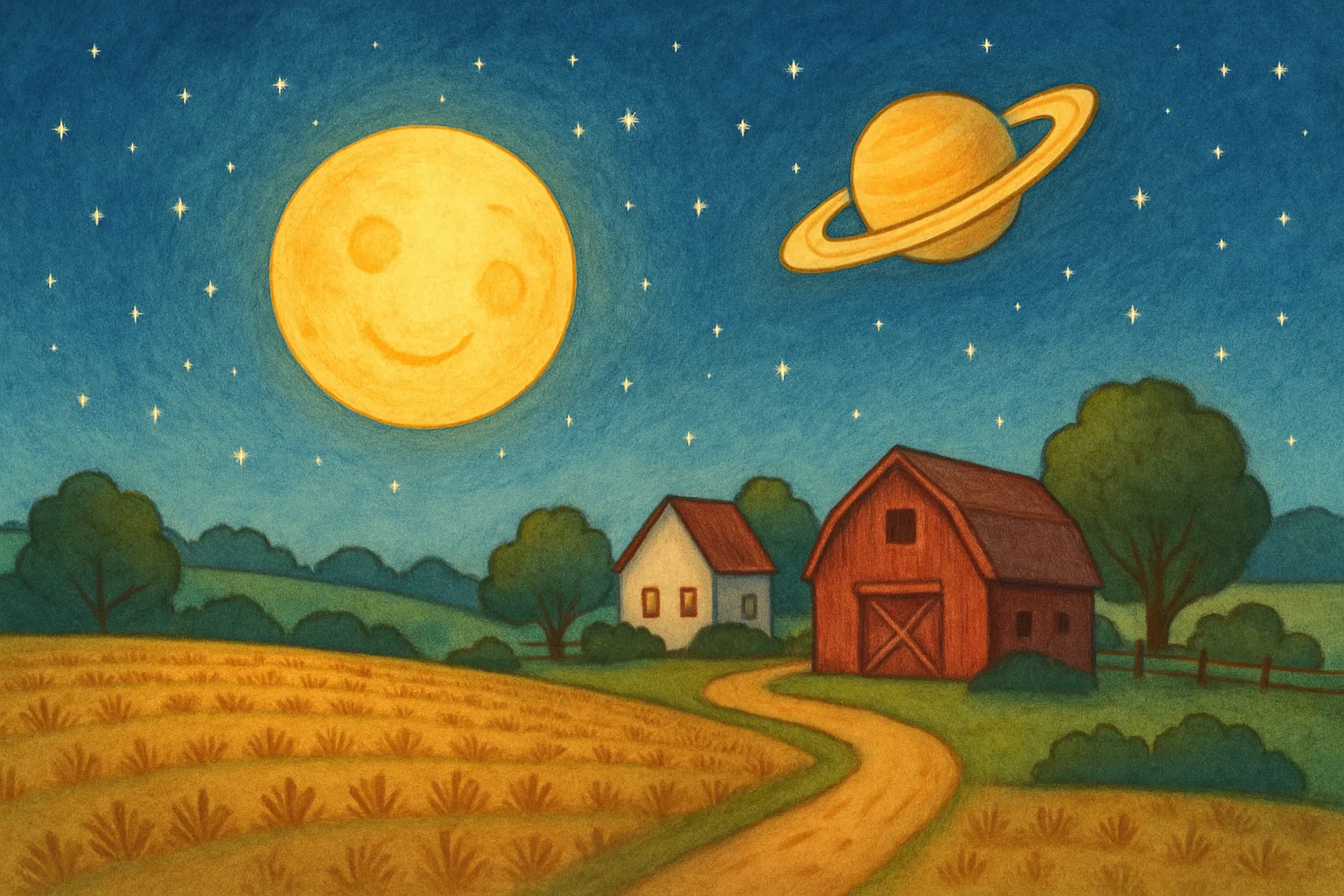
Two for One! Tonight’s Full Moon Comes with a Ringed Planet Surprise
Quick Summary
Tonight is the Harvest Moon — the most famous full moon of the year. But this year’s is extra special. Saturn is glowing right beside it in the evening sky, and you don’t need a telescope to see it!
What Happened?
The Harvest Moon reached its fullest point today, Saturday, September 26, at 12:49 p.m. Eastern Time. That’s during the daytime, so you won’t miss anything. The best show comes tonight, when the big round Moon rises in the east just around sunset.
As the sky grows dark, look for a bright, steady, golden light near the Moon. That’s Saturn — the ringed planet. It won’t twinkle like a star. Planets glow with a steady, calm light, almost like a tiny lamp hanging in the sky.
Neptune, a much fainter planet, is also nearby. You’ll need binoculars or a small telescope to find that one.
The Harvest Moon has a special trick no other full moon can match. Around the autumn equinox, it rises only a few minutes later each night instead of the usual 50 minutes. In the past, that meant farmers could keep working by moonlight for several evenings in a row — even after the sun went down. That’s how it got its name.
Saturn is especially exciting right now because it’s heading toward its closest point to Earth. That date is October 4. The closer Saturn gets, the brighter and bigger it appears. Think of it like a friend walking toward you — the closer they get, the easier it is to see their face.
Why Does It Matter?
You don’t need fancy equipment to enjoy tonight’s sky show. Just step outside after sunset, look east, and you’ll see one of the most beautiful natural sights of the year. The Moon and Saturn look close together from Earth. But they are actually very different distances away. The Moon is about 239,000 miles away — a trip a car could make in about 24 weeks. Saturn is more than 800 million miles away — roughly 3,000 times farther than the Moon.
Even a small pair of binoculars will let you spot Saturn’s famous rings. A telescope will reveal them clearly, along with some of Saturn’s moons.
Big Words
- Harvest Moon — the full moon that falls closest to the first day of autumn each year
- Opposition — when a planet lines up exactly opposite the Sun from Earth, making it look its biggest and brightest
- Equinox — the two days each year when day and night are almost exactly the same length
- Constellation — a group of stars that form a pattern or picture in the sky
- Gravitational pull — the invisible force that keeps the Moon orbiting Earth and planets orbiting the Sun
Fun Fact
The Moon travels around Earth at about 2,300 miles per hour. Even at that speed, going from the Moon to Saturn would take more than 40 years!
Think About It
Farmers long ago used moonlight to work late into the night. What kinds of jobs today might still benefit from a brighter night sky?
Sources
- NASA Science — What’s Up: September 2026 Skywatching Tips from NASA
- BBC Sky at Night Magazine — See the Harvest Moon rise with Saturn this weekend
- Discover Magazine — The 2026 Harvest Moon Rises This Weekend With Saturn Shining Nearby
- EarthSky — The September full Moon is the Harvest Moon near Saturn
- Farmers’ Almanac — The 2026 Harvest Moon Is Almost Here
- CNN — September’s full harvest moon will pair with Saturn