
Turn Up the Cool! Scientists Learned to Steer Heat Like a Beam of Light
Quick Summary
Scientists at UCLA made a big discovery about heat. They found a special crystal that can guide heat in a straight beam — like how a fiber optic cable guides a beam of light. This could help computers and phones stay cool and run faster than ever.
What Happened?
You know how heat spreads out in all directions? Think about warming your hands over a campfire. The warmth radiates outward in a big cloud. That is how heat normally behaves in most materials — it just spreads in every direction randomly.
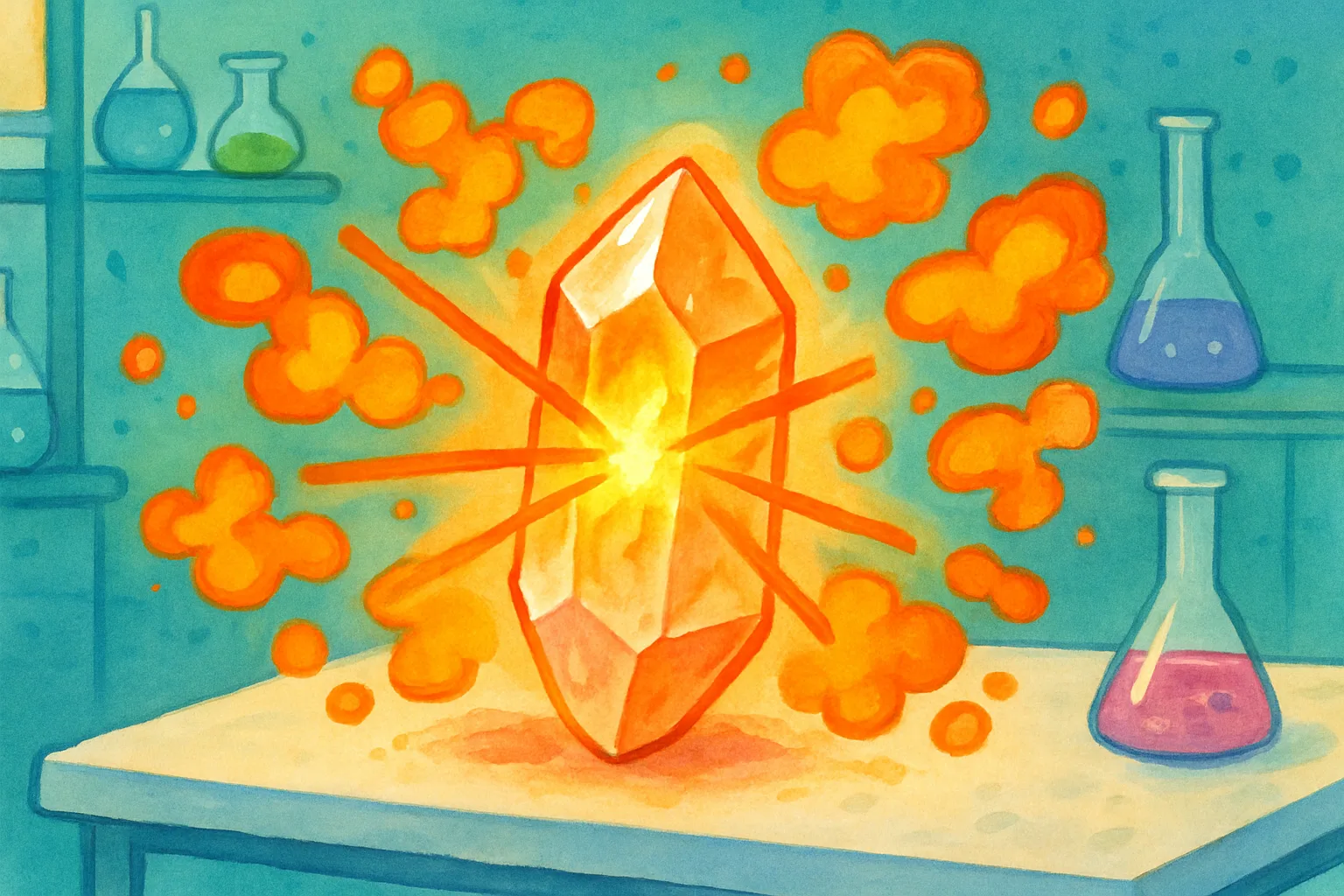
But researchers at UCLA found a special crystal called boron arsenide that breaks this rule. In this crystal, heat travels in tight, focused rays — almost like a laser beam. Instead of spreading out like a puddle, the heat moves in one precise direction, just like light travels through a fiber optic cable.
The scientists published their findings in the journal Nature Physics. Before this discovery, scientists could only get heat to behave this way at extremely cold temperatures — colder than outer space. Now, UCLA’s team showed it can happen at ordinary room temperature, the same temperature as your classroom.
They used an incredibly tiny temperature-measuring tool — small enough to measure things at the scale of a human hair divided into a thousand pieces — to watch the heat rays travel through the crystal in real time.
The key to boron arsenide’s superpower is the way its atoms are arranged inside. The crystal’s structure channels heat along certain paths, almost like train tracks built into the material itself.
Why Does It Matter?
Computers and phones get hot when they run. Too much heat is one of the biggest reasons electronics can slow down, break, or use extra energy. Engineers spend a lot of time trying to cool chips down.
If heat can be guided in precise beams, engineers could design chips that steer dangerous heat away from delicate parts — like building tiny one-way roads inside a computer chip. This could help future computers, AI systems, and quantum computers run faster, last longer, and use less energy.
It is a discovery that could change the inside of nearly every electronic device made in the future.
Big Words
- Phonon — a tiny vibration that travels through a material and carries heat; think of it as a heat particle
- Boron arsenide — a special crystal material that can guide heat in a focused beam
- Crystal — a solid material where atoms are arranged in a neat, repeating pattern — like a perfectly stacked pile of boxes
- Quantum — a word describing the strange behavior of matter and energy at an incredibly tiny scale
- Fiber optic cable — a thin glass tube that guides light along its length, used to send internet signals super fast
Fun Fact
Boron arsenide is also one of the best-known materials at conducting heat — so good that scientists sometimes call it a “super-cool” heat conductor. Now it turns out it can direct that heat like a spotlight, too!
Think About It
If you could design a future computer chip using this discovery, what would you want to build that is impossible to build today because chips get too hot?
Sources
- UCLA Newsroom — UCLA engineers observe quantum heat waves at room temperature
- ScienceDaily — UCLA Scientists Discover How to Guide Heat Like Light at Room Temperature
- EurekAlert — UCLA engineers observe quantum heat waves at room temperature
- Phys.org — Engineers observe quantum heat waves at room temperature
- SciTechDaily — Quantum Heat Waves Spotted at Room Temperature for the First Time
- Open Access Government — UCLA engineers observe quantum heat waves at room temperature