
The Universe Recycles! A New Telescope Watches a Dead Star’s Remains Turn Into New Worlds
Quick Summary
A brand-new telescope — built from camera lenses — spotted something nobody had ever seen before. It found 22 glowing shock waves around a dying star’s leftover cloud, showing scientists exactly how a dead star’s material gets broken apart and recycled into the ingredients for new stars and planets.
What Happened?
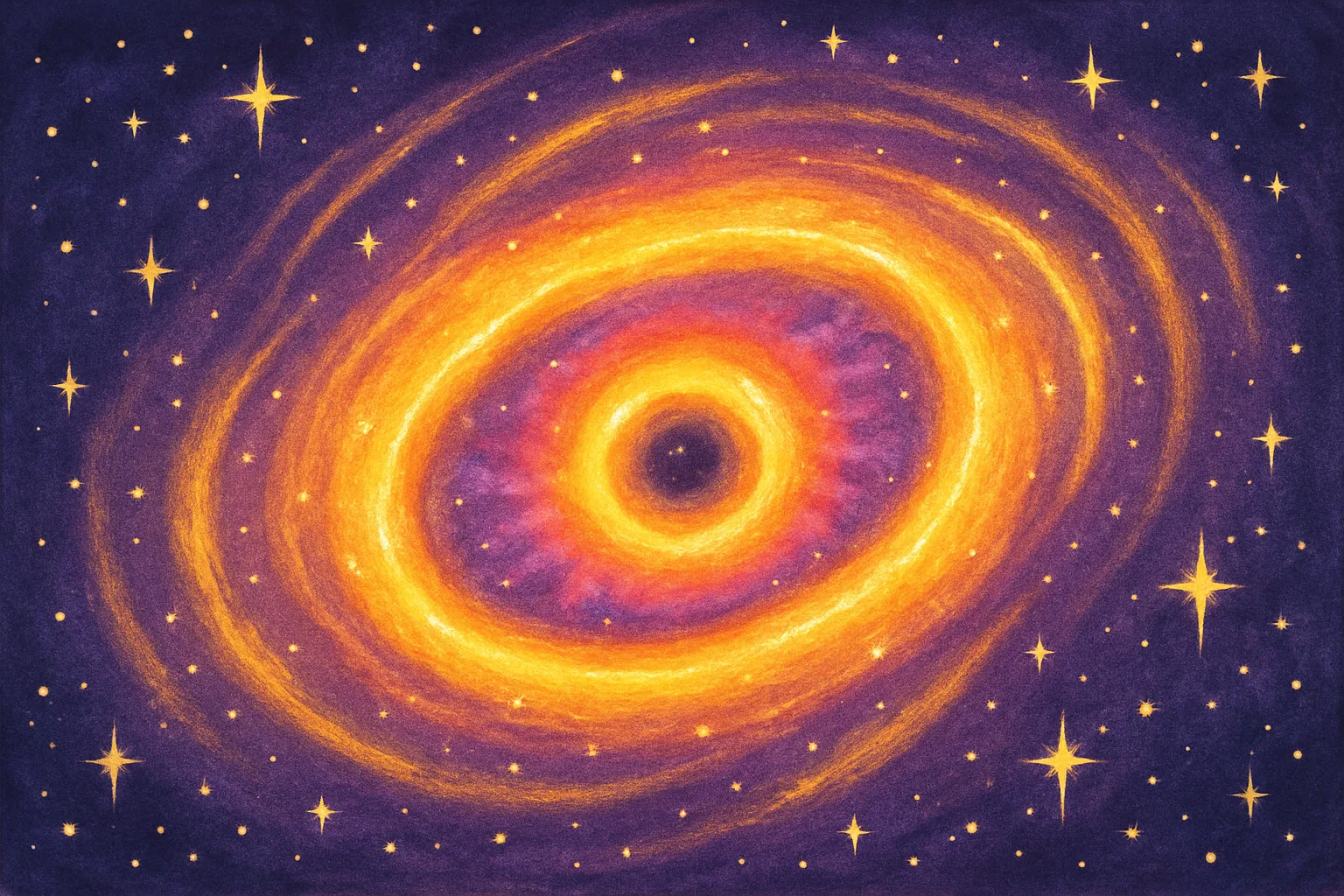
About 650 light-years away from Earth — that is nearly 4,000 trillion miles — floats a beautiful cloud of gas called the Helix Nebula. It is sometimes called the “Eye of God” because it looks like a giant glowing eye in space.
Long ago, a star like our Sun used up all its fuel. It puffed up into a huge ball, then gently blew its outer layers outward into space. That puff of material became the Helix Nebula. What is left of the star — a tiny, super-dense object called a white dwarf — still sits at the center like a tiny pearl.
Scientists have studied the Helix Nebula for years. But in November 2025, something surprising happened. A team led by Yale University astronomer Pieter van Dokkum was testing a new telescope called MOTHRA in Chile. They pointed it at the Helix Nebula just to check if the telescope was working properly — almost like testing a new camera by snapping a photo of your backyard.
What they found stunned them. MOTHRA spotted 22 glowing curved arcs at the outer edges of the nebula. These arcs are called bow shocks. Imagine a boat moving through a lake — the water piles up in a curve at the bow, the front of the boat. These stellar bow shocks work the same way. Clumps of the dead star’s material race outward at up to 100,000 miles per hour and slam into the slower gas around them, pushing it into glowing arcs.
The team studied how the bow shocks changed shape at different distances from the center. Closer in, the arcs were clean and clear. Farther out, they looked fuzzy and tattered. That showed scientists the debris is being slowly shredded and mixed into space — like a sandcastle slowly crumbling as the tide comes in.
They calculated that a single clump of stellar debris survives for only about 10,000 years before it completely dissolves. Ten thousand years sounds like a long time, but in space, it is about as brief as a blink.
The research was published in the journal Nature on August 12, 2026.
Why Does It Matter?
Here is a mind-blowing fact: the carbon in your body and the oxygen in the air you are breathing right now were made inside ancient stars. When those stars died, they scattered those ingredients into space. Over millions of years, that material clumped together to form new stars — and the planets around them, including Earth.
But scientists had never actually watched this process happen. They knew it must occur, but they had never caught it in the act. Now they have. MOTHRA has shown us, for the first time, exactly how a dead star’s remains break apart and become the raw material for future worlds.
The MOTHRA telescope itself is also extraordinary. Instead of one giant mirror, it is built from 1,140 Canon camera telephoto lenses working together. When completed, it will be one of the most unusual scientific instruments ever built.
Big Words
- Nebula — a giant cloud of gas and dust in space; some nebulae are left behind by dying stars
- White dwarf — the small, super-dense core left behind after a star like the Sun runs out of fuel and sheds its outer layers
- Bow shock — a curved wave of energy that forms when something fast-moving slams into something slower, like the wave at the front of a boat
- Interstellar medium — the thin gas and dust that fills the space between stars
- Ejecta — material thrown outward from a star or explosion
Fun Fact
The Helix Nebula is one of the closest planetary nebulae to Earth. If you held out a full moon in the night sky, the Helix Nebula stretches to about twice the width of that full moon — it is enormous, but too faint to see without a telescope.
Think About It
Scientists discovered something amazing completely by accident while just testing their telescope. Can you think of other great discoveries that happened by accident?
Sources
- Nature — Numerous bow shocks in the outer Helix Nebula (van Dokkum et al., Aug 12 2026)
- Universe Today — MOTHRA Shows Us A Star Being Recycled in the Helix Nebula (Aug 18 2026)
- Physics World — New image captures glowing shock waves in the Helix Nebula
- Science Times — New MOTHRA Telescope Finds Stellar Debris Being Recycled Around the Helix Nebula
- Northwestern University Weinberg College News — A dying star’s debris reveals the galaxy’s recycling process in action