
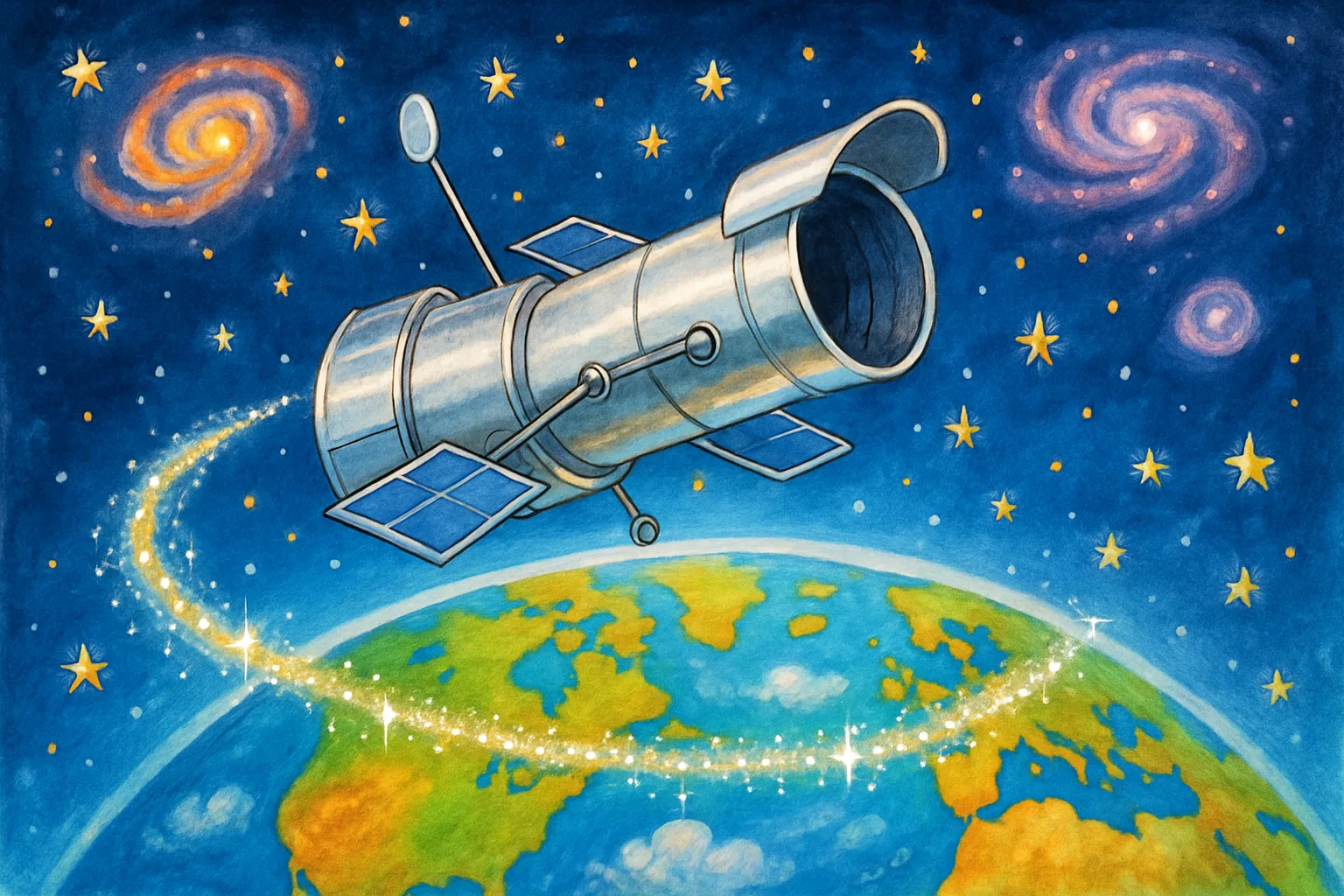
Still Going Strong! Hubble Just Lapped Earth for the 200,000th Time
Quick Summary
NASA’s Hubble Space Telescope just hit an incredible record. On September 19, 2026, it completed its 200,000th trip around Earth. Hubble was only supposed to last 15 years. It has now been working for over 36 years — more than twice as long — and it’s still making discoveries!
What Happened?
When NASA launched the Hubble Space Telescope in April 1990, the plan was for it to work for about 15 years. That plan turned out to be way too small. Hubble just completed its 200,000th orbit around Earth, and it is still going strong.
To picture how much traveling that is: in those 36 years, Hubble has flown more than 5 billion miles around our planet. That’s like driving a car to the Sun and back — more than 25 times!
On the exact day of that 200,000th orbit, Hubble was doing something exciting. It was staring at a distant galaxy cluster called MACS J0417, which sits about 4.65 billion light-years away. Scientists are hunting for a supernova — a giant star explosion — called Athena, which was first spotted by the James Webb Space Telescope in 2025. Athena is expected to reappear sometime between now and early March 2027.
Here’s what makes it extra cool: the galaxy cluster acts like a giant magnifying glass in space. Its massive gravity bends and stretches light from objects even farther away. Scientists call this “gravitational lensing.” It’s like using a curved mirror at a carnival to make things look bigger — except the mirror is an entire galaxy cluster!
Over 36 years, Hubble has made more than 1.7 million observations. Astronomers around the world want so much time on Hubble that they request about seven times more hours than Hubble can actually give.
Why Does It Matter?
Hubble changed how humans understand space. It helped scientists figure out that the universe is expanding — getting bigger and bigger every second. It has photographed galaxies billions of light-years away and spotted planets around other stars.
Even with newer telescopes like James Webb working alongside it, Hubble remains one of our most powerful tools. Its ability to see ultraviolet light — which Webb cannot — makes it still uniquely valuable.
Big Words
- Orbit — one complete trip around a planet or star, like a lap around a track
- Light-year — the distance light travels in one year, about 5.88 trillion miles; it is used to measure distances in space
- Supernova — a massive explosion when a giant star reaches the end of its life
- Gravitational lensing — when a massive object’s gravity bends light around it, acting like a giant magnifying glass
- Hubble Constant — the number scientists use to describe how fast the universe is expanding in every direction
Fun Fact
Hubble travels around Earth about once every 95 minutes. That means it sees a sunrise — and a sunset — about 15 times every single day!
Think About It
Hubble was designed to last 15 years but has lasted more than 36. What do you think is the secret to making something last much longer than expected?
Sources
- NASA Science — NASA’s Hubble Seeks Lensed Supernova, Marks 200,000 Orbits
- NASA.gov — NASA’s Hubble Telescope Reaches Milestone, Looks for Elusive Supernova
- Space.com — Hubble Space Telescope finishes 200,000 Earth orbits in style
- AccuWeather — NASA marks Hubble’s 200,000th orbit around Earth with a stunning image
- Starlust — Five billion miles and 200,000 orbits around Earth
- TechExplorist — Hubble has orbited Earth 200,000 times, and it’s still chasing a cosmic mystery