
Your Eyes Started as One Weird Eye on a Worm! Scientists Trace Human Vision Back 600 Million Years
Quick Summary
Scientists have discovered something wild: your eyes have a very surprising family history. Nearly 600 million years ago, a tiny worm-like creature with just one eye on top of its head may be the distant ancestor of every eye in every vertebrate animal alive today — including yours. And a piece of that ancient eye still exists inside your brain right now!
What Happened?
Researchers from Lund University in Sweden and the University of Sussex in England have been studying how animal eyes evolved over hundreds of millions of years. Their findings were published in a scientific journal called Current Biology.
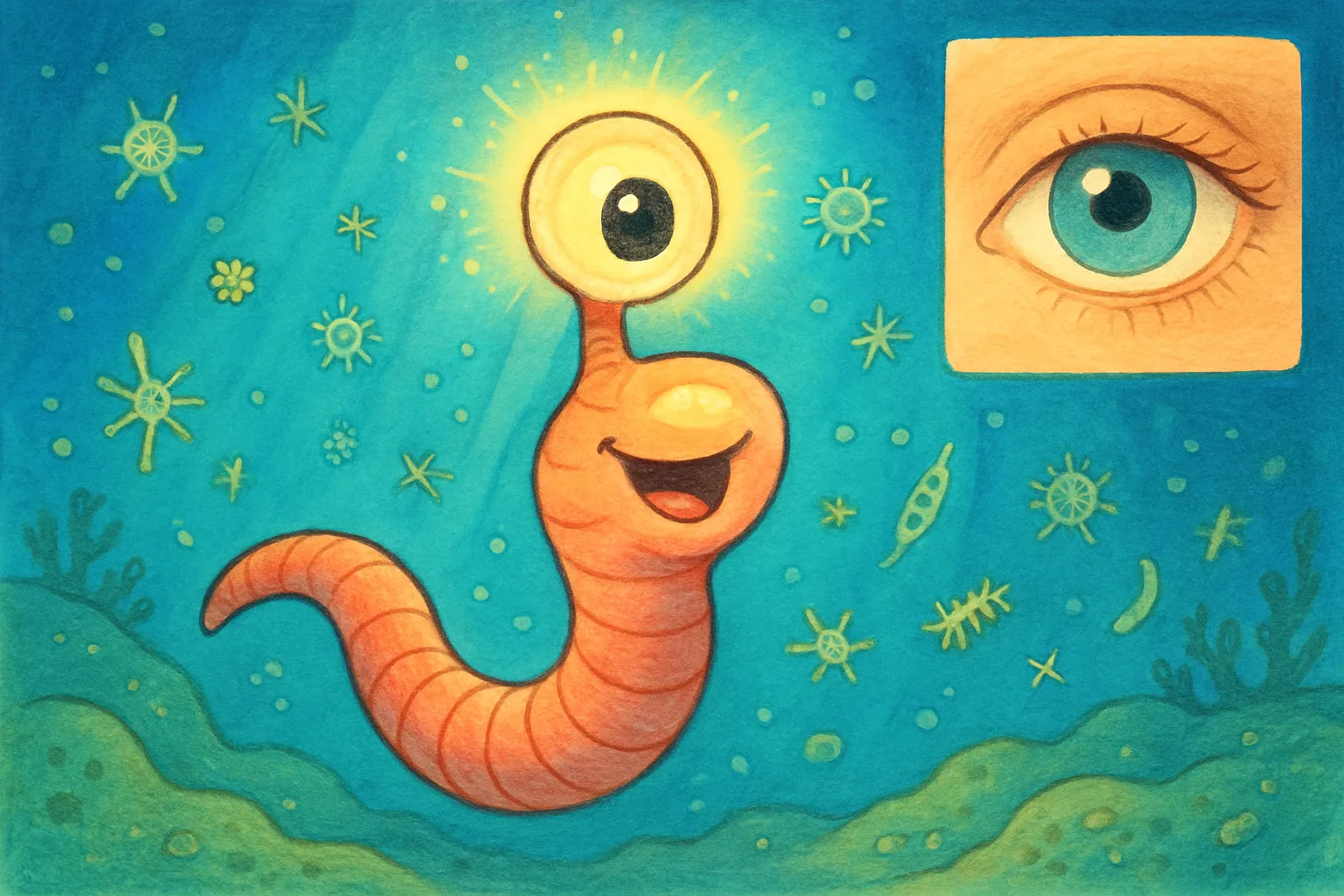
Here is what they figured out. Long, long ago — about 600 million years before dinosaurs, before fish, before almost anything with a backbone — there lived a tiny creature in the ocean. It looked a bit like a worm. It was small enough to hold on a fingertip. It spent most of its time in one spot, slowly filtering tiny bits of food called plankton from the water around it.
This creature had a single eye. Not two eyes like most animals we know today. Just one — sitting right on top of its head, facing upward. Scientists call it a median eye. In stories and myths, a creature with one eye in the center of its face is called a cyclops. This ancient animal was a little like that.
Over millions and millions of years, this creature’s descendants slowly changed. They started swimming around instead of sitting still. Moving around meant they needed better vision. Over time, that one central eye gradually transformed and split into the pair of eyes we see in fish, frogs, birds, cats, and people today.
But here is the most amazing part. That original single eye did not disappear completely. It changed into something else inside the brain. Today, in humans, it became the pineal gland — a tiny, pea-sized structure deep in the middle of your brain. Your pineal gland helps control your sleep schedule by sensing light and producing a chemical called melatonin. That is why you feel sleepy when it gets dark!
In some animals like certain lizards, a faint trace of the ancient median eye can still be seen as a pale spot near the top of the skull. It can still detect light.
The lead scientist, Professor Dan-Eric Nilsson, called the discovery mind-blowing. He said it was astonishing that the same organ that once helped an ancient sea worm sense light now helps you fall asleep at night.
Why Does It Matter?
This discovery changes how scientists understand the history of vision. For a long time, researchers were not sure how vertebrate eyes evolved. This study gives them a clear new story: it started with one eye, on a worm, in the ocean, more than half a billion years ago.
It also shows that evolution is creative in unexpected ways. Rather than building brand-new body parts from scratch, evolution often repurposes old ones. Your eye did not appear out of nowhere. It was recycled and improved from something much simpler.
Big Words
- Evolution — the slow process by which living things change over many generations, helping animals survive better in their environment
- Vertebrate — an animal with a backbone, like a fish, frog, bird, or human
- Median eye — an eye located in the center or top of an animal’s head; some ancient creatures had one instead of the two side eyes most animals have today
- Pineal gland — a tiny structure deep in the human brain that helps control sleep by sensing light and releasing a sleep hormone called melatonin
- Melatonin — a natural chemical your brain makes that signals your body it is time to sleep when it gets dark
Fun Fact
Some lizards alive today, like the tuatara of New Zealand, still have a visible “third eye” on the top of their heads. It is covered by a thin scale, but it can detect light and shadow. It is a real-life leftover from that ancient one-eyed ancestor!
Think About It
If your pineal gland still senses light to help you sleep, what do you think happens to your body when you stare at a bright screen right before bedtime?
Sources
- ScienceDaily — Scientists trace the shocking origin of human eyes to an ancient ‘cyclops’ (July 26, 2026)
- Tribune India — Scientists trace the shocking origin of human eyes to an ancient ‘cyclops’: Study (July 26, 2026)
- Futura Sciences — Your eyes evolved from a 600-million-year-old ‘cyclops’ creature — and it’s still inside your brain today
- The Debrief — Scientists Propose Our Eyes Evolved From This Ancient ‘Cyclops’ Organ
- Nautilus — Our Eyes Originated in a 600-Million-Year-Old Cyclops
- Current Biology, Vol. 36 Issue 4 — Evolution of the vertebrate retina by repurposing of a composite ancestral median eye (Kafetzis et al., 2026)