
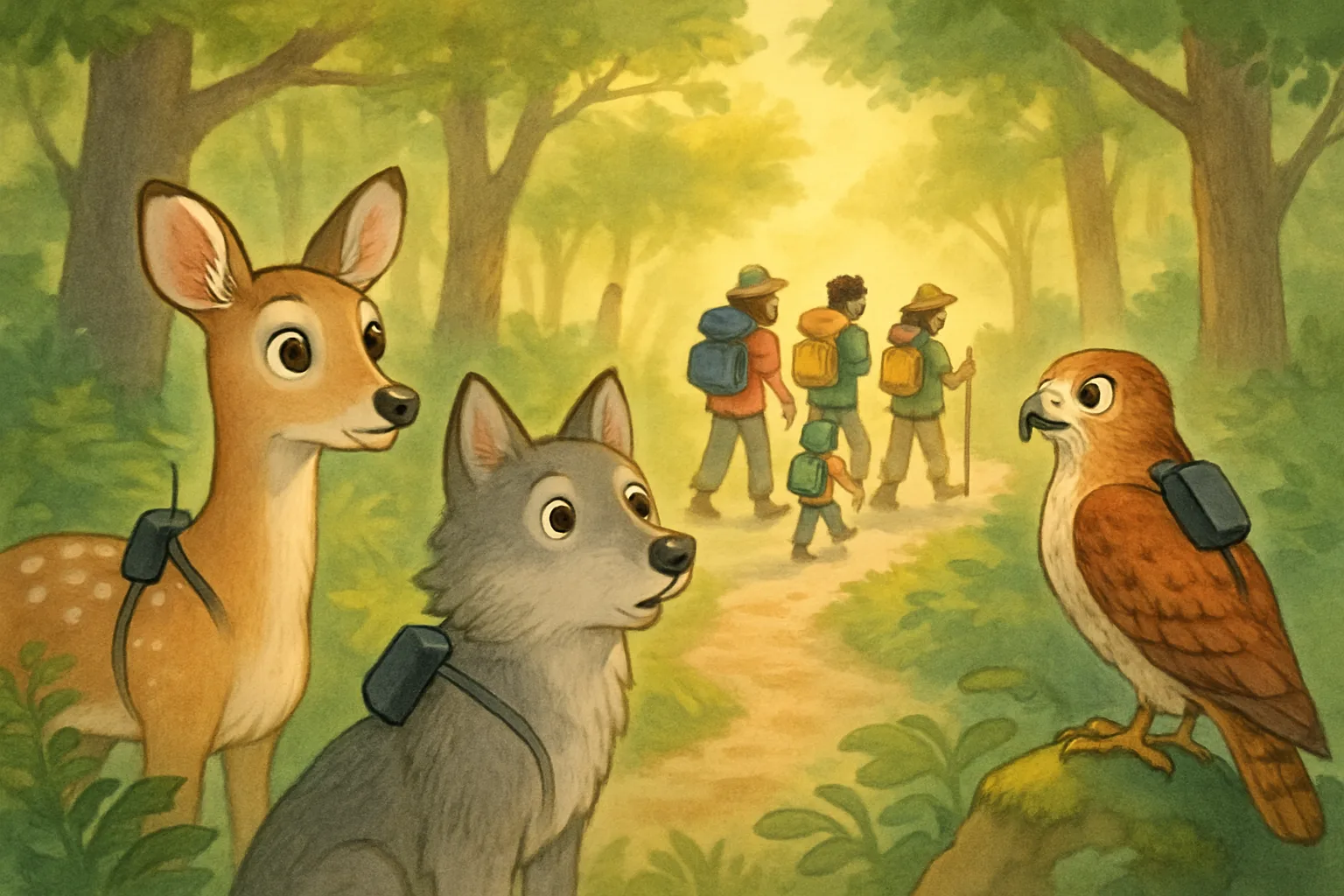
You’re Being Watched! Animals Change Their Whole Lives Just Because We’re Nearby
Quick Summary
Scientists tracked more than 4,500 wild animals across the United States using GPS. They found something surprising: most animals change their behavior just because people are nearby — not because of roads or buildings. Even a quiet walk in the woods can affect where wild animals go.
What Happened?
Have you ever walked into a room and watched your cat or dog suddenly act differently? It turns out wild animals do something similar — except they are reacting to you, the human.
A team of scientists from Yale University, the University of California Santa Barbara, and the Smithsonian’s National Zoo ran one of the biggest animal tracking studies ever. They attached GPS devices to 4,581 individual animals from 37 different species. That includes white-tailed deer, wolves, coyotes, raccoons, skunks, vultures, hawks, ducks, cranes, and more.
All together, the researchers collected about 11.8 million location points. That is like checking where each animal is standing, every single week, for two years.
To figure out where people were, the scientists used anonymous cellphone location data. This told them how many humans were in different areas at different times.
Here is where a lucky natural experiment helped. During COVID-19 lockdowns in 2020, people suddenly stayed home. Streets went quiet. Parks emptied out. By comparing animal movements in 2019 — when people moved normally — with 2020 — when they mostly stayed inside — scientists could separate two different things. They could ask: do animals react to human-built places like roads and farms? Or do they also react to humans themselves just walking around?
The answer was both — and the results were eye-opening.
More than 65 percent of the species studied changed their behavior when people were physically nearby. That means two out of every three types of animals shifted where they went or how much territory they used, simply because humans were present. Some animals shrank their territory to avoid people. Others actually expanded their range, perhaps searching for safer, quieter spots.
The effect was often just as strong as the effect of roads and cities. That was the big surprise.
Why Does It Matter?
For a long time, scientists focused on things like deforestation, roads, and pollution when thinking about wildlife protection. This study says we also need to think about where people go and when.
The good news? People can actually help. If we know that hiking in certain areas during certain times pushes animals away, we can plan trails and parks more carefully. We can give animals the space and quiet they need, without tearing anything down.
One researcher called the findings hopeful — they suggest that smarter, more flexible rules about where and when people enter wild places could help humans and wildlife live side by side.
Big Words
- GPS (Global Positioning System) — a technology that uses satellites to pinpoint exactly where something is on Earth, like a dot on a map that updates constantly
- Species — a group of living things so similar to each other that they can have babies together; wolves are one species, deer are another
- Territory — the area of land an animal uses for finding food, raising young, and living its daily life
- Conservation — the work of protecting animals, plants, and wild places so they can survive and thrive
- Anonymous data — information collected in a way that hides who specifically it came from, protecting people’s privacy
Fun Fact
Gray wolves in the study often expanded their territory when humans were around — possibly because our presence scared off other predators, giving wolves a chance to roam more freely.
Think About It
If your footsteps on a hiking trail can change where a deer decides to sleep that night, what do you think is the most important rule a hiker should follow to be kind to wildlife?
Sources
- Yale News — Wildlife is watching us, too — and changing their behavior in response
- UCSB The Current — Data on human and wildlife movement during the pandemic suggest new ways for us to coexist
- ScienceDaily — Scientists tracked 4,500 animals and found a surprising human effect
- Science journal — Interacting effects of human presence and landscape modification on birds and mammals (doi: 10.1126/science.adq3396)