
Hiding in Plain Sight! Scientists Find a New Ice Age Toad That Lived in Los Angeles
Quick Summary
Scientists have discovered a brand-new species of extinct toad that lived in Los Angeles during the last Ice Age. The bones were already sitting in a museum collection — since the 1950s! Nobody realized they belonged to a totally new species until a researcher took a very close look.
What Happened?
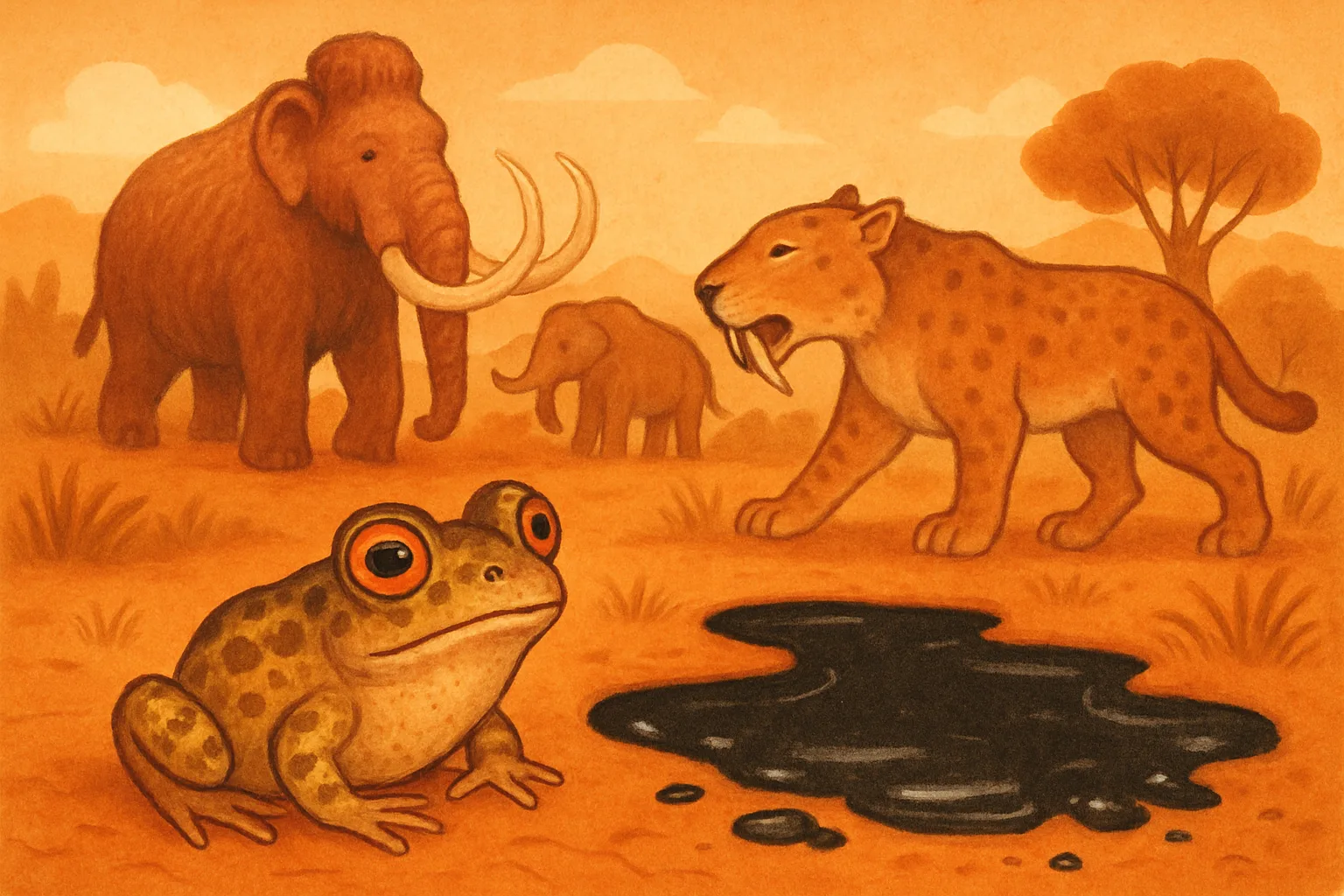
The La Brea Tar Pits in Los Angeles, California, are one of the most famous fossil sites in the world. Thousands of years ago, animals wandered close to sticky pools of natural tar and got stuck. Over time, the tar preserved their bones perfectly. Scientists have dug up mammoths, saber-toothed cats, giant sloths, and many more creatures there.
But hidden among all those big, famous animals were much smaller bones — tiny pieces of a toad’s skeleton. They had been sitting in the museum’s collection since the 1950s. For decades, nobody studied them carefully.
Then a researcher named Dr. Alberto Cruz decided to look closely at the museum’s old collections of amphibians and reptiles. When he examined one small, incomplete bone from the base of a toad’s spine — about as small as a grape seed — he noticed something strange. It did not look quite like any toad species he had ever seen.
At first, he thought the toad might just have been sick or injured. But after comparing it with dozens of modern toad specimens, he was convinced: this was a completely new species. He and his colleague Dr. Emily Lindsey named it Spea labreae — named after the La Brea Tar Pits.
This is only the second known extinct amphibian ever found from the Pleistocene epoch in North America. The Pleistocene is the scientific name for the time period we call the Ice Age, which lasted from about 2.6 million years ago until about 11,700 years ago.
Here is an amazing clue about ancient climate: today, the closest relatives of this toad live nearly 2,500 kilometers away, in southern Mexico. That is like the distance from New York City all the way to Houston, Texas! This tells scientists that Los Angeles was a very different, wetter place during the Ice Age.
Why Does It Matter?
Finding a new extinct species in a collection that is over 70 years old is a wonderful reminder. Scientists do not always need to travel somewhere brand new to make a discovery. Sometimes the discovery is already waiting, right in a museum drawer.
Small animals like toads are also very sensitive to changes in temperature and rainfall. Studying where they lived long ago helps scientists understand how Earth’s climate shifted at the end of the Ice Age — and what might happen to animals today as the climate keeps changing.
Big Words
- Extinct — a species that no longer exists anywhere on Earth
- Amphibian — a cold-blooded animal that can live both in water and on land; frogs, toads, and salamanders are all amphibians
- Pleistocene — the scientific name for the time period known as the Ice Age, roughly 2.6 million to 11,700 years ago
- Fossil — the preserved remains or traces of an ancient living thing, often found in rock or, in this case, sticky tar
- Holotype — the single specific specimen that scientists use to officially describe and name a new species
Fun Fact
Amphibian bones are so fragile that they almost never become fossils — which is why the sticky tar at La Brea is so special. The tar preserved tiny bones that would normally disappear completely.
Think About It
If you were a scientist looking through an old museum collection, what kind of animal would you most hope to find hiding there that nobody had noticed before?
Sources
- La Brea Tar Pits — Official Press Release, ‘A New Species of Ice Age Toad Discovered at La Brea Tar Pits: the spadefoot toad Spea labreae’ (August 5, 2026)
- phys.org — ‘A new species of Ice Age toad discovered at La Brea Tar Pits’ (August 5, 2026)
- EurekAlert — ‘A new species of Ice Age toad discovered at La Brea Tar Pits’ (August 5, 2026)
- ScienceDaily — ‘A new Ice Age species was hiding in la brea tar pits fossils for decades’ (Aug. 16, 2026)