
A Giant Power Upgrade! Astronauts Gear Up the Space Station for Its Brightest Future
Quick Summary
Two NASA astronauts floated outside the International Space Station for more than six hours this week. They installed a key piece of hardware that will let the station get a powerful new set of solar panels. It was a big step in keeping the space station running strong.
What Happened?
On Thursday, August 6, NASA astronauts Jessica Meir and Anil Menon suited up and stepped outside the International Space Station (ISS). Their spacewalk lasted 6 hours and 27 minutes — that’s about as long as a full school day!
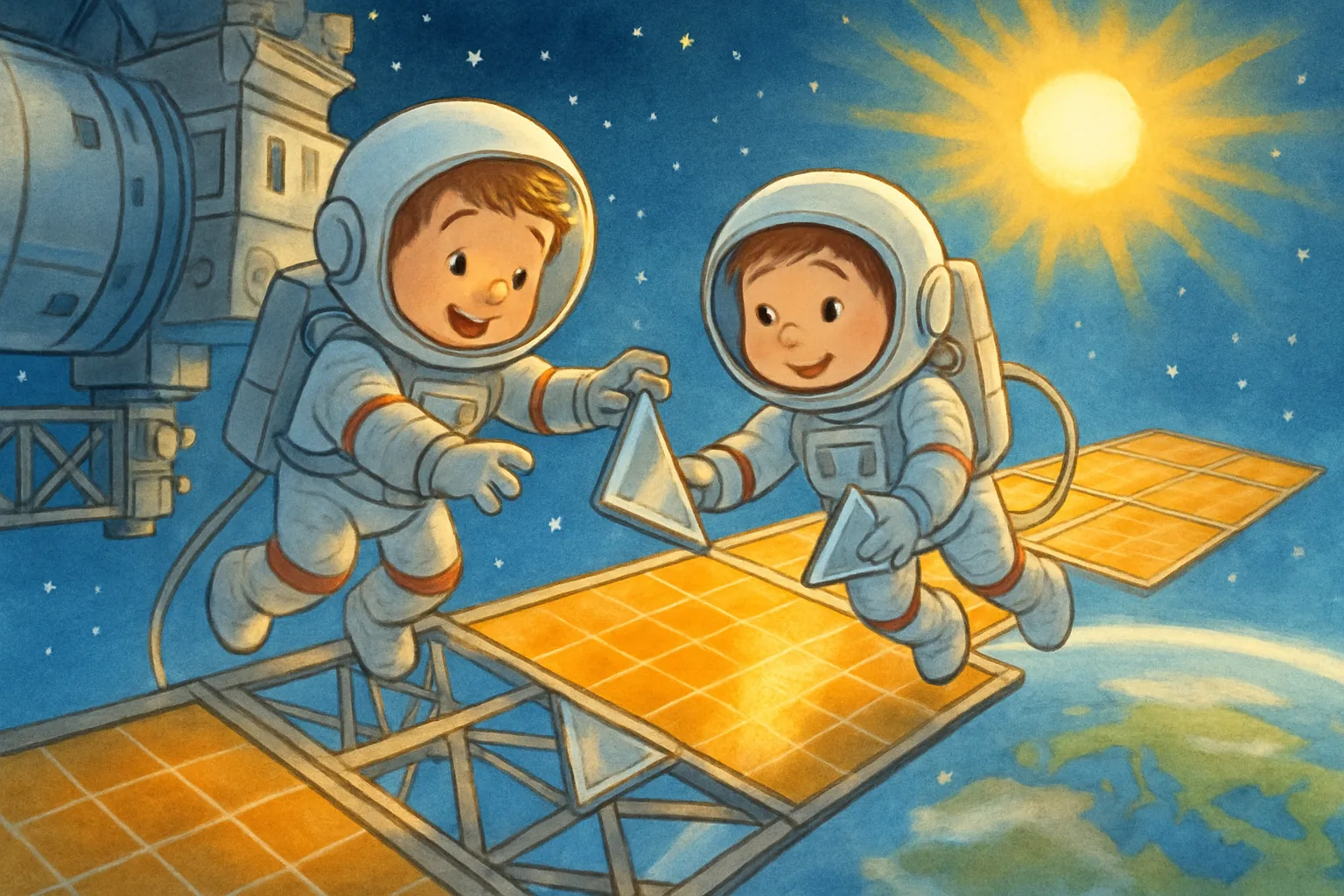
The two astronauts bolted together a set of triangular metal brackets on the outside of the station. Think of it like snapping together a giant LEGO frame in zero gravity. Once those brackets are in place, a brand-new roll-out solar array — called an iROSA — can be attached later this year.
Solar arrays work like giant flat sponges that soak up sunlight and turn it into electricity. The ISS uses electricity to power everything on board: its lights, computers, science labs, and even the air that astronauts breathe.
This was the 281st spacewalk ever performed to help build and maintain the space station. It was also a special moment for Menon — it was his very first spacewalk, just 23 days into his first trip to the ISS. For Meir, it was her sixth career spacewalk. She is also the current commander of the space station.
Since 2021, astronauts have installed six of these new roll-out solar arrays. This new hardware prepares the way for a seventh — and final — one. The extra power will help the station keep running safely all the way until its planned retirement in 2030.
Why Does It Matter?
The ISS has been flying for over 25 years. Like any old machine, it needs regular upgrades to stay powerful and safe. These new solar arrays give the station more electricity than ever before.
More power means the station can run more science experiments, keep its systems healthy, and help future astronauts do more amazing work in space. The new arrays also play a role in keeping the station safe when it is eventually brought down from orbit in a controlled way.
Every spacewalk that adds to or fixes the station is a reminder of what humans can do when they work as a team — even 250 miles above Earth.
Big Words
- Spacewalk — when an astronaut goes outside a spacecraft into open space, also called an EVA (extravehicular activity)
- Solar array — a large panel made of many solar cells that captures sunlight and turns it into electricity
- iROSA — short for ISS Roll-Out Solar Array; a new type of flexible solar panel that unrolls like a scroll when it opens up
- Commander — the lead astronaut in charge of the space station and its crew
- Orbit — the curved path a spacecraft follows as it travels around Earth
Fun Fact
The International Space Station travels at about 17,500 miles per hour. That means Meir and Menon completed their whole spacewalk while zooming around Earth more than four times!
Think About It
If you were going on your very first spacewalk, what would be the first thing you would want to look at from outside the space station?
Sources
- NASA.gov — Spacewalk Begins for Solar Array Modifications
- Space.com — ‘One more step’: NASA astronauts conduct 6.5-hour spacewalk to prep ISS for solar array upgrade
- TechTimes — ISS Spacewalk 96 Complete: Mounting Hardware Cleared for Final Solar Array
- Business Standard — Nasa astronauts Anil Menon, Jessica Meir complete spacewalk to upgrade ISS
- AIAA — NASA Astronauts Complete Spacewalk to Prepare ISS for New Solar Arrays