
🔎 This story is still developing. We will update it as we learn more!
Racing Against the Clock! Rescue Teams Work Day and Night After Japan Earthquake
Quick Summary
A strong earthquake struck southwestern Japan on Tuesday. Rescue workers have been searching day and night for anyone still missing. Tens of thousands of people have left their homes while the search continues.
What Happened?
On Tuesday afternoon, a magnitude 7.1 earthquake shook Kumamoto Prefecture on the southern island of Kyushu in Japan. It registered the highest possible level on Japan’s special earthquake shaking scale — the strongest kind of shaking the scale measures.
The earthquake caused serious damage in several areas. One of the hardest-hit spots was a large shopping mall in a town called Kashima. Thousands of shoppers were inside when the shaking started. About 3,000 customers were safely guided to a parking lot. But an explosion happened in another part of the mall, and the second floor collapsed.
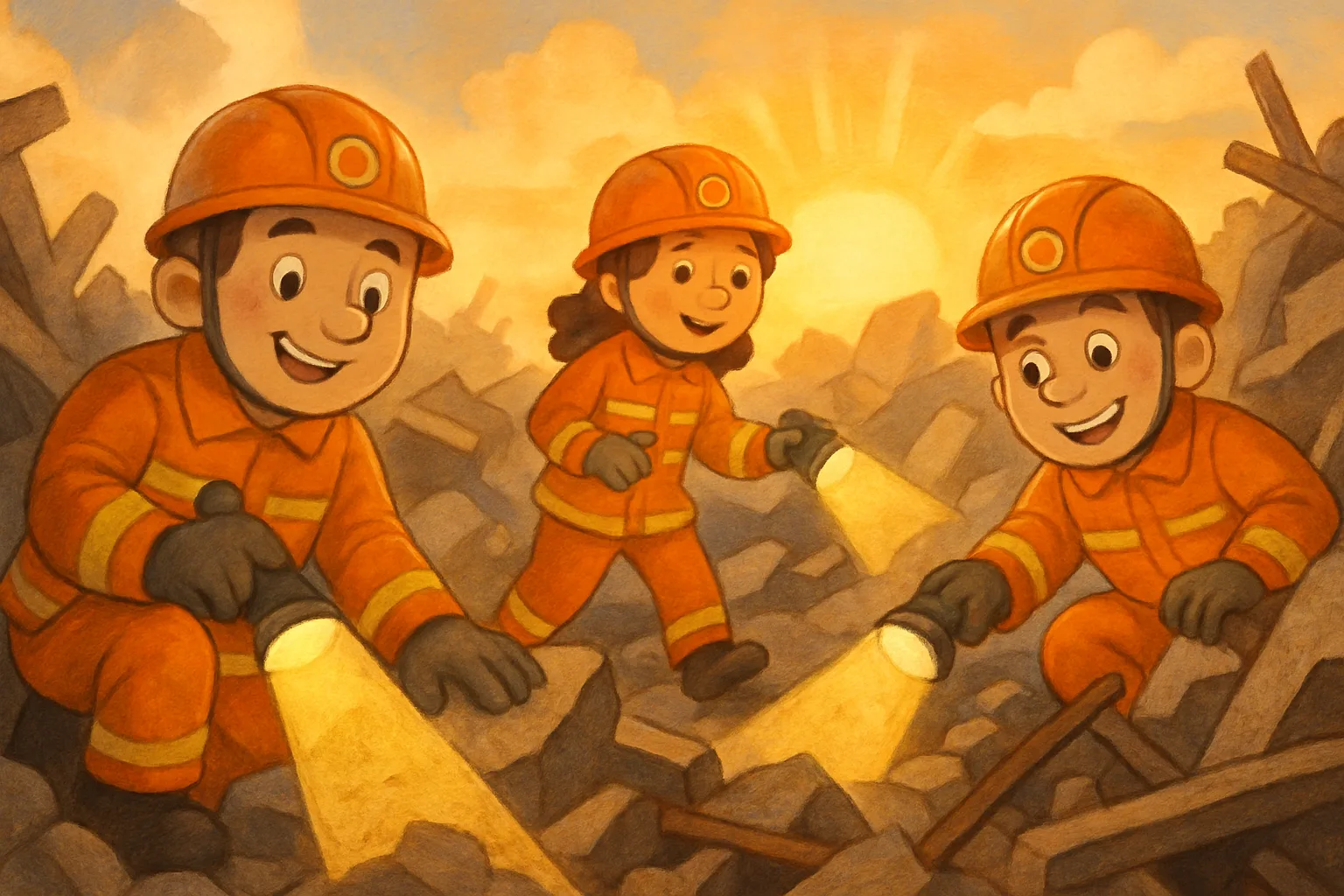
Rescue workers — including firefighters, police, and Japan’s Self-Defense Forces — quickly moved in to help. Soldiers and rescue teams used special equipment to carefully search through broken buildings, looking for survivors.
About 10,000 people had to leave their homes, and more than 400 emergency shelters were set up across the area. Roughly 23,000 homes were without electricity, and about 74,800 homes had no running water. Rescue workers also reminded evacuees to drink enough water and stay cool, because temperatures were forecast to rise above 35 degrees Celsius — that’s about 95 degrees Fahrenheit, nearly as hot as a warm bath.
Why Does It Matter?
Japan is one of the most earthquake-prone countries on Earth. It gets thousands of small earthquakes every year. Because of this, Japanese buildings are built with some of the strictest safety rules in the world. When a big quake still causes damage, it shows just how powerful these events can be.
The story also shows what incredible teamwork looks like in an emergency. Thousands of rescue workers arrived quickly. Neighbor nations offered help through emergency agreements. Communities set up shelters and shared food and water. In difficult moments like this, people working together makes a huge difference.
Big Words
- Magnitude — a number scientists use to measure how strong an earthquake is; a 7.1 is considered a major earthquake
- Seismic intensity — how hard the ground shakes in a specific place during an earthquake; Japan uses a special scale from 0 to 7
- Self-Defense Forces — Japan’s military, which helps with disaster relief and rescue missions
- Evacuate — to leave a dangerous area quickly and go somewhere safe
- Aftershock — a smaller earthquake that follows a bigger one, sometimes hours or days later
Fun Fact
Japan experiences about 1,500 earthquakes every single year — that’s more than 4 per day! Most are so small that people can’t feel them at all.
Think About It
If you were a rescue worker arriving to help after an earthquake, what would be the most important thing you would bring with you, and why?
Sources
- NPR — Hope dwindles for rescue in southwestern Japan quake as death toll climbs
- The Japan Times — Kumamoto quake death toll rises as rescuers race against clock
- Euronews — Death toll from Japan’s earthquake rises as vital 72-hour window for rescues enters critical phase