
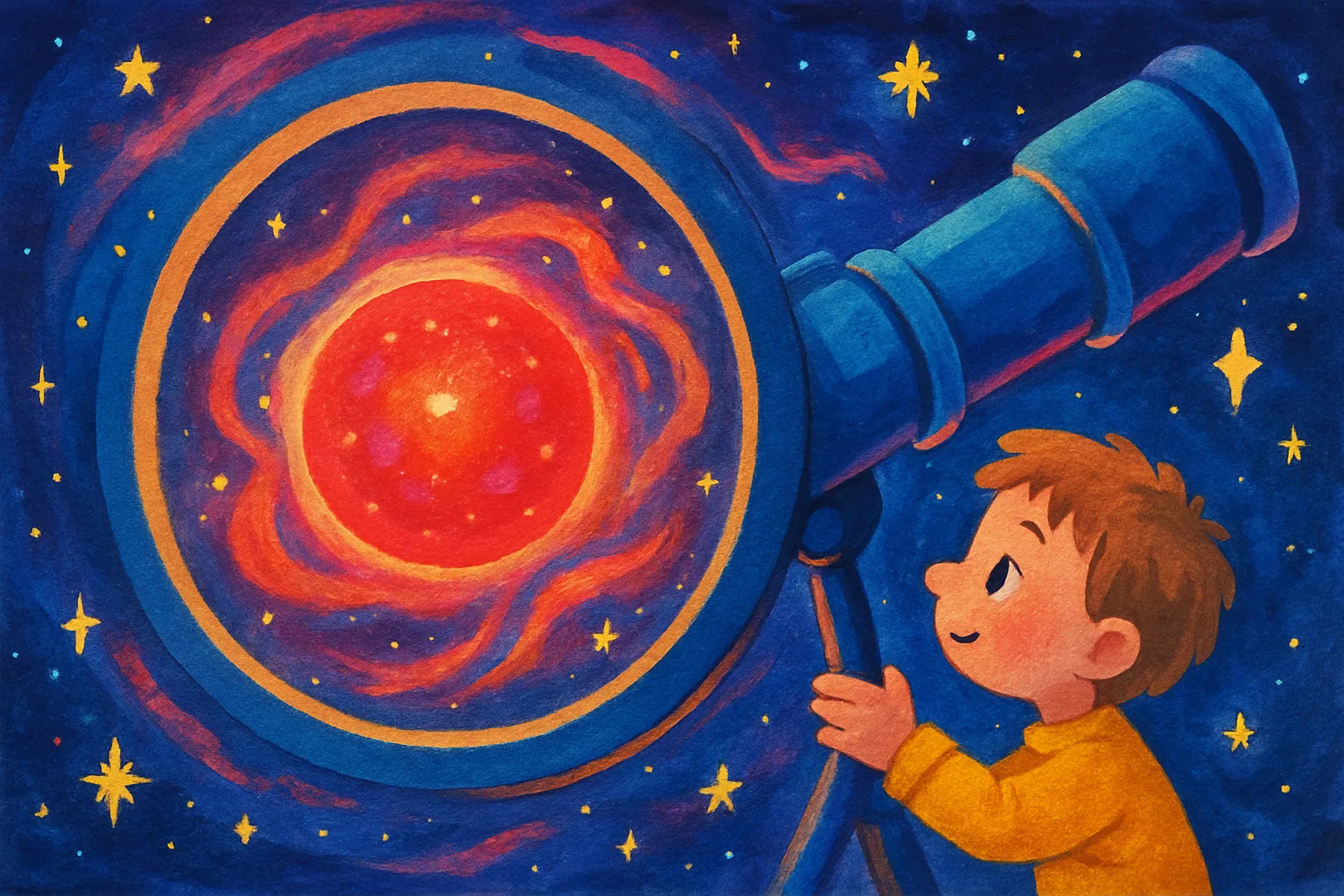
Star or Black Hole? Astronomers Discover a Cosmic Object Nobody Has Ever Seen Before!
Quick Summary
Scientists using the James Webb Space Telescope spotted something in deep space that nobody has ever seen before. It looks like an enormous star. But it blazes with the power of a black hole. Astronomers are calling it a “black hole star.”
What Happened?
For the past few years, the James Webb Space Telescope — the most powerful telescope ever launched — has been puzzling scientists. It kept finding hundreds of tiny, super-bright red dots scattered across the very early universe. Nobody could figure out what they were.
Now, a team of scientists from MIT and other universities may have cracked the mystery. They studied one of those red dots very closely. It dates back to about 660 million years after the Big Bang — which sounds like a long time, but the universe is about 13.8 billion years old. So this object existed when the universe was like a very young toddler.
What they found was wild. The object, named MoM-BH*-1, looks like a star roughly the size of our entire solar system. That’s already enormous — imagine a ball that could swallow up Earth, Mars, Jupiter, and everything else in our neighborhood. But this thing shines with 100 billion times more energy than any star could possibly make. Normal stars glow by burning fuel inside themselves. But nothing burns that brightly.
The best explanation, say the scientists, is that a massive black hole sits at the center. It is wrapped inside a huge cloud of gas, like a gift stuffed inside a bag. The black hole gobbles up material, and all that energy bursts out as blinding light. It is not quite a star. It is not quite an ordinary black hole. It is something brand new.
The study was published in the science journal Nature.
Why Does It Matter?
Black holes are one of the biggest mysteries in science. They are so heavy and so dense that even light cannot escape them once it gets too close. Scientists have long wondered how some black holes grew to be billions of times heavier than our Sun — so quickly, so early in the universe’s life. That should be almost impossible.
Black hole stars could be the answer. If this kind of object really exists and is common, it might explain how those super-massive black holes formed so fast. Every one of those puzzling little red dots the telescope has spotted could be a black hole star in disguise.
Right now, this is the strongest evidence yet. Scientists will keep studying these objects to learn more.
Big Words
- Black hole — a region of space where gravity is so strong that nothing, not even light, can escape it.
- Black hole star — a brand-new kind of cosmic object: a giant black hole wrapped inside a huge cloud of glowing gas that looks like a star from far away.
- Telescope — a tool that collects light from far-away objects, making them easier to study; the James Webb Space Telescope collects infrared light from billions of light-years away.
- Big Bang — the moment scientists believe the universe began, about 13.8 billion years ago, when all matter and energy exploded outward from an incredibly tiny point.
- Quasar — an extremely bright object in the early universe powered by a rapidly growing black hole; black hole stars may be related to quasars.
Fun Fact
The James Webb Space Telescope launched on Christmas Day 2021 and now orbits nearly 1 million miles from Earth — about four times the distance to the Moon. At that distance, it can study light that left its source over 13 billion years ago!
Think About It
If a black hole is hidden inside something that looks like a star, what other surprises might be hiding inside objects we think we already understand?
Sources
- CBS News — Newly discovered ‘black hole star’ could solve mystery of strange red dots spotted in the early universe
- ScienceDaily / MIT — JWST spots a bizarre ‘black hole star’ 100 billion times brighter than a star
- Phys.org — Mirage or miracle? JWST finds earliest known ‘black hole star’ at cosmic dawn
- TechExplorist — A brand-new type of astrophysical object discovered: A black hole star