
City of Stars! James Webb Telescope Finds Billions of Hidden Stars in Ancient Galaxies
Quick Summary
Scientists using the James Webb Space Telescope have made a surprising discovery. Ancient galaxies are hiding enormous numbers of small, faint stars that were too dim to spot before. This means these galaxies may be three to four times more massive than scientists previously thought!
What Happened?
An international team of astronomers studied nine very old galaxies using NASA’s James Webb Space Telescope (JWST). These galaxies stopped making new stars billions of years ago. Scientists wanted to understand exactly how heavy — or “massive” — they really are.
For a long time, astronomers could only count the brightest stars in faraway galaxies. They assumed the ratio of big stars to small stars was similar to what we see in our own Milky Way galaxy. But JWST is so powerful it can detect faint signals that older telescopes simply missed.
When scientists split the galaxies’ light into different colors — a process called spectroscopy — they found something stunning. Hidden between all the blazing bright stars were enormous numbers of tiny, faint stars. These small stars had been there all along, invisible to earlier telescopes.
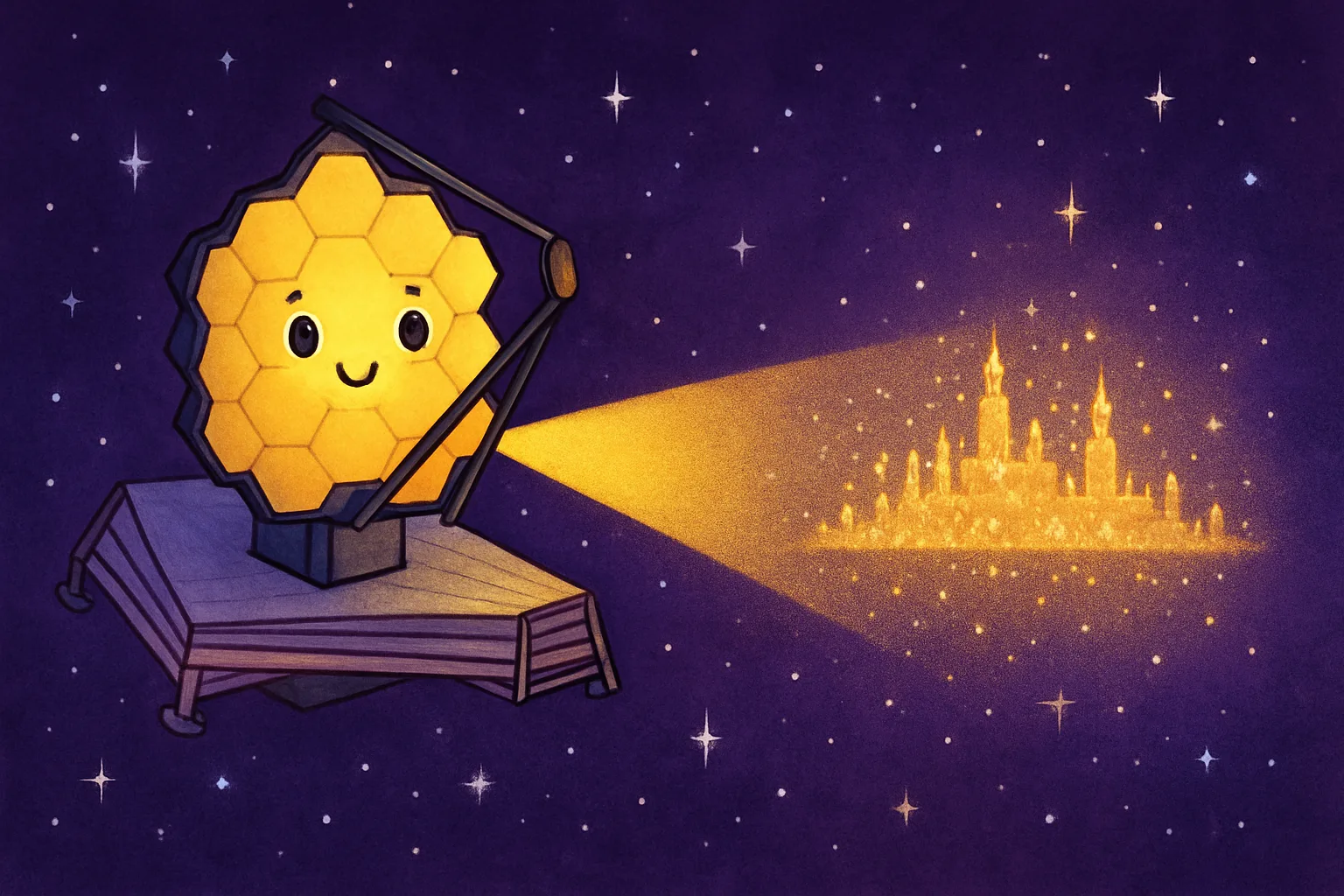
Lead scientist Chloe Cheng compared it to looking at a city from far away. If you stare at a city from a great distance, you only see the tallest skyscrapers. But get closer, or use a much more powerful tool, and you start to notice thousands of smaller buildings tucked in between. That is exactly what JWST did for these galaxies — it revealed the “smaller buildings” hiding between the “skyscrapers.”
The result? Some of these ancient galaxies may be three to four times heavier than scientists estimated. That is like thinking a backpack weighs 10 pounds and then discovering it actually weighs 30 to 40 pounds!
The research was published in the science journal Nature Astronomy. Scientists at Penn State University and Leiden University in the Netherlands were part of the team. They also used data from the Very Large Telescope in Chile to confirm their findings.
Why Does It Matter?
This discovery creates a big new puzzle. Scientists already knew from JWST that huge, old galaxies existed surprisingly early after the Big Bang — far sooner than theories predicted. Now those same galaxies turn out to be even bigger than thought. That makes the mystery even harder to solve.
Understanding how galaxies form and grow helps scientists piece together the full story of the universe — from the Big Bang nearly 14 billion years ago all the way to today. It also hints that planets around small, faint stars may have been far more common in the early universe than anyone realized.
Scientists plan to study many more galaxies with JWST to see if this surprising pattern is true everywhere.
Big Words
- Galaxy — a huge group of stars, gas, and dust held together by gravity; our home galaxy is called the Milky Way
- Spectroscopy — splitting light into its different colors (like a rainbow) to learn what something is made of or what kinds of stars it contains
- Massive — in science, “massive” means having a lot of mass, or matter; it does not just mean “large in size”
- Big Bang — the enormous event about 13.8 billion years ago when the universe began expanding from a tiny, incredibly hot point
- Stellar population — all the different types of stars found inside a galaxy, from giant bright ones to tiny dim ones
Fun Fact
The James Webb Space Telescope is so sensitive it could detect the heat of a bumblebee on the Moon from here on Earth. That incredible power is what allowed it to spot faint stars hidden inside galaxies billions of light-years away.
Think About It
If you could build a telescope even more powerful than JWST, what would you most want to look at in the universe, and why?
Sources
- Penn State / ScienceDaily — Hidden stars suggest that distant galaxies are more massive than they appear
- Space.com — James Webb Space Telescope finds ‘hidden stars’ making the universe’s 1st galaxies much bigger than we knew
- Knowridge Science Report — Hidden Stars Reveal Early Galaxies Were Far Bigger Than We Thought
- Nature Astronomy — Cheng et al., ‘Hidden mass in early galaxies revealed by bottom-heavy initial mass functions,’ 2026