
Ancient Footprints in Kenya Reveal a Surprisingly Big Human Relative!
Quick Summary
Scientists studied ancient footprints discovered in Kenya, Africa. The tracks are 1.4 million years old. They show that a human relative called “Nutcracker Man” was much larger than scientists had thought — and walked in groups!
What Happened?
Imagine stepping in wet mud near a lake, leaving a perfect footprint behind — and that print being preserved for 1.4 million years. That is exactly what happened near Lake Turkana in northern Kenya.
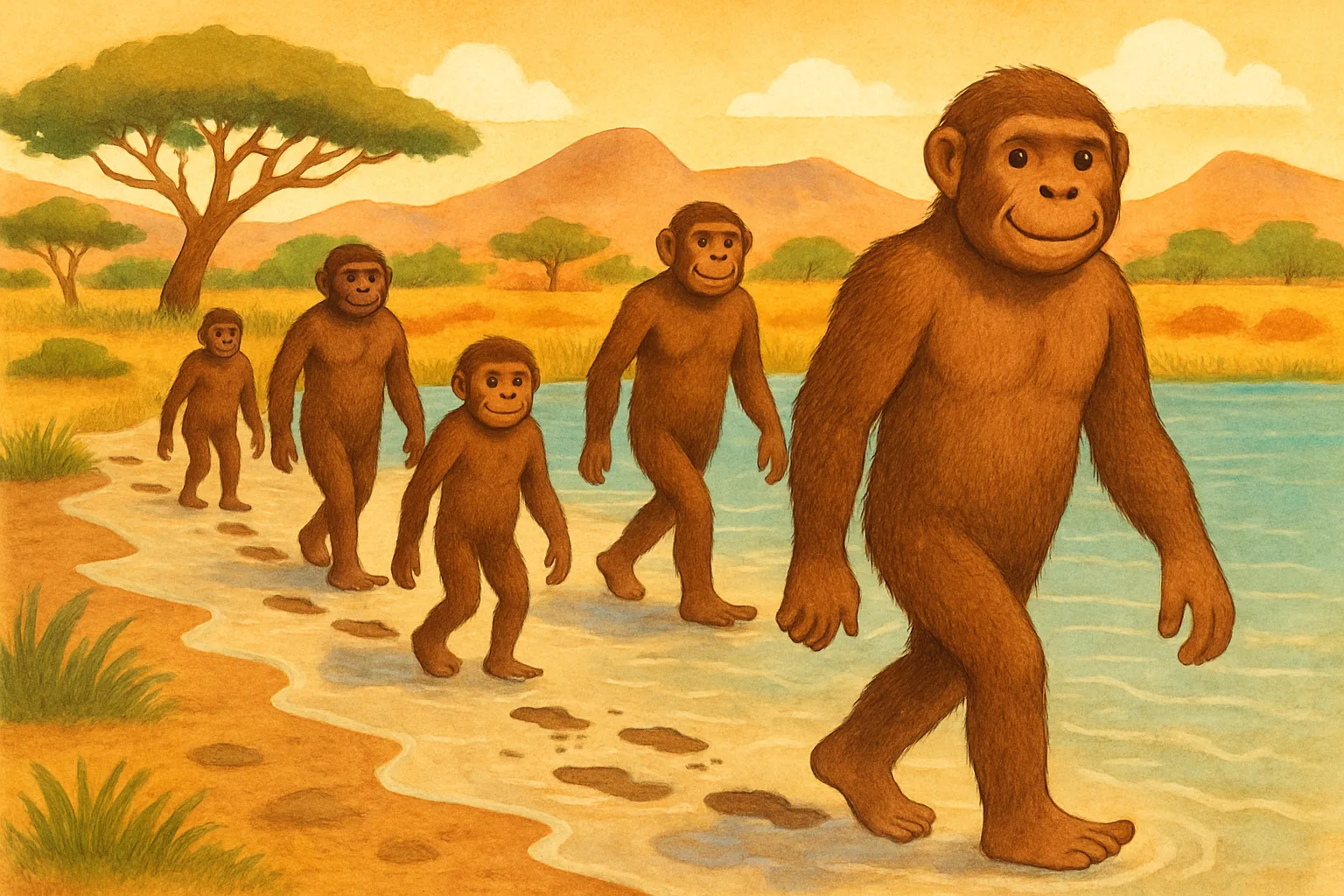
Scientists found 21 fossilized footprints left by eight individuals walking together along an ancient lakeshore. A new study, published in the prestigious science journal Proceedings of the National Academy of Sciences, examined these tracks in amazing detail.
The footprints were most likely made by a creature called Paranthropus boisei. Scientists nicknamed it “Nutcracker Man” because of its enormous, powerful teeth and wide jaw — built for chewing tough plants and seeds. Imagine a face like a very powerful nutcracker!
Here is the big surprise. Scientists used to think Nutcracker Man was quite small. But the footprints tell a different story. Based on the size of the tracks, some of these individuals may have stood about 1.8 meters tall — nearly 6 feet. That is about as tall as a grown adult today. They may have weighed around 75 kilograms, similar to an average adult human.
The footprints also showed that multiple large adults were traveling together. Researchers think the group included several adult males walking side by side across the muddy shore. Hippos, antelope, and other animals left prints on the same shoreline.
What is really special about footprints is that they capture a single moment in time — like a photograph in mud. Fossils usually only preserve bones, which tell you what an animal looked like but not how it moved or who it traveled with. Footprints do all of that.
The site was first discovered all the way back in 1978 by a scientist named Kay Behrensmeyer from the Smithsonian. Teams returned in 2016 and 2023 to excavate more prints. The full study has now been published.
Why Does It Matter?
This discovery rewrites part of our understanding of human evolution. We now know Nutcracker Man was bigger and more humanlike in body size than scientists had guessed from bones alone. It also shows that these ancient relatives may have lived and traveled in social groups — not alone.
Every new footprint adds one more piece to the puzzle of how our ancient relatives lived millions of years ago, long before modern humans appeared.
Big Words
- Fossil — the preserved remains or traces of a living thing from long ago, turned to rock over time
- Paleoanthropologist — a scientist who studies ancient human relatives using fossils and other clues
- Paranthropus boisei — an extinct human relative that lived in Africa from about 2.3 million to 1.2 million years ago
- Hominin — the group of species that includes modern humans and all our closest extinct relatives
- Trackway — a series of footprints left by an animal, preserved in rock or hardened mud
Fun Fact
The volcanic ash surrounding the footprints helped scientists date them. When a volcano erupts, it leaves a distinctive layer of ash that scientists can date precisely — like a time stamp baked into the ground!
Think About It
If scientists in the future found YOUR footprints fossilized in mud, what could they learn about you just from looking at your tracks?
Sources
- SciTechDaily — 1.4-Million-Year-Old Footprints Reveal a Giant Human Relative (PNAS)
- Discover Magazine — Ancient Footprints Reveal Eight Human Relatives Walked Together Along a Kenyan Lakeshore 1.4 Million Years Ago
- Phys.org — Fossil footprints reveal body size and group dynamics of 1.4-million-year-old human relative
- Sci.News — Ancient Footprints in Kenya Hint at Bigger Bodies and Group Behavior among Early Human Relatives
- Smithsonian Magazine — Ancient Fossil Footsteps Found in Kenya May Hint That an Early Human Relative Was Larger Than Previously Thought