
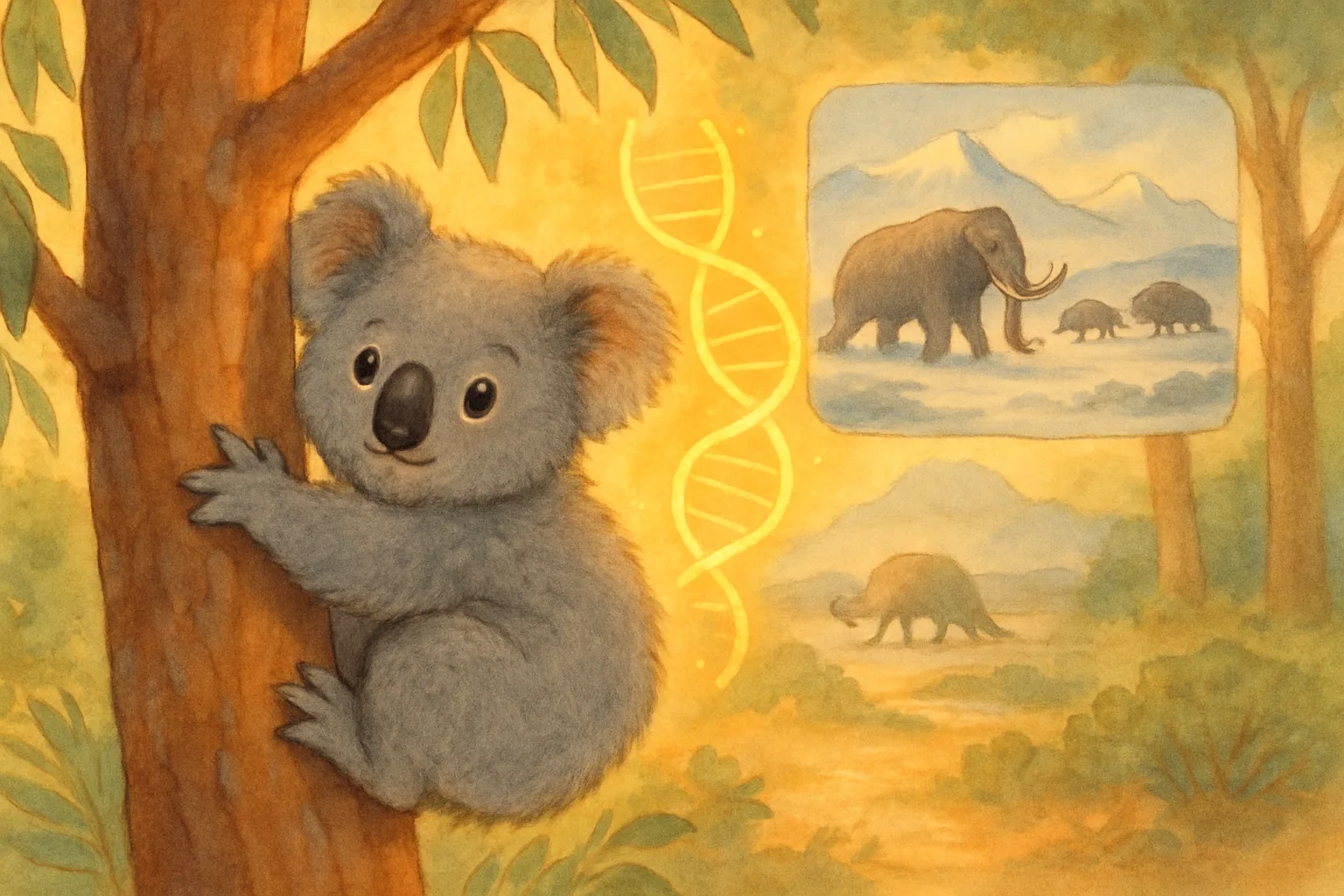
Surprise! Koalas Nearly Vanished Long Before People Arrived — DNA Has the Proof
Quick Summary
Scientists have rewritten the history of koalas. A major new DNA study shows that koalas nearly disappeared from Earth about 100,000 years ago. That is long before the first humans ever set foot in Australia — and it was the climate, not people, that almost wiped them out.
What Happened?
Researchers at the University of Sydney and Texas A&M University studied the DNA of 457 koalas from across Australia. That is like reading the genetic diaries of hundreds of koala families.
By measuring how quickly tiny genetic changes — called mutations — build up over time, scientists could work backward like a clock. They rebuilt a timeline of how many koalas lived at different points in history.
What they found was shocking. Koala numbers started dropping about 100,000 years ago. The population hit rock bottom around 60,000 years ago — during the last ice age. That is when Australia’s climate became much drier and cooler.
The drying conditions split the country in half. Koalas in the west died out. Only a small group of koalas in eastern Australia survived. Every single koala alive today is a descendant of that tiny, tough eastern group. Think of it like all the people on Earth being descendants of one small village.
Humans did not arrive in Australia until around 60,000 years ago — roughly when the koala population was at its lowest. So people were not the cause of this ancient crisis.
Lead researcher Toby Kovacs, a PhD student at the University of Sydney, said the study “rewrites the timeline for the koala’s genetic history.”
Why Does It Matter?
Koalas are currently endangered in parts of Australia. Their numbers today are threatened by habitat loss, disease, and wildfires — all caused or worsened by people.
Knowing that koalas once bounced back from near-extinction gives scientists important clues. It shows which groups of koalas have the healthiest genes for surviving hard times. That knowledge can help conservationists make smarter choices to protect koalas today.
It also shows us that climate change is not a new threat to wildlife — it has shaped life on Earth for hundreds of thousands of years.
Big Words
- Genome — the complete set of DNA instructions inside a living thing, like a full recipe book for building that animal.
- Mutation — a tiny change in DNA that happens naturally over time and gets passed from parents to offspring.
- Population bottleneck — when a species’ numbers crash so low that only a small group survives to rebuild the population.
- Ice age — a long, very cold period in Earth’s history when ice sheets covered large parts of the planet.
- Endangered — when a species has so few individuals left that it is at risk of disappearing forever.
Fun Fact
Researchers read the DNA of 457 individual koalas for this study. If you stacked all that genetic code end to end, it would stretch far enough to wrap around Earth many times over!
Think About It
Koalas survived a near-extinction 100,000 years ago without any human help. What do you think helped them make it through? And what can we do today to make sure they survive the threats they face now?
Sources
- ScienceDaily — Koalas nearly went extinct before humans arrived, DNA study reveals (July 17, 2026)
- University of Sydney — Koala population crash came before humans, genomic study reveals
- Phys.org — Koala population crash came before humans, genomic study reveals
- Molecular Biology and Evolution (Oxford University Press) — Mutation rate estimate and population genomic analysis reveals decline of koalas prior to human arrival