
Scientists Recreated the Stuff From Right After the Big Bang — In a Machine!
Quick Summary
Scientists at CERN used the world’s largest machine to smash tiny atoms together. The collisions created signs of a super-rare form of matter that filled the entire universe just after the Big Bang. All four major experiments at the Large Hadron Collider spotted these signs at the same time!
What Happened?
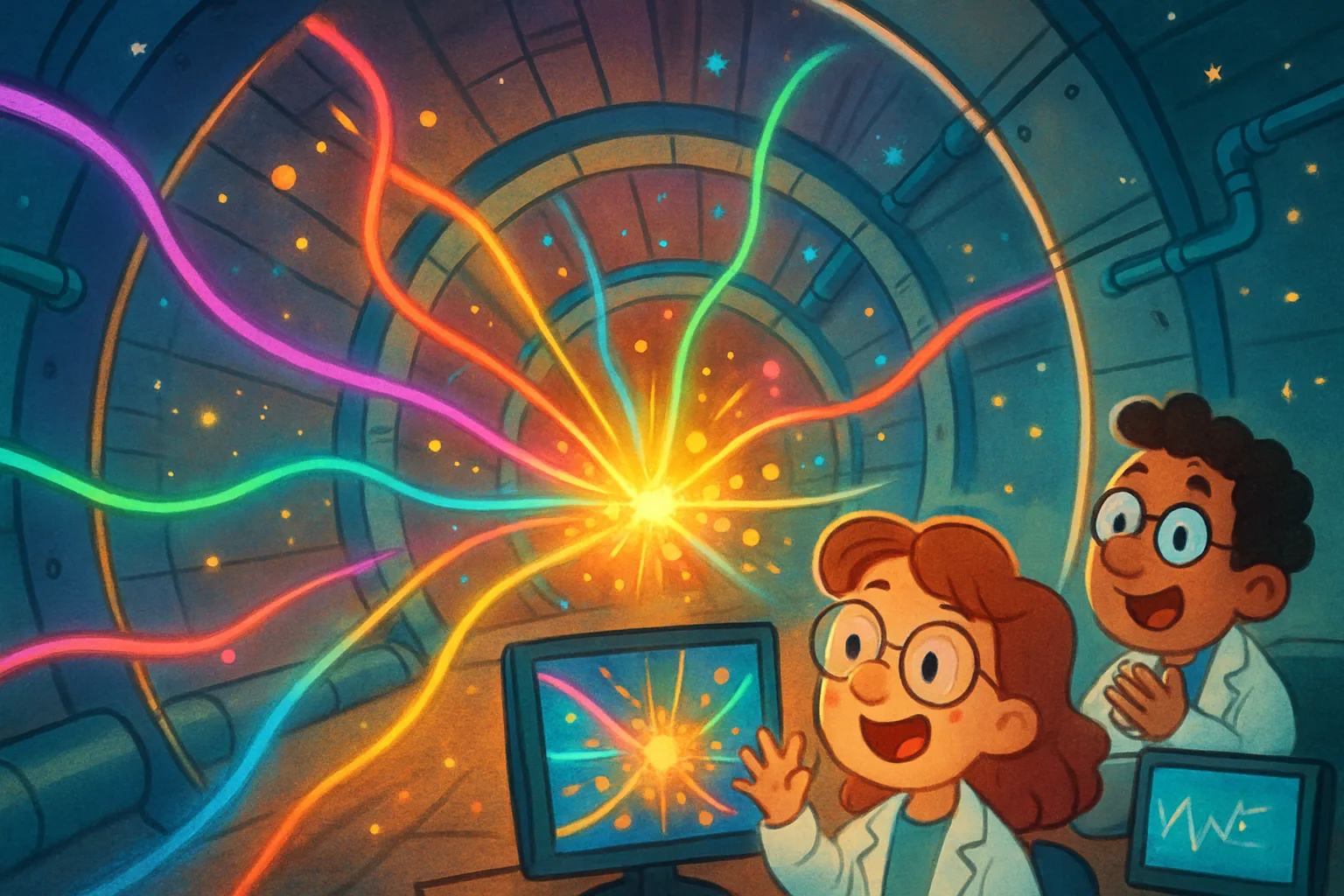
Deep underground near Geneva, Switzerland, sits a giant ring-shaped machine called the Large Hadron Collider, or LHC. It is 17 miles around — so big you could fit the entire island of Manhattan inside it. Inside this ring, scientists shoot tiny particles at each other at nearly the speed of light and watch what happens when they crash.
This week, scientists reported something extraordinary. All four of the main experiments at the LHC found signs of a very special substance called quark-gluon plasma, or QGP. This is a form of matter that scientists believe filled the entire universe during the very first millionths of a second after the Big Bang — the enormous explosion that created our universe about 13.8 billion years ago.
QGP is extremely unusual. Normally, the tiny particles called quarks are locked tightly inside other particles. Think of quarks like marbles stuck inside a rubber ball — they never get to roam free. But under unbelievable heat and pressure — temperatures more than 100,000 times hotter than the center of our Sun — those rubber balls break apart and the marbles go wild. That wild, soupy state is quark-gluon plasma.
For a long time, scientists thought you could only create QGP by smashing huge, heavy atoms like lead together. Lead atoms are more than 200 times heavier than a single proton. But this new result is different and surprising. Scientists smashed much smaller atoms — oxygen and neon — and still found signs of QGP. Oxygen atoms are about 16 times smaller than lead atoms. It is like discovering you can make the same amazing fireworks from a small sparkler that you thought only a giant rocket could produce.
All four research teams — called ALICE, ATLAS, CMS, and LHCb — reported finding the same signs independently. That agreement between four separate groups of scientists makes the result much more convincing.
Why Does It Matter?
By recreating the conditions of the very first moments of the universe, scientists can test their ideas about how everything came to exist. Every answer leads to even more fascinating questions about where we all came from.
This result also shows that quark-gluon plasma may form more easily than scientists thought. That changes our understanding of what the early universe looked like — and opens up new experiments to explore.
Big Words
- Large Hadron Collider (LHC) — the world’s biggest and most powerful particle accelerator, located underground near Geneva, Switzerland
- Quark-gluon plasma — an ultra-hot, soupy state of matter where tiny particles called quarks roam free instead of being locked inside other particles
- Quarks — incredibly tiny building blocks that combine to form the particles (like protons) inside every atom
- Big Bang — the enormous event about 13.8 billion years ago when the universe began expanding from an extremely hot, dense point
- Particle accelerator — a machine that speeds up tiny particles to nearly the speed of light and smashes them together so scientists can study what they are made of
Fun Fact
The LHC uses enough electrical power to run about 300,000 homes. And it keeps its superconducting magnets colder than outer space — at -271°C — to work properly!
Think About It
If you could build a machine to study one big mystery about the universe, what would you want to find out?
Sources
- CERN — Oxygen collisions at the LHC show new indications of extreme state of matter
- Phys.org — Oxygen collisions at the LHC show new indications of extreme state of matter (July 24, 2026)
- SciTechDaily — CERN Experiments Detect Signs of the Universe’s Primordial Matter
- Innovation News Network — LHC experiments on oxygen and neon collisions show quark-gluon plasma