
Did Life Begin… Twice? A Mind-Bending Discovery About Earth’s Oldest Secret
Quick Summary
Scientists have found surprising new clues about how life first appeared on Earth — and the answer might be stranger than anyone expected. A new study suggests that the very first living cells may have appeared not once, but twice. The discovery is shaking up one of biology’s biggest questions.
What Happened?
For a long time, scientists believed all life on Earth traces back to a single, very first cell. Imagine a giant family tree. Scientists thought there was just one original seed at the very bottom of that tree.
But now, a team of researchers from Heinrich Heine University in Düsseldorf, Germany, has found evidence of something remarkable. They studied the chemistry of the two most ancient types of living things on Earth: bacteria and archaea (say it like “ar-KEY-uh”). These are both incredibly tiny, single-celled organisms — so small that a million of them could fit in a drop of water.
The researchers traced how these two groups build the basic ingredients they need to live. They looked at the special molecules called enzymes that do the work inside each type of cell. Here is what surprised them: bacteria and archaea use completely different enzymes to do the same jobs. It is like if two different people both built the same sandwich, but one used a knife and the other used scissors — they reached the same result in totally different ways.
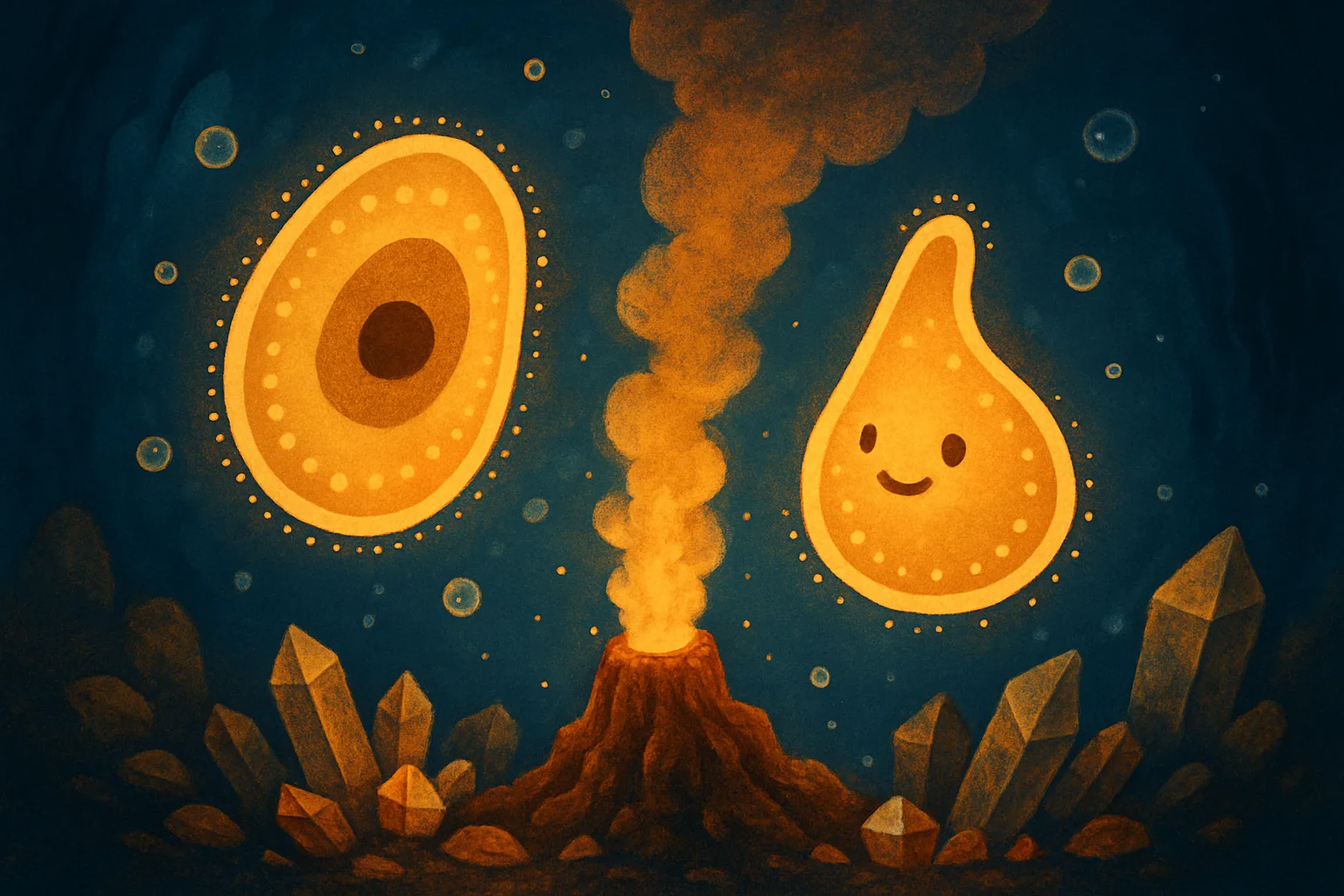
This tells scientists that bacteria and archaea probably did NOT both copy their way of living from a single, fully alive ancestor. Instead, both groups appear to have figured out how to become truly “alive” on their own, separately.
The study was published in a science journal called Science Advances. The researchers believe this happened around 4 billion years ago, near bubbling hot water vents deep on the ocean floor. Before either group became fully alive, a shared ancestor existed — but that ancestor was not quite alive in the way we mean today. It still needed minerals and metals from its watery environment to help run its chemistry.
The lead researcher put it this way: there is one origin of the genetic code shared by all life — but two separate moments when cells crossed the line from non-living to truly living.
Why Does It Matter?
This discovery changes how we picture life’s earliest history. It suggests life is very good at figuring things out. Even faced with the same impossible challenge — becoming alive — two different groups found their own path.
For scientists searching for life on other planets, this is exciting news. If life emerged independently more than once here on Earth, that hints that life might not need just the perfect moment to appear. It might find a way in more than one place, more than one time.
Researchers say the discovery is still new, and more work is needed. But it is already one of the most talked-about biology findings of the year.
Big Words
- Bacteria — the most common type of single-celled living thing on Earth; they live almost everywhere, from soil to your stomach.
- Archaea — another group of ancient, single-celled life forms; they often live in extreme places like boiling hot springs or very salty lakes.
- Enzyme — a special molecule inside a cell that acts like a tiny tool, helping to speed up the chemical reactions the cell needs to survive.
- Hydrothermal vent — a crack in the ocean floor where hot water and minerals shoot up from inside the Earth; scientists think life may have started near these.
- Evolution — the slow process by which living things change over many generations, often developing new traits that help them survive.
Fun Fact
Archaea were only discovered to be a completely separate group from bacteria in the 1970s. Before that, scientists lumped them all together. Today we know archaea can survive in boiling, acidic, or super-salty places that would kill almost anything else — making them some of the toughest living things on the planet!
Think About It
If life appeared twice on Earth — in two different ways — do you think it could appear on other planets too? What kind of environment do you imagine life might need to get started somewhere else in the universe?
Sources
- ScienceDaily — ‘Scientists find evidence for two origins of life on Earth’ (Aug 11–12, 2026)
- SciTechDaily — ‘Did Cellular Life Begin Twice? New Study Points to Two Independent Origins’
- Phys.org — ‘Two origins of life: Free-living cells may have emerged twice as bacteria and archaea diverged’
- ScienceAlert — ‘Radical Study Suggests Life on Earth Arose Twice’