
Happy Birthday, Lucy! NASA’s Asteroid Explorer Turns 5 in Space Today
Quick Summary
Exactly five years ago today — October 16, 2021 — NASA launched a spacecraft called Lucy on a grand adventure. Lucy is on a 12-year journey to visit 11 different asteroids near Jupiter. Today, it is more than 550 million miles from Earth and still going strong.
What Happened?
At 9:34 in the morning on October 16, 2021, a rocket blasted off from Cape Canaveral, Florida, carrying the Lucy spacecraft into the sky. NASA named the mission after a famous fossil — the 3.2-million-year-old bones of an early human ancestor discovered in Ethiopia in 1974. Just as those bones taught scientists about our ancient history, the Lucy spacecraft is meant to teach us about the ancient history of the solar system.
Lucy’s targets are called Trojan asteroids. These are rocky space rocks that share Jupiter’s path around the Sun. They travel in two giant groups — one cluster ahead of Jupiter and one behind it, like a pair of bodyguards on either side of the planet. Scientists believe these asteroids formed very early in our solar system’s history, about 4.5 billion years ago. Studying them is a bit like opening a time capsule from when the planets were just being born.
Over its 12-year mission, Lucy will fly past a record-breaking 11 different asteroids — more than any spacecraft has ever visited. It has already zoomed past three asteroids in the main asteroid belt between Mars and Jupiter. Its first visit to a Trojan asteroid is expected in 2027.
As of today, Lucy is more than 550 million miles from Earth — farther away than the distance between the Sun and Jupiter. Yet it is right on track and perfectly healthy.
Why Does It Matter?
The Trojan asteroids are like frozen leftovers from the early solar system. By studying them up close, Lucy may help answer big questions: How did the planets form? Where did Earth’s water come from? How did our solar system get its shape? Every asteroid Lucy visits is a new clue in one of the biggest puzzles in science.
Big Words
- Trojan asteroids — two large groups of rocky objects that share Jupiter’s orbit around the Sun, traveling ahead of and behind the planet
- Asteroid — a rocky object, smaller than a planet, that orbits the Sun
- Flyby — when a spacecraft passes close to an object in space to take pictures and measurements without stopping or landing
- Time capsule — something that preserves information from the past so future people (or scientists!) can learn from it
- Orbit — the curved path an object takes as it travels around a star, planet, or moon because of gravity
Fun Fact
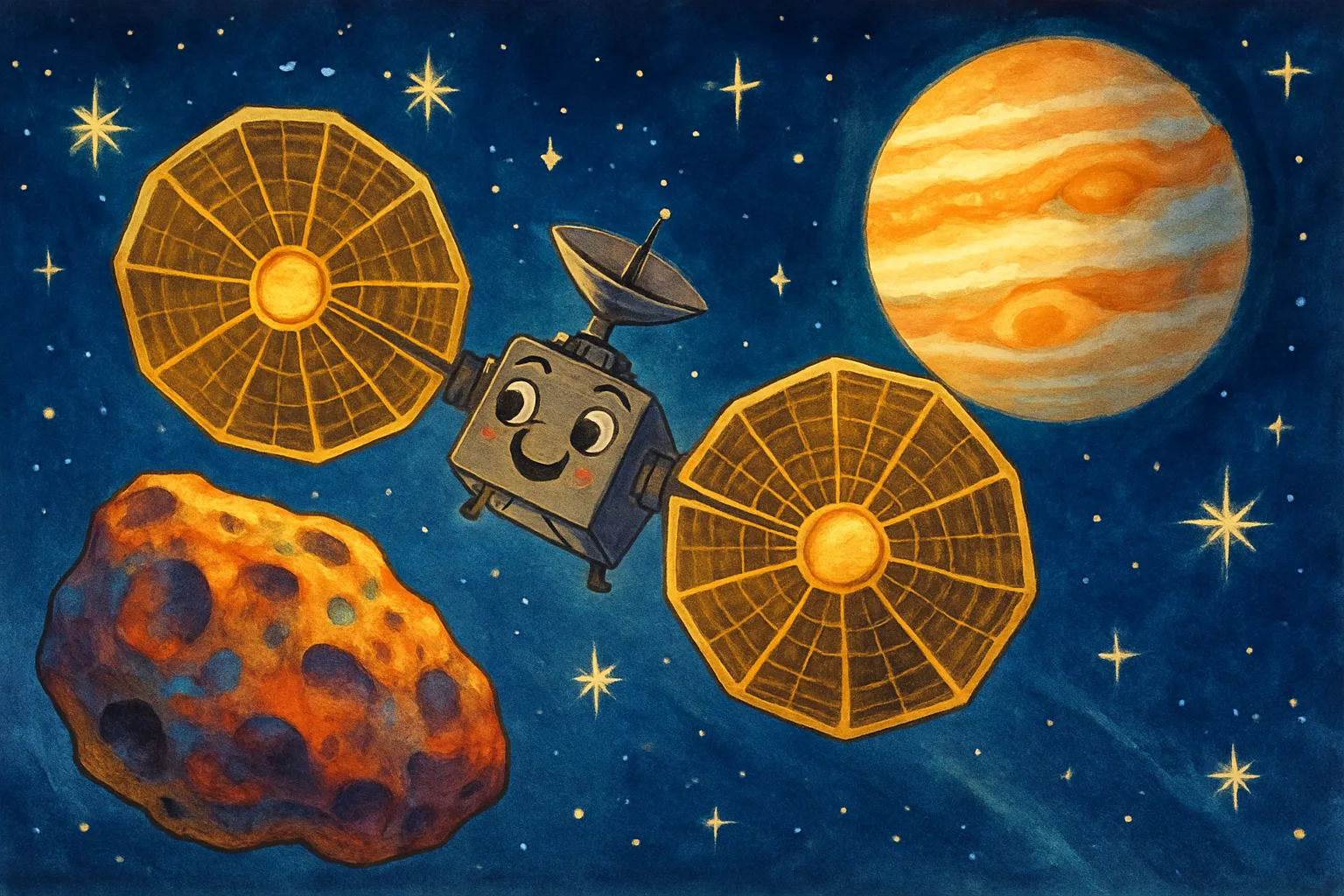
The Lucy spacecraft has two enormous circular solar panels — each one about as wide as a school bus is long — that it uses like wings to collect sunlight for power, even billions of miles from the Sun.
Think About It
If you could design a spacecraft to visit any part of the solar system, where would you send it, and what would you hope to discover there?
Sources
- NASA Science — Lucy Mission Overview and launch records
- Starlust — NASA’s Lucy spacecraft marks 5th launch anniversary (Oct. 16, 2026)
- SpaceCalendar — 5 Years in Space: Lucy Spacecraft (Oct. 16, 2026)
- Wikipedia — Lucy (spacecraft)