
Mystery Solved! Giant Space Waves Are Stealing Mars’ Air
Quick Summary
Scientists figured out why Mars lost most of its air billions of years ago. The Sun’s powerful wind creates giant waves that sweep Mars’ atmosphere away into space. A new study published this week explains how this works.
What Happened?
Mars did not always look like the cold, empty desert it is today. Long ago, it had a thicker atmosphere — a layer of gas around it — and scientists believe liquid water once flowed on its surface. Over billions of years, that atmosphere slowly disappeared. Now scientists know one big reason why.
A new study by researchers at Boston University, published in the journal Science Advances, reveals that the Sun is the main culprit. The Sun constantly shoots a stream of charged particles into space. Scientists call this the solar wind. Think of it like an invisible river of tiny speeding particles that never stops flowing.
Earth has a strong magnetic shield — like a force field — that blocks most of the solar wind. Mars does not have that shield. So the solar wind hits Mars’ upper atmosphere directly.
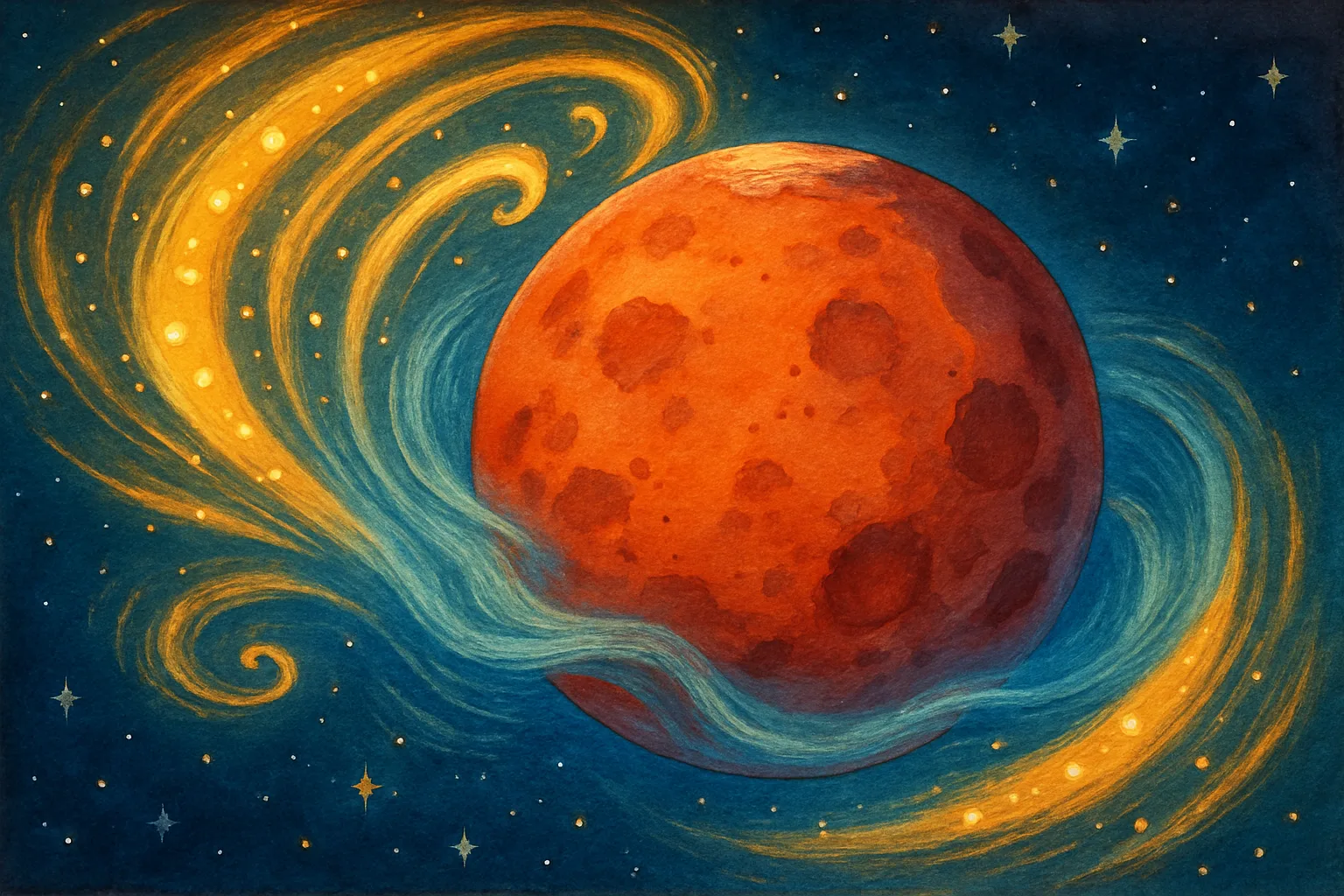
Here is the really cool part. When the solar wind rushes past Mars, it stirs up the outer edge of the atmosphere. This creates giant rolling waves — similar to the waves you see when wind blows across a lake. Scientists call these Kelvin-Helmholtz waves. These waves grow enormous and break apart into huge clouds of electrically charged gas called plasma. Those plasma clouds carry atmospheric particles off into space, a little bit at a time.
Researchers figured this out by combining data from two spacecraft. NASA’s MAVEN orbiter tracked particles escaping Mars. China’s Tianwen-1 spacecraft measured the incoming solar wind before it reached the planet. Together, the two spacecraft gave scientists the full picture.
Why Does It Matter?
This discovery helps scientists understand how a planet can change from warm and wet to cold and dry over billions of years. Mars may have once been a place where life could have existed. Understanding what happened there helps us appreciate how special Earth’s magnetic shield really is.
It also helps scientists think about other planets around distant stars. Many planets may not have magnetic fields. Now we know those planets could be slowly losing their atmospheres the same way Mars did.
Big Words
- Atmosphere — the layer of gases that surrounds a planet, like the air around Earth
- Solar wind — a steady stream of charged particles that shoots out from the Sun in all directions
- Magnetic field — an invisible force field around a planet that can deflect solar wind — Earth has one, Mars does not
- Kelvin-Helmholtz waves — giant rolling waves that form when two fluids (like air and solar wind) move past each other at different speeds
- Plasma — a superheated gas where particles carry an electric charge
Fun Fact
Mars’ atmosphere is now so thin that if you stood on Mars, the air pressure would feel like standing at 22 miles above Earth’s surface — way higher than any airplane flies!
Think About It
If Earth lost its magnetic field tomorrow, what do you think might start to happen to our planet over time?
Sources
- ScienceDaily / Boston University — Giant Waves Are Sweeping Mars’ Atmosphere Into Space (Science Advances)
- Eurasia Review — How The Sun Is Stripping Away Mars’ Atmosphere
- Daily Galaxy — Scientists Just Discovered a Powerful Force That Is Quietly Tearing Mars’ Atmosphere Away
- digitalphablet.com — Solar wind forms massive space waves that erode Mars’ atmosphere