
A Martian Mystery! NASA’s Rover Discovers a Giant Honeycomb Floor on Mars
Quick Summary
NASA’s Curiosity rover has found something on Mars it has never seen before — a massive field of tiny honeycomb-shaped cracks stretching as far as the camera can see. Scientists are now racing to figure out what created this strange pattern. The answer could reveal secrets about Mars’s ancient water.
What Happened?
Curiosity has been slowly driving up a mountain on Mars called Mount Sharp for years. In June 2026, it rolled into a valley nicknamed Valle Grande — and stopped in its tracks.
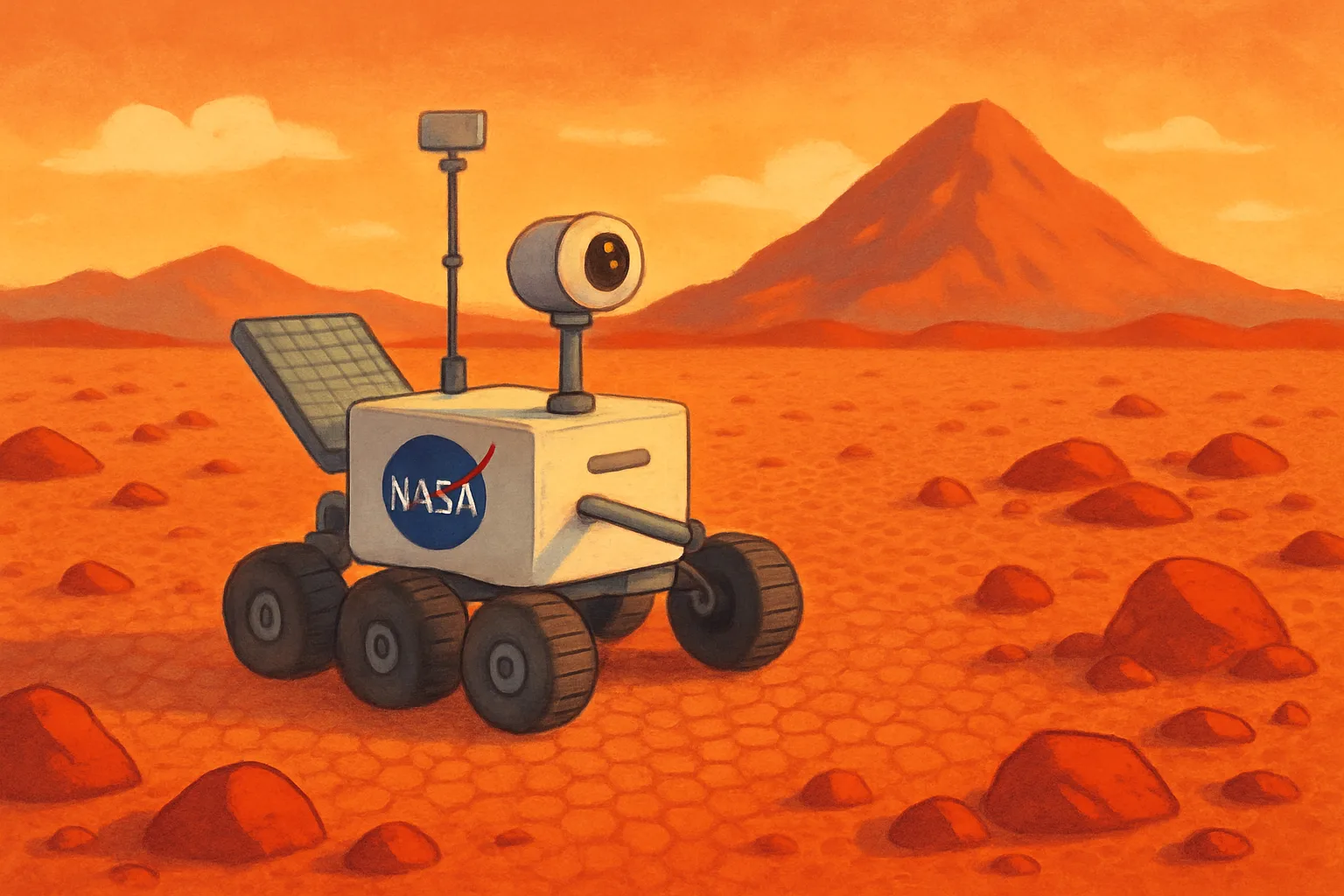
Every direction the rover’s camera looked, the ground was covered in a pattern of small hexagonal shapes, like the cells inside a beehive. Each tiny crack is only about 1.5 to 3 inches wide — roughly the size of a matchbox. But they go on and on, as far as Curiosity can see, all the way to the horizon.
Curiosity has spotted small patches of these shapes before. But nothing like this — never covering an entire valley. The rover stitched together 340 photos to create one giant 360-degree panorama of the honeycomb sea.
Scientists have three main ideas for how the pattern formed. First, wet mud could have dried out long ago and cracked into these shapes — just like mud does in a dried-up puddle on Earth. Second, the surface could have expanded and cracked from heating and cooling over millions of years. Third, heavy layers of rock could have squeezed and cracked the ground underneath. None of these ideas has been confirmed yet. Curiosity is now using its special tools, including a laser and a close-up camera, to study the cracks and look for chemical clues.
Why Does It Matter?
Curiosity’s big mission is to figure out if Mars was ever a place where tiny living things — like bacteria — could have survived. For that, scientists need to understand how water once moved across Mars.
Honeycomb patterns like these on Earth almost always form in places that used to be wet. If the cracks on Mars formed the same way, it would be more evidence that water once pooled in this valley long ago.
Curiosity has already discovered organic molecules — the building blocks of life — in this same area of Mars. The honeycomb cracks could help scientists understand the full story of this ancient watery world.
Curiosity landed on Mars back in August 2012. It was only supposed to work for two years. Now, 14 years later, it is still going strong — and still making surprising discoveries.
Big Words
- Polygonal fractures — cracks in rock or ground that form geometric shapes like hexagons, pentagons, or squares
- Panorama — a very wide photograph made by stitching many smaller photos together
- Organic molecules — chemical compounds that contain carbon, which are considered building blocks for life
- Sediment — tiny bits of sand, mud, or rock that settle at the bottom of a lake or river over time
- Valle Grande — the nickname scientists gave to the Martian valley where Curiosity found the honeycomb cracks; it means “Great Valley” in Spanish
Fun Fact
Curiosity’s panorama of the honeycomb valley is made of 340 individual photos snapped by the rover’s camera — then stitched together by scientists back on Earth, like a giant puzzle!
Think About It
If you could send one question to the Curiosity rover to help solve the honeycomb mystery, what would you want it to find out?
Sources
- Sci.News — Curiosity Finds Massive Field of Honeycomb-Shaped Fractures on Mars
- ScienceDaily — NASA’s Curiosity Rover Discovers Vast Honeycomb Landscape on Mars
- Gizmodo — NASA’s Curiosity Rover Finds a Vast Sea of Strange Honeycomb Patterns on Mars
- AirGuide.info — NASA Curiosity Finds Vast Honeycomb Patterns on Mars
- ZME Science — A Sea of Tiny Honeycomb Cracks on Mars Could Show Ancient Water