
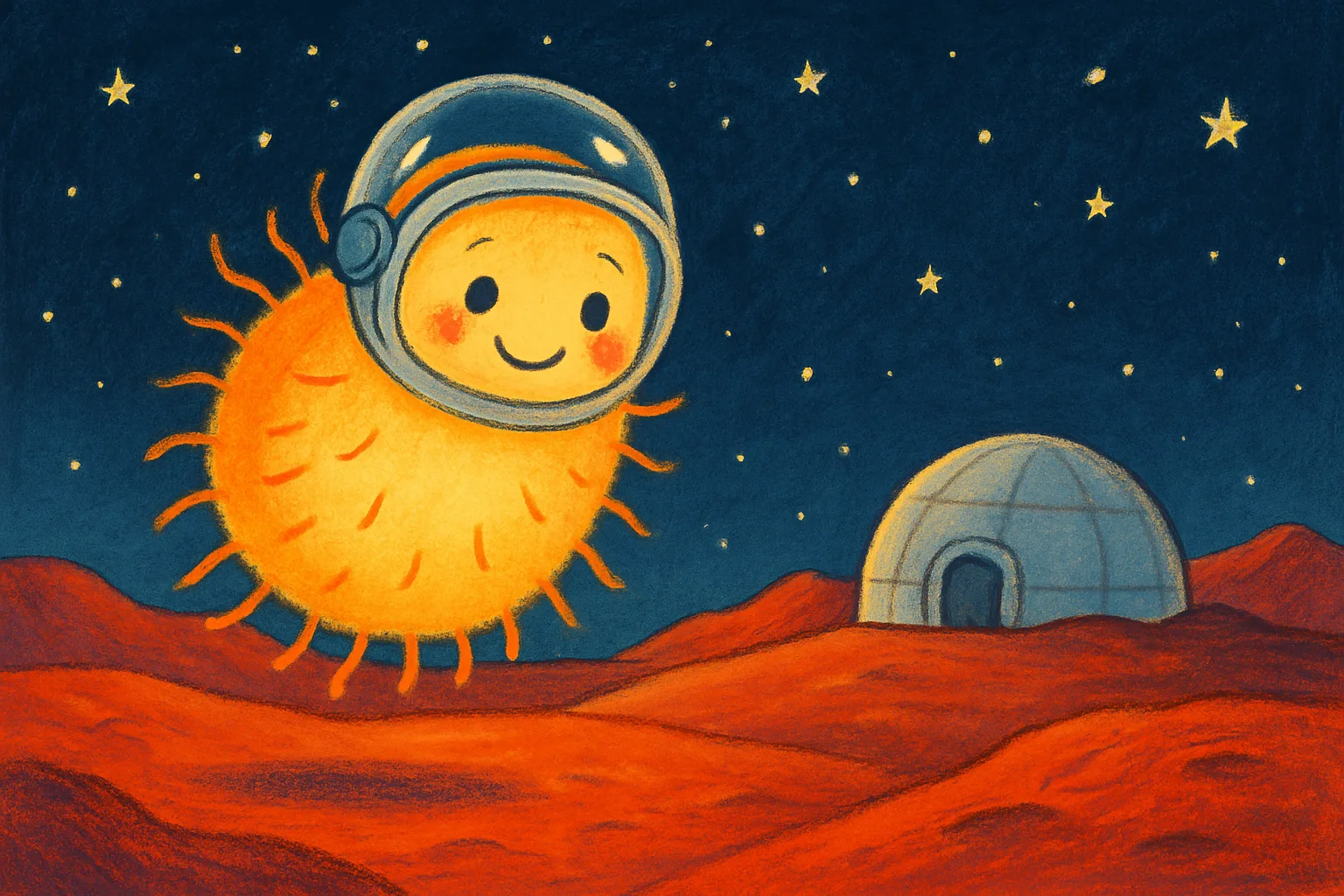
Tiny Helper, Big Dream! Scientists Build a Microbe to Help Humans Live on Mars
Quick Summary
Scientists have created a tiny engineered organism that can survive on Mars-like dirt, water, and air. The microbe is called sPL.001. One day, creatures like it might help the first human settlers on Mars build homes, grow food, and breathe.
What Happened?
Mars is a cold, dusty, and very harsh planet. The soil there is mixed with poisonous chemicals. The air is thin. The temperatures are extreme. Living on Mars would be very hard — even for a tiny microbe.
But a group of scientists at a nonprofit research startup called Pioneer Labs, based in California, have been working on a very creative solution. They have engineered — or specially designed — a bacterium that can handle conditions very similar to Mars.
They named it sPL.001. It is a single-celled living thing, far too small to see without a microscope. Think of it this way: if a regular bacterium were the size of a grain of sand, you would need to line up about 1,000 of them to stretch across a single period at the end of this sentence.
The scientists grew sPL.001 in a heated container called a bioreactor. They fed it artificial Martian dirt, water, and processed air — all chemically accurate copies of what you would actually find on Mars. And the microbe survived!
Even more exciting: sPL.001 can produce bioplastics — a type of stretchy, buildable material — from those Martian ingredients. Future settlers might use those bioplastics to construct shelters, almost like the microbe is a tiny biological factory.
The Pioneer Labs team says this is just the first step. Their long-term dream is to create a whole team of different microbes — five in total — that could together help transform Mars into a place where humans could eventually live.
Erika DeBenedictis, the CEO of Pioneer Labs, put it this way: on Mars, these organisms could do the same kinds of jobs that nature does on Earth — making healthy soil, producing oxygen, and providing food.
The scientists are careful to point out that sPL.001 cannot survive on open Mars right now. It needs a special protective container. So there is no danger of it accidentally changing Mars before humans are ready.
Why Does It Matter?
If humans ever travel to Mars, they will not be able to bring everything they need from Earth. A trip to Mars takes around seven months. Sending supplies would take even longer. Astronauts will need to use whatever Mars has to offer.
Microbes like sPL.001 could be the very first “settlers” on Mars — arriving before humans to help prepare the planet. In one estimate, scientists said this microbe could help a crew build a whole city on Mars using just the materials that land in a single rocket!
Big Words
- Microbe — a living thing so tiny you need a microscope to see it; bacteria are one type of microbe
- Engineered organism — a living thing that scientists have carefully modified or designed in a lab
- Bioreactor — a special container where scientists can grow living things in a controlled environment
- Bioplastic — a kind of plastic material made by living things instead of from oil or chemicals
- Terraforming — the idea of slowly changing a planet’s environment so that it can support life like Earth does
Fun Fact
Earth has always used microbes to build and shape the land. Billions of years ago, tiny cyanobacteria produced all the oxygen in Earth’s air! Without those ancient microbes, neither you nor any other animal would be here today.
Think About It
If you were designing a microbe to help humans live on Mars, what would you want it to do first — make oxygen, clean the soil, or build materials? Why?
Sources
- Space.com — Scientists engineer microbe to help humanity settle Mars
- NewsBytesApp — This genetically engineered microbe might help us settle on Mars
- Pioneer Labs Blog — Announcing the First Microbe for Mars
- The Scientist — A Microbial Approach to Mars Terraforming
- Root-Nation.com — Scientists Develop a Microbe to Help Humanity Settle Mars