
Two Planets Sneak Up Side by Side This July 4th Morning!
Quick Summary
Early this morning, the planets Mars and Uranus appeared extremely close together in the sky. It was one of the best chances in decades to spot Uranus, the distant ice giant. All you needed were binoculars!
What Happened?
Most years, finding Uranus in the sky is really hard. It is so far away and so faint that it looks like just another dim star. But today, July 4, 2026, something special happened.
Mars and Uranus lined up almost perfectly close together in the pre-dawn sky. The two planets were separated by only about one-tenth of one degree — that is less than a quarter of the width of a full moon. Imagine holding two grapes right next to each other from a mile away. That is how close they appeared!
You could find both planets in the constellation Taurus, the Bull. They sat between two famous star groups — the Pleiades (a little cluster sometimes called the Seven Sisters) and the bright orange star Aldebaran. About an hour before sunrise, the pair glowed about 16 degrees above the eastern horizon.
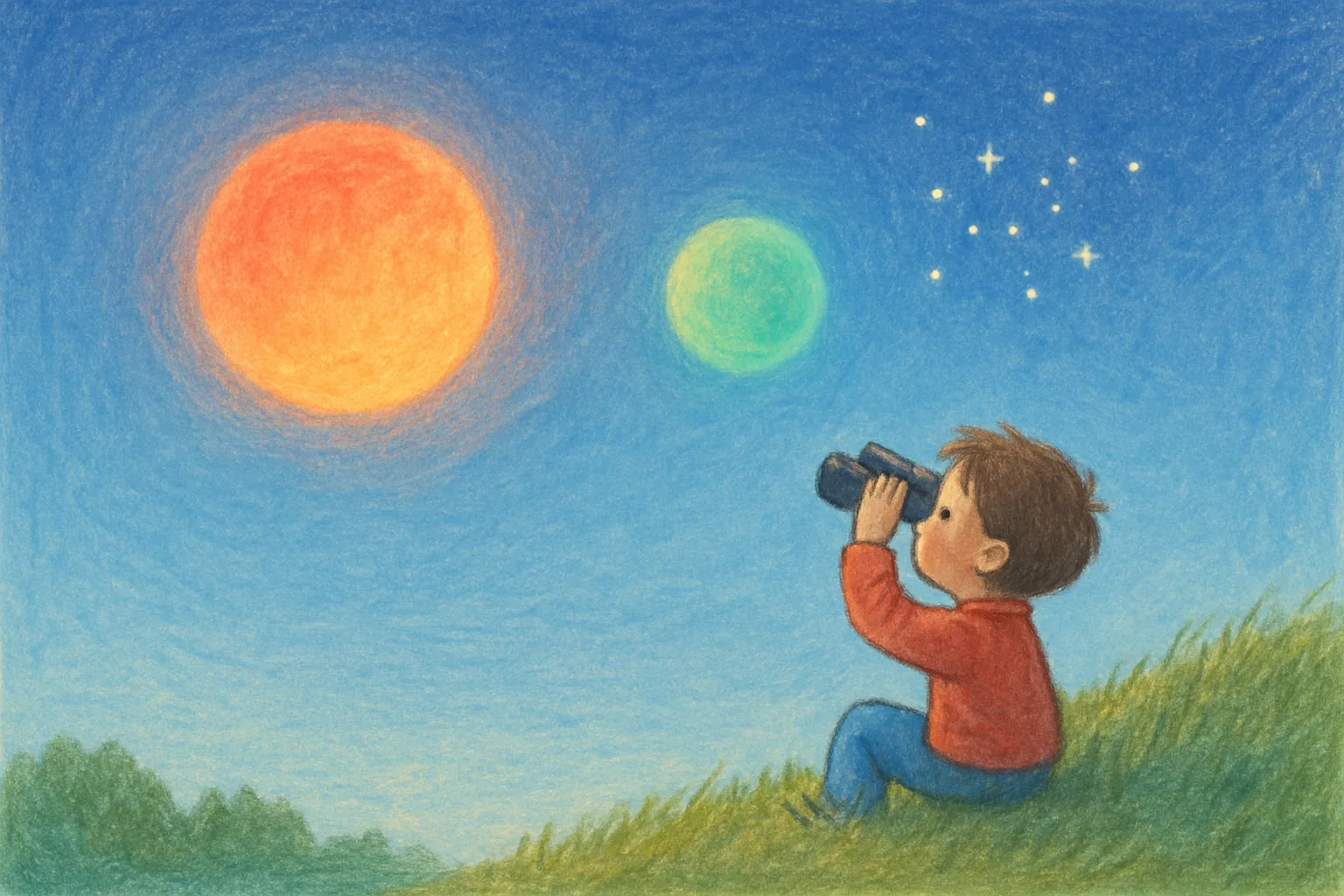
Mars was easy to spot with the naked eye. It shone with a reddish-orange glow, like a tiny ember in the sky. Uranus was much harder to see on its own. But anyone who pointed binoculars or a small telescope just above Mars found a tiny blue-green dot — that was Uranus! It looked like a miniature green pea floating next to a small orange marble.
This kind of close meeting between two planets is called a conjunction. Conjunctions happen when planets line up along the same line of sight from Earth. But they are not always this tight. Today’s event was unusually snug.
Why Does It Matter?
Uranus is the seventh planet from the Sun. It is 1.8 billion miles away from Earth. Most people have never seen it in real life — even many adults! Today’s event gave skywatchers a rare and easy guide: just find Mars, look just above it, and there was Uranus.
Even if you missed it this morning, events like this remind us how our whole solar system is always moving. The planets drift through the sky like slow travelers on a long road. Every so often, their paths bring them close together for a brief, beautiful visit.
Astronomy experts say an opportunity this good to find Uranus may not come again for many years. Parents, teachers, and curious kids who were up early and looked east today got a rare treat!
Big Words
- Conjunction — when two or more planets appear very close together in the sky, as seen from Earth
- Ice giant — a type of large planet made mostly of icy materials and gas; Uranus and Neptune are ice giants
- Pre-dawn — the dark time just before the Sun rises in the morning
- Magnitude — a number astronomers use to measure how bright something looks in the sky; a lower number means brighter
- Constellation — a group of stars that people have named and drawn imaginary pictures between, like Taurus the Bull
Fun Fact
Uranus spins on its side! While most planets spin upright like a top, Uranus is tilted so far over that it rolls around the Sun like a bowling ball. Scientists think a giant object may have crashed into it billions of years ago and knocked it sideways.
Think About It
If you were an astronaut traveling between Mars and Uranus, how long do you think the journey would take — and what might you see along the way?
Sources
- Space.com — ‘Want to see Uranus? July 4 could be your best chance in decades’
- Astronomy.com — ‘The Sky Today on Saturday, July 4: A conjunction of Mars and Uranus’
- TimeAndDate.com — ‘Skywatching in July 2026’